Showing posts with label Bailey's Prize. Show all posts

Monday, 30 May 2016

Ruby, by Cynthia Bond

This is certainly not an easy novel to read- the ritual animal sacrifices, lynching, suffering, sex trafficking, child abuse, incest and misery. The novel’s two main characters, Ephram Jennings and Ruby Bell meet once, right at the beginning, when they are about seven and six. It’s a memorable but traumatic meeting- Ephram is beaten to a pulp, Ruby is subjected to a sort of rustic exorcism behind the closed door of a witch-like forest dwelling voodoo woman, Ma Tante. Bruised and bloodied by the boyish Margaret, Ruby’s cousin and sole protector, Eprham will never forget Ruby’s beauty or her braids, and will carry this image of her for the rest of his life. Ephram catches one or two glimpses of Ruby over the next decade in church and in the town, but their paths do not cross again until Ruby returns from New York after 13 years away.

Raised by his sister after his mother went crazy and his preacher father was lynched by white men, Ephram begins as a pious, routine abiding character. Bagging groceries at the market, handing all his wages over to his domineering, coddling and manipulative sister, Celia his ‘mama’ since he was 14. Her only aspiration in life is to become the Church Mother, something that was almost a given until Ephram took the notion to spoil everything.

Ruby escapes Liberty to New York in an attempt to re-invent herself and for a chance to find the light-skinned mother who abandoned her as a baby. It’s unclear initially just what horrors Ruby is truly escaping; her childhood will be revealed to Ephram via flashbacks as the novel progresses. New York seems exciting, glamorous, seedy. It’s the closest thing to equality available to “coloured” folks in 1950s America. It’s not much different for Ruby though- she resorts to the same skillset as she’s always used to survive, detaching her mind from her body whilst it does not belong to her.
Upon her return, accent slightly lost, her first lost spirit in tow, judgemental stares from the townspeople redoubled, Ruby spends another 11 years slowly going crazy. Avoided and derided by the community, she talks to spirits, lives alone on her family’s land, filthy and detached, just wandering the woods and wailing. We later learn that the spirits she obsesses over, hundreds of them, are the lost souls of the murdered children that wander the Piney Woods. One of the worst part of Ruby’s story is that she is by no means the only person to have been used in such a way. She soothes their pain and gives them shelter in her battered body.

The people of Liberty Township, the devout, church-going community, seem to view Ruby’s troubled mind as inevitable recompense for what they see as waywardness, her sinfulness, her unusually pretty face. She’s brought it on herself. What the township chooses to turn its blind eyes away from is incredible. The injustice of it is so frustrating- the men and boys that have abused her and taken advantage for decades condemn her for her wickedness. The book’s most powerful point is the things that happen under our noses that we choose to ignore.

If the reader’s heart breaks for Ruby from the beginning; they are thoroughly ruined by the end. As Ruby becomes more lucid, as Ephram diligently coaxes her back from her spirits and her torment, she fills in the gaps of her life with horrific details. We learn that the ‘boarding school’ that Ruby was sent to work at is nothing more than a brothel, that she has been passed from pillar to post ever since that first meeting in the woods. Various lynchings, escapes and desertions within her family left her without an adequate carer and she fell into the evil, horrific hands of the very people that would be expected to save her. The author makes a powerful point about evil being something that can occur anywhere- literally anywhere without exception. Evil is a powerful and uncontrollable thing, which is made all the more surprising by the ease with which it can be hidden.

Ruby is a beautifully written book, full of a kind of old, trickster magic, evil spirits and the horrific weight of history. But it’s also about patience and kindness, and about tackling injustice, no matter how insurmountable it seems, or how ill-equipped one is to do it. I loved the quiet diligence of Ephram, as he acts on the feelings he has harboured for decades. He cleans Ruby’s house, washes her clothes. Painstakingly and lovingly washes her hair. He listens to things that she has lived, things that she has bottled up all her life. He treats her like a person again, and Ruby doesn't know how to act. Her behaviour is so divorced from her feelings, she has literally no idea how to be act when shown kindness. I liked that there are still good people, who will still do selfless things, even if it is years overdue.

I know I haven’t really done justice to this book- I could never get across the depth of its effect on me. It’s a haunting book that tells the story of a life of such unimaginable cruelty and dehumanisation. It’s shocking and raw and brutal, told in a style of prose that is disarmingly beautiful. I can see this willing the Bailey’s Prize this year (and it would be a well deserved victory)
for its honesty, its lyrical prose and its brilliantly crafted mysticism. It would be easy, with a plot so laden with misery and trauma to become melodrama, but the characters are so balanced and so well realised that this never happens. An incredible novel.

Wednesday, 2 March 2016

Women's Bailey's Prize predictions 2016

It's that time of the year again! I think the Bailey's Prize is my favourite literary award- there is always so much variety and depth to the eventual shortlist that it always makes for a thought provoking and enjoyable spring hunkering down to get them all finished. There's always something to love and something to discover on the Bailey's shortlist, always an author you'll resolve to keep an eye out for in future and always something you would otherwise never have found.

I've not spent ages agonising over this list, because at the end of the day it's impossible to tell what will get chosen. There's always an absolute avalanche of amazing fiction every year, and it's a brilliant problem to be faced with really; there's just too much good stuff to read. My predictions are assembled from books I've read and enjoyed, books I've got waiting to be read that I've heard great things about, books that I *want* to read very soon and a couple that just seem likely to be included on any longlist for which they are eligible.


A God in Ruins, by Kate Atkinson
The Private Life of Mrs Sharma, by Ratika Kapur
A Little Life, by Hanya Yanagihara
Fates and Furies, by Lauren groff
Rush, Oh! by Shirley Barrett
Things We Have in Common, by Tasha Kavanagh
Early on Morning, by Virginia Bailey
Girl at War, by Sara Novic
The Little Red Chairs, by Edna O'Brien
the BUtcher's Hook, by Janet Ellis
The Ballroom, by Anna Hope
In A Land of Paper Gods, by Rebecca MacKenzie
The Mountain Can Wait, by Sarah Leipciger
The Portable Veblen, by Elizabeth McKenzie
Jakob's Colours, by Lindsay Hawdon
Under The Udala Trees, by Chinelo Okparanta

So let's see! The longlist is announced on Tuesday 8th March via the Prize's website here: Bailey's Prize Website

Now's the good bit. We wait, we speculate, we predict...we read!

Are there any books that you absolutely are convinced will be on the list? Any that I've predicted that you really didn't like? What's your wishlist/predictions?

Monday, 22 February 2016

A Spool of Blue Thread, by Anne Tyler

Spanning 7 decades and 3 generations of the Whitshank family, A Spool of Blue Thread is a sprawling tale of social climbing, family, the desire for something that somebody else has and belonging. Providing the location for the majority of the story and becoming almost a character in its own right it The Whitshank House. With a sweeping porch running the whole way round, the house is an impressive Baltimore home built by Junior Whitshank by his own two hands, lovingly maintained by his son Red throughout his life, and with homing-pigeon power to call the (not exactly scattered) members of the family home to roost. The house is truly the heart of the Whitshank family. its building and eventual acquisition passed on from generation to generation as family legend.

Much time is spent examining the relationships between spouses, siblings, parents and children and the bonds and resentments that define such relationships. There's a lot of things that go unsaid, and many whispered discussions and secrets. A lot of the story is built around Abby, a hippyish hands-on mother of four, a wife, a daughter-in-law. We see her whole life, out of sequence, but still, from her modest background, her courtship with Red's friend and then Red himself, her relationship with the original Mrs Whitshank and then onwards through life...When we first meet Abby she is in her 40s, stressing over a brief phonecall from Denny, the flighty and commitment-phobic prodigal son. She is fierce and assertive and vital. But we see her begin to deteriorate, her memory and her mind start to decay. Families, as a concept go on, even though they lose members all the time.

The book's other characters include Stem, a kind of modern day foundling adopted into the fold who grows into a dependable and protective man, his evangelical and well-meaning wife Nora, sisters Jeannie and Amanda, a joiner and lawyer respectively and various assorted husbands, children and dogs. The prior generation of Whitshanks feature too, Linnie and Junior, who seemed for all the world a happy and successful family, prospering from the opportunities that post-depression America had to offer. Naturally they had secrets and forgotten stories of their own- a scandal and an estrangement and all sorts of secrets that weren't well known enough to become legend.

I liked the sort of hazy, oppressive summer heat vibe that this book gives out, its drifting narrative that lazily winds its way through 3 generations and leaves some enigmatic blank spaces for the fourth. I like the suggestion that families are infinitely complicated, complex and different, and what seems normal to one family might seem absurd to another. The family in focus, the Whitshanks, consider themselves to have excellent taste, to always be the ones who reach out to those in need, reassuringly old fashioned. In reality they're fairly ordinary; they're wallowing in secrets and resentment and bitten-back harsh words that they could never actually say. They love each other unquestionably, but they don't seem to always like each other all the time. So normal.

I really enjoyed reading this, much more than I expected- I'd expected a domestic tale of romance, hardships and triumphs. Which I guess it was in places, but with so much more depth and nuance. I really enjoyed and understood its themes of family and legacy and the inevitable passage of time. I liked too how the recurring element of never being satisfied, of always wanting what a friend or neighbour kept rearing its head to just keep happiness at bay. I liked how even the most apparently perfect, wholesome families, with their wrap-around porches and their annual beach holidays have their secrets and their scandals, and that sometimes they're lost to history and forgotten...but it doesn't mean that it never happened. I really liked how the passage of time sort of roughs off the edges and redefines what's passed. It was a thought provoking book that dealt with undiagnosed mental issues in Denny, with his anxiety and his self hatred, with dementia and elopement and the anguish and loss of ageing, but it wasn't wholly about any of these issues. It's just about the random pot-luck of life and the assorted events and issues that arise in any and every family. 

I was reminded in many places of  We Are Not Ourselves by Matthew Thomas (the social mobility, the three generation narrative, the dementia, the prodigal son with his detachment and relationship issues) but also the family that's normal until you dig too deep and lives in a beautiful house seemed to come from the same hazy summer memory stock as E. Lockhart's We Were Liars, and the family legend until it becomes fact reminded me of the first couple of chapters of Donna Tartt's The Little Friend. This was my first attempt at an Ann Tyler novel, and I'm certainly not averse to trying one of her other 19 works now I've enjoyed this so much.

Friday, 9 May 2014

The Undertaking, by Audrey Magee

Peter Faber, a Nazi solder on the Russian front marries a photograph in a ceremony conducted by an army chaplain. Hundreds of miles away in Berlin, Katherina Spinell marries a photograph of the soldier. They meet for the first time when the lice-riddled Peter is given honeymoon leave in Berlin. Leave for him, a widow's pension for her in the event of his death. Also the possibility of a new German baby to continue the empire, which obviously every German has the God-given right to produce. Expecting a marriage of convenience, both Peter and Katherina are surprised by the strength of their attraction to each other and the passionate intensity of their relationship. After his leave, Peter returns to the Eastern front with Katherina's promise that she will wait for him.

This book handles the idea of trial by separation (and subsequent proving of the marriage bond) in an unusual way. Peter's promise to his new wife protects him, gives him a reason to drag himself outside in the morning and the courage to shoot Russian old ladies and drag screaming children from their homes because he's doing it to create a better world for his wife (and eventual child). But the reader is constantly aware of the fact that his marriage is a lie really, part of the Nazi agenda.

I've read narratives featuring Nazis before, but almost always these stories feature the politicians or soldiers. Magee writes of the ordinary people in Berlin, sitting out the war and hoping for the best. Not Katherina and her parents though. All fully buy into the Nazi ideals, swallowing propaganda as gospel and believing themselves entitled to whatever they like simply because they are German. They're vain, greedy and shameless social climbers. Her father, Gunther is an associate of the notorious Doctor Weinart whose mysterious nocturnal business involves raiding the homes of Jews and deporting them, taking the spoils for himself and his circle of friends. Katherina's family grab greedily at all the privileges and tidbits that the Doctor offers them, basking in their raised positions.

The style is sparse, detached. Functional. The narrative places the victims at arm's length so the shootings, pistol whippings and the cruel evictions are experienced through the eyes of the German soldiers, simply tasks to be done, obstacles to remove. They complain among themselves of the frustration and discomfort of being stuck in Russia, but it's mixed in with their intense feelings of pride and elation at the thought of being national heroes, expanding the reach of the great German Empire one meter at a time.

This novel made me wonder at the motivations of German soldiers (or pretty much anybody that decides to fight a war for a cause). Does an individual lace his boots and pick up his gun because he truly believes in the cause he is fighting for? Or does he eventually condition himself to believe in the cause to justify his war atrocities? To explain his behaviour and absolve his guilt? And with the Nazis in particular, did they ever doubt themselves? Did the party news of victory after victory, of triumph and entitlement ever seem even for a moment to be too good to be true? Peter and Katherina both suffer horrifically, and it's almost possible to feel sympathy for them at times. But their suffering does not change them as people, merely makes them bitter. They seem to really believe that they were right.

I really enjoyed reading this book. The eastern front from an Axis perspective is a voice that I've never experienced before and the dialogue heavy structure gave the narrative a detached immediacy. It was horrific at first, but the reader quickly becomes hard to shock. It's just the way of war. Peter and Katherina could be anybody. The narrative does not go into their inner worlds too much, but sticks to descriptions of their movements and widely-held opinions. It is not a very personal story at all and that is what makes it so thought provoking.


Thursday, 8 May 2014

The Bailey's Prize 2014: Thoughts and Predictions

The winner of the Bailey's Prize will be announced until June 4th in a fancy ceremony at the Southbank Centre, but there's always room for some speculation and predictions...

http://www.womensprizeforfiction.co.uk/2014/baileys-womens-prize-for-fiction-announce-the-2014-shortlist

The judges are given the key criteria for the Prize – "accessibility, originality and excellence in writing by women". That's fairy broad. It makes predicting the winner pretty difficult. Each book is undoubtedly excellent. But which is best? It depends who you ask and what they like.

Over the last 6 weeks, I've been on a mission to read them all. It's the first prize shortlist that I've ever read in its entirety (prior to the announcement of the winner at least) so I have never truly been able to objectively view a shortlist. I honestly think this is an incredible selection of titles. It's truly diverse, featuring locations in India, Iceland, Nigeria, America, Ireland, Russia, Germany and The Netherlands. The authors themselves are American, Irish (x2), Australian, Nigerian and Indian-American- so even if the reader (like me) is not especially well travelled, this year's shortlist offers some fascinating looks into life in other countries and other times.

So who's going to win? And if they are going to win, what's likely to edge it for them? This is what I reckon...

Burial Rites, by Hannah Kent- (full review here)

If Burial Rites wins, it will be down to the accessibility of this novel. Broad enough to appeal to Nordic Noir fans, as well as crime fiction and historical fiction readers, it offers something appealing to all at the same time that it offers something perhaps less frequently experienced in these genres. It's beautifully written, and frames a tragic story of loyalty and persecution with some incredible and original settings.

If it misses out, it will be because whilst it is an engaging, tragic read, on the whole it is not really doing anything enormously new.

A Girl is A Half Formed Thing, by Eimear McBride- (full review here)

If it wins, it will be for reinventing the modern novel. Its originality is staggering and its fragmented, jerky prose (is it even prose??) creates such an immediate narrative effect that it's an unforgettable reading experience. The narrator does not tell her story, she shows it. It's brave, unique and incredibly personal and the unnamed narrator is such an arresting, tragic character.

If it loses out, it will be because the style (which is so unique and effective) could alienate some readers, and as accessibility is one of the three things to look out for, this could prove a stumbling block.

The Goldfinch, by Dona Tartt- (full review here)

If this wins, it will be because of the breathless, insane spectacle of this novel. It's brilliantly original, intricate and filled with incredible characters. The quality of the prose is astonishing, it's an absolute joy to read and the love and the craft that's gone into this novel is evident on every page. I could rave all day about its brilliance.

If anything is going to ruin it for the Goldfinch, it would be the size of it. The hardback is beautiful but enormous and I think many readers that would otherwise love this novel might be deterred by its sheer bulk.

The Undertaking, by Audrey Magee (full review here)

The prose is unique in that it is very dialogue heavy and quite dreamlike in its descriptions of frozen Russia and the horrors of the Eastern front. It's unusual to see an Axis perspective in WW2 fiction, and often narratives are more Western front that Eastern. It's accessible on a technical level as the prose is so readable, but it's incredibly thought provoking and the characters are so brilliantly anonymous and evoke a strange type of empathy...so much so that it sometimes comes as a surprise to be reminded that they are big believers in the Nazi cause. It's accessible in that historical fiction readers would find it appealing and the romantic and political elements might score extra readers.

If it falls down on one thing it would be the dialogue style. While this is very well handled, a lack of signposting might be considered frustrating, and I can see why it could put people off. The plot could seem quite far fetched to some readers.

Americanah, by Chimamanda Ngozi Adichie (full review here)

An honest, unique and well characterised story of race, loss and identity. The character's blog posts help to characterise and to increase the novel's uniqueness, as well adding substance to the style. The writing is beautiful, the characters are excellent and the plot is both believable and sprawling. It's an incredibly appealing novel, and really thought provoking, sensitively written without asking for sympathy or (I think) being preachy.

If it misses out, it could be down to an interpretation or fear of preaching. Sensitive subjects being tackled honestly and without apology will always be in danger of appearing preachy to some readers.

The Lowland, by Jumpa Lahiri (full review here)

A dreamlike, absorbing read about life in and out of India. The characters' relationships are expertly drawn up and the world feels real and authentic. It's an engaging narrative of tradition versus success and the conflicting sense of family loyalty under the strain of estrangement. Well written, but sparse in style.

Though it's enjoyable and stylish and the plot is engaging, the prose is lacking some of the lyrical drama of the rest of the list. It's works within the style of the narrative, but doesn't really hold up under direct comparison.


So- there are reasons why each of them might not win the Bailey's Prize for Women's Fiction (and most of them I'm just Devil's advocating on). It really is a struggle to call. All of the remaining titles are unique and though some are more accessible than others, the reading is all the more rewarding for weathering the storm. They are all examples of excellence in writing full stop- it genuinely baffles me that the term "Women's Fiction" is usually used so restrictively, when there's such an abundance of diverse writing by women with such rich, evocative prose as these.

Gun to head though...When the criteria have been weighed up, and they all obviously meet the criteria or they would never have made it this far, I'm going with the Goldfinch. Purely because as I was reading them, it is the one that I enjoyed the most. It's the one I still think about and the one that I read most quickly as I couldn't get enough. It is also the only one that I feel like I want to read again.

Tuesday, 6 May 2014

Americanah, by Chimamanda Ngozi Adichie

Americanah is what one of its characters claims is impossible- an honest novel about race in America. It tells the story of Ifemelu and Obinze, two Nigerian teenagers that fall hard in love during their school years, becoming inseparable. They start university together, but due to the constant government strikes Ifemelu leaves Nigeria to finish her degree and begin her postgraduate studies in the United States, a destination that has always seemed almost mythically exotic to Obinze. They plan for Obinze to join her later, but a post 9/11 America is not a willing to give any young Nigerian men the benefit of the doubt. After failing to hear from Ifemelu for months and months, Obinze moves to England. Finding work in an Essex warehouse using a false identity, he resorts to an arranged sham marriage to obtain a visa and a NI number. 

Though the two characters spend the vast majority of the narrative apart, their connection is unmistakable. They are flawed, self destructive and misguided, but they are powerfully and permanently linked. We follow the paths of their separate lives, led on different continents. Both paths are blighted with poverty, depression and desperation that each of them endure and overcome alone, before they are reunited once more in Lagos many years later.

I was really drawn into the worlds and the characters of this novel, not just the star crossed lovers but the vibrant cast of supporting characters- the boisterous African-American cousin Dike, the enigmatic General, the hunky intellectual professor ex boyfriend and the inquisitive but depressing Africans that staff the American braiding salon. The care and craft that went into depicting the supporting characters and grim detail of the surroundings did a really effective job of setting the stages in Nigeria, England and America. The reader really understands that there are all kinds of lives and times tied up in the events of Americanah and that though the experiences of its characters are intensely personal, the types of discrimination, the various struggles and difficulties experienced by each of the characters feels universal.

One of the concepts that I found most intriguing about this book was the cultural and social differences between being an African and an African American. Ifemelu points out that whilst a Nigerian might have been running for political office in Nigeria, an African American during the same period would have been sitting at the back of the bus and drinking from specially designated water fountain. The theme of personal and cultural identity runs thickly through this book, and it manifests itself in many ways, including (surprisingly) through the multiple hair styling options available to black women and what each decision potentially says about its wearer.

I loved the blogging element of this novel- I devoured all of Ifemelu's posts, feeling outrage and disgust on her behalf and ignorance and shame on my own. Every reader must wonder if they've ever had a conversation with another that's inwardly provoked a similar internal reaction. What if you've said something annoying or obvious in trying to seem sensitive or interested? The posts were interesting and intricate and really gave the reader the opportunity to get into the head of the protagonist. Her explorations of contemporary race and identity politics were fascinating, heartbreaking and so honestly written. It would be easy for the author to take the opportunity to be heavy handed, judgmental or preachy, but they felt so genuine and valuable and depressingly every day. While social commentary and racial politics play an important role in the book, it's the credible characters and the perceptive, confident story-telling that takes centre stage.

I was absolutely bowled over by the prose in this book- it's simply a beautifully told narrative. A fairy ordinary but very personal story of loss, separation and new starts, narrated in a way that is beautiful, assertive and evocative. A fascinating insight into the minds and lives of others, filled with vibrant and memorable characters and unique voices full of identity. I honestly thought the Goldfinch had the Bailey's Prize in the bag, but now all bets are off.

Tuesday, 29 April 2014

A Girl is a Half Formed Thing, by Eimear McBride

A Girl Is a Half Formed Thing, Baileys Prize, Women's Fiction, Eimear McBride
I can't make my mind up about this book. I think it's going to take some time for the dust to settle.

It might well be a truly great novel, but it is an incredibly difficult read not only because of the content but because of the style too. The plot follows an unnamed narrator's adolescence in (presumably) 1990s Ireland and focuses on the her relationships with her ranting, impossible mother and her older brother who has been left with cognitive damage after suffering a brain tumour in infancy. The narrator's bond with her brother is complex; she is both deeply embarrassed by him but loves him fiercely- his presence and his dependence are one of the only constants in her life. Her mother is infuriating, repeatedly demanding specific behaviors and actions, then indignantly reprimanding and lecturing when they are delivered. The guilt and shame that she attempts to pile onto the narrator in an effort to control her do nothing but drive her further and further away. Guilt, anger and shame are probably the most prominent themes throughout.

The narrator is a tragic and honest, if slightly mysterious character. She never really gives much information about herself, never really talks about what she wants or hopes for. After a sexual encounter with an uncle at the age of 13, various lectures about godliness and obedience from her mother and after enduring constant shame for having to live with her socially withdrawn brother, the narrator becomes a sexual loose cannon first at school, then college. Rumours quickly circulate about her lifting her skirt behind the bike shed, in the school's toilets, in the bushes at the park. Stumbling from one meaningless encounter to another, she becomes increasingly masochistic, only responding to pain and shame. The unnamed protagonist is such a tragic character, though she never seems to be seeking pity. All she ever really feels is anger and loss.

McBride's prose is poetic, but hardly lyrical- I don't ever recall encountering enjambment in any other prose, and that's the only thing it can be called really, however pretentious it sounds to say so. The fragmented style is jerky, often difficult and sometimes quite obstructive- long paragraphs are constructed out of sentences that are one or two lines long. Syntax, tenses and verb endings go right out of the window from the first line, creating an almost flick-book effect with words. Thoughts and speech become indistinguishable and monologue and dialogue look identical. Sometimes it's hard to tell if what is happening is real or imagined. It's like a novel got cut up into shreds and only partially pieced back together and the effect of this is pretty incredible.

Difficult as it might be to understand, it cannot be denied that McBride's technique is incredibly effective. There's a first-hand quality to the plot's events that is remarkable- it does not evoke it delivers. The narrator does not describe her life, but displays it before the eyes of the readers- almost in flashcard-like images. The violence, the breathlessness of the plot's events are embedded into the writing in a way that description could never manage. It's incredibly immediate, though it is hard to take it in at the time. It's a reading experience that's very, very hard to forget. I think it is in with a very decent shot at the Bailey's Prize for 2014, for the uniqueness of the read at the very least.

Tuesday, 22 April 2014

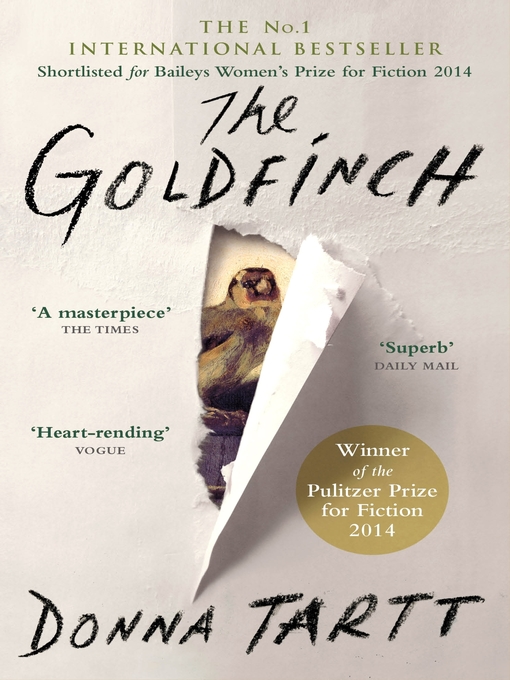
The Goldfinch, by Donna Tartt

It's too hard to even talk about this book. It's beyond description, really. But I shall try.

The novel starts with a feverish young man shivering alone in an Amsterdam hotel room. Afraid to go out, he scans indecipherable Dutch newspaper articles for his name amongst pictures of police cars, incident tape and dead bodies. We go back 14 years to the beginning.

12 year old scholarship student Theodore Decker is in trouble at school for silly, petty reasons. On the morning he is due to attend a meeting with his headmaster, Theodore and his mother Audrey take shelter from the rain in one of New York's lesser known museums, but one that Audrey visits regularly. Theo isn’t much of an art lover, sulking about his impending meeting and squinting at dreary Dutch paintings of autopsies and dissections. He feels a strange, inexplicable connection to a red headed girl, attending the exhibition with her elderly grandfather- they remind him of his mother; gentle, absorbed in the art.

Doubling back for one last look at the mystery girl when the explosion occurs, Theo becomes an unlikely survivor of a huge terrorist attack. Comforting the girl's dying grandfather in his last moments of life, the man gives the dazed and shock ravaged Theo a family heirloom and an address in the West Village. Theo, operating purely on adrenaline and instinct staggers out of the museum with a tiny painting of a Goldfinch and the dead man's ring. And without his mother.

Displaced and homeless with no family in New York and a herd of councillors, therapists and social workers on his case, Theo desperately tries to avoid falling into 'the system'. When his alcoholic, gambling-addict father turns up to whisk Theo to a fresh start in Las Vegas, his life becomes a cloud of disillusion, drugs, booze and underachievement with fellow waster Boris, the alcoholic schoolboy on a self-destructive path to crime. The bulk of the middle section of the story follows Theo's emotional ups and downs of living in Vegas, the lack of company, the endless hours of TV and dog walking in the desert, and the effects of gambling in a town of addicts. He sees how similar he is to the father he despises and he's afraid for his future. He never really stood a chance. Over the years, Theo's lies, omissions and bad decisions draw him deeper and deeper into the shady underworld of Art criminals, traffickers and drug gangs as he leads a double life of antiquarian respectability and narcotic-deadened depression and fraud.

The cast of characters in this book is immense. Each is beautifully realised, full of their own little nuances, motivations and flaws as they weave in and out of Theo's life, colliding and clashing and building a complicated web of accomplices, allies and antagonists. Hobie, the antique dealer is easily the most stable aspect of Theo's post-explosion life, constant and dependable and the origin of most of Theo's happiness. He repairs the old and the damaged and feels fresh out of a Dickens novel. Poppy, the granddaughter of Hobie's late business partner is the unobtainable dream girl from the museum- the girl that constantly reminds Theo what he could have had if he'd had a normal life and hadn't been so hopelessly ravelled up in theft and fraud and drugs.

The Goldfinch is essentially a complicated coming of age story about dealing with loss, betrayal and about the weird adventure that friendship can be. Central also is the importance of cultural history and the preservation of beautiful, important things, and the concepts of home and belonging. It's about life's often sickening pace, but also about its excruciating stagnation. The book is a sequence of causes and their effects as Theo lurches from one disaster to another, uprooted at such an early age and drifting ever since. I loved the character of Theo, apathy, passion and all the rest of his bipolar baggage and desperately wanted him to be ok. I loved how much he cared about the painting that he unintentionally stole, the effect that it has on him and the secret sense of self-worth that he believes it gives him. There's something vulnerable about him, even as an adult, and his seld destructive personality makes him pretty funny at times, and thoroughly tragic in others.

Tartt's prose is amazing, she draws the reader into a world that's real and tragic, populated with characters that are self-destructive and nihilistic and others that are almost angelic in their innocence, all drawn together by chance and circumstances. The acrid dry heat and huge dark skies of Las Vegas and the cramped and impersonal chaos of garbage strewn New York. It's a book of opposites and contradictions. For everything beautiful, there's something destructive and ugly. There are huge sections of prose that seem so meaningful and applicable to all of life. The language in this book, especially sections that relate to the art, the effect of art on the heart and the importance of preservation are incredible.

I hope this waffly adoration makes sense. It's simply an incredible, intricate, important piece of writing It's beautiful and horrific and heart-breaking. Fast paced but measured and delicate, and full of brilliant characters and ideas and important little moments. An instant modern classic. I loved it so much I was procrastinating towards the final section, so it didn't have to end. The Goldfinch makes me want to go out into the world and scrutinise some art and see which picture it is that speaks to me personally, like the Goldfinch does to Theo.

The Lowland, by Jumpa Lahiri

Though Subhash is technically the older of the two brothers, he can barely remember his younger brother Udayan not being at his side. Growing up together in the outskirts of Calcutta, Udayan has always been the adventurous, brave and fun loving type, whilst Subhash has always been thoughtful, quiet and studious. Exceptionally close despite their differences, they take divergent paths in life. Subhash chooses a career in academia (out of a sense of family duty) and Udayan drifts into the new and dangerous Naxalite movement and political activism. The Lowland centres on the lives of different family members as they struggle with themes of identity, duty and unfulfilled expectations.

This book was very evocative and made me feel quite reflective. I read it in one day, such was the appeal of the sweeping, melancholy family saga. I just wanted everybody to be happy and for their conflicts to be resolved. Many characters try so hard to do the right thing, and though they have the best intentions in the world, it just doesn't always work that way. I'm sure most people can relate to that.

The language in the novel was quite unusual, but for reasons that I've struggled to identify. It's quite sparse, but it really reflects the tension and the delicacy that emerges in the story. There aren't really huge, lengthy paragraphs full of emotion or description, but these elements are not non-existent. I can see why some readers might be disappointed by this lack of poetic-ness, but I found that the prose had a sort of mysterious voiceover feel to it that was unique. It felt quite deliberate and helped greatly in creating the almost confessional style that the story adopts later on as the lives of the characters become more complex and their decisions become more difficult.

Though it is a bit of a slow starter it does not take long before the reader is absorbed in the intense relationship between two very different brothers. The story certainly gathers pace once the young brothers decide upon their separate futures- the narrative switches back and forth between India and the US so the reader can keep tabs on each sibling. Whilst Subhash tries to stay as close as possible to traditional values, what he thinks will make his parents proud, he ends up alienating them much more than his charismatic, rebellious brother by moving to America to pursue a PhD. Udayan feels less obliged to follow the path wished for by his parents, falling in with a dangerous revolutionary faction. Though his parents are blind to his rash behaviour, refusing to believe that he is treading a destructive path- they still appear to prefer him over his dutiful brother.

Lahiri’s characters are so expertly crafted, and full of shifting thoughts and complexity. They really did feel real- flawed and desperate in some cases, and full of love and good intentions in others. Always conflicted. Thought the plot spans three generations The Lowlands has a relatively small circle of characters. The novel is full of sadness and disappointment and is really quite haunting. Misguided but well-meaning decisions, selfish decisions and genuine mistakes lose their distinctions as the effects are the same. Choices made a long time ago can have huge, unknowable effects on the lives of others, even years later and the ways in which family members can still pull and break one another from continents away is very clear throughout.

Overall, an evocative, sombre novel about the various ways that families can pull themselves apart. Beautifully written (though sparse in choice of language) with excellent, tragic characters with a great deal of strength and resolve.

Thursday, 10 April 2014

Burial Rites, by Hannah Kent

The first step on my Spring mission to read the Bailey's Prize short list and I can't think of a better way to start.

Set in the desolate yet magical landscape of Northern Iceland in 1829, Burial Rites tells the story of the last year in the life of Agnes Magnúsdóttir, murderess, as she awaits her execution by beheading. Convicted of a bloody dual murder at an isolated farm by the sea, Agnes is incarcerated at the homestead of a local farmer and low-ranking public officer, as there are no prisons on Iceland in which she can be held.

Begrudging her presence and afraid of her past, the farmer, his wife and daughters attempt to ingore Agnes, setting her to work in the fields, the croft and the dairy. She's a hard worker, used to service and settles in as well as can be expected. With one so notorious and ruined under their (turf) roof, it is not long before the family are the subject of gossip within the sparse but tight knit valley community.

As the year rolls on, the seasons change from one to another and the annual cycle of lambing, shearing and slaughtering comes full circle, Agnes gradually imparts her life's story to the assistant reverend Tóti. Requested specifically by his charge, Tóti has been assigned the task of reconciling the condemned woman to her fate and bringing her back to the arms of God. The rest of the family, whatever their opinions of her (and it does vary greatly), are drawn into Agnes' history, as there is no privacy in a farm croft that only has one room.

Whether the reader believes Agnes' version of events or not (a decision that is left up to the reader) it's sobering to think of the countless times that the fate of an individual has depended on the stories, opinions and judgements of others. In this novel, the only person alive with a comprehensive viewpoint of events is Agnes, yet she is the last one to speak. She is an example to be made and there is little thought given to proving her guilt conclusively. Personally, I really liked Agnes- she is intelligent, resilient and the sections of the novel in which she speaks directly to the reader are the most arresting. Her voice and her words are lyrical and measured, and though she considers it an injustice, she is simply too tired and too powerless to do anything but accept her fate. She is not a victim and she never allows herself to be treated as such, she is just an innately tragic character- like Tess Durbeyfield or Lennie Small. Wrong place, wrong time.

Based on a true story, the book is incredibly well researched, and the lives of the characters and the world that they inhabit feels authentic and alive. It's a haunting, beautifully told story, and it is hard to imagine that such an accomplished work is the work of a début author. Kent's prose is impressive and quite unique in style, full of unexpected thoughts and sudden, striking images. Her descriptions of the impossible Icelandic winters and the frostbitten, rock strewn landscape are very evocative and some of the blizzards and frosts trigger a few involuntary shivers (and this even from a definite cold-weather dweller like myself). Though Iceland is a country that is infrequently featured in fiction, Burial Rites carefully and confidently brings to life the communities, customs and landscapes of such a unique country. Hannah Kent has done an incredibly good job of evoking the isolation, the grimness and the beauty of life on the edges of the world, and the character of Agnes Magnúsdóttir is going to haunt a lot of imaginations for a long time.