Showing posts with label Carnegie 2013. Show all posts

Wednesday, 1 May 2013

Maggot Moon, by Sally Gardner

Maggot Moon is the story of Standish Treadwell, zone 7 resident and probable orphan.  His parents 'disappeared' months ago, but that makes them as good as dead.  Now now he lives in a tumbledown house in a derelict street with his Gramps.  Brutal, cruel and ruthlessly ambitious, The Motherland, a Nazi-esque totalitarian state has no place for people like Standish, with his odd eyes and his dyslexia.  He is imperfect, something that he is made aware of every day.

Dyslexia is a bit of a structural influence in this novel, as well as a character trait.  Gardner herself is dyslexic, and here has written a novel and a character that proves that the condition makes you anything but stupid.  The fact that people constantly underestimate the illiterate Standish only makes it easier for him to do the right thing and make a difference.  Proof that dyslexia does not stand in the way of making a person remarkable.  The novel's structure, 100 very short (sometimes not even a whole page) chapters make this book a lot more accessible for struggling readers.  The shortness of the chapters and the brutality of the setting and some of the events that Standish witnesses is made all the more shocking by Gardner's beautiful writing.  She obviously has a very special understanding of language.

The story is set in 1956, but the social decay and the neglect make Standish's world feel much more dystopian than alternate history.  We hear about the corruption, institutionalised bullying and espionage that happens as a matter of course at Zone 7 school.  Standish's school experience culminates in an exceptionally violent scene where his psychopathic teacher savagely beats one of his classmates and nobody can do anything about it.  The main story begins shortly after, when new neighbours move into Standish's parents' old house. For the first time, Standish has a friend, Hector, and he and his Gramps are no longer alone. They might have to look over their shoulders wherever they go and whatever they do, but there are now other people in their lives.  When Hector and Standish discover something that they are not supposed to know- something that could possibly topple the Motherland forever, life in Zone 7 gets all the more impossible. It's up to Standish to bring the Motherland's regime to the eyes of the World.

I don't usually quote from books online, but I do record passages that I think are outstanding in my book journal- I feel compelled to share one quote.  Standish describes his relationship with words- though he can't read or write, he has an almost multi-sensory understanding of language and understands even foreign tongues implicitly.  He explains "I collect words - they are sweets in the mouth of sound." Amazing writing.  Such a short sentence, but it's stayed lodged in my head ever since.

I loved Standish's voice in this novel- how he could remain so innocent with such an uncurbed imagination despite the brutality of the world that he lives in and how the goodness and the bravery that he is able to exhibit is never broken by the Motherland's rulers.  The character of Gramps is also beautifully written, quietly enraged at the inhumanity of his world, decent to his core and incredibly resourceful, fixing and re-fixing things that are useful with his big, safe hands that "make whole all that is broken".  I just desperately wanted Gramps to be safe and it's obvious that that's what Standish wants too.

I don't want to give too much of the plot away, but it's a carefully crafted story, very imaginative but disturbing in places.  Maggot Moon is both heartbreaking and uplifting, using the themes of imagination, friendship and bravery to prove to the reader that you do not have to be perceived as remarkable to do remarkable things.

Monday, 29 April 2013

The Weight of Water, by Sarah Crossan


Continuing with the Carnegie Shortlist for 2013...

Flicking thorough these books when they first arrived, I thought how much the layout of this book put me off.  It looks like a collection of poems, not your usual left to right blocks of text.

Having now read it, I can see how the form makes sense for the story.  Cassie has moved to Coventry from Poland with her mother.  Their only reason is looking for Tata, Cassie's step-dad, who disappeared to England and left them alone. 

Cassie speaks in the first person about how much of a struggle it is to be an alien in a new country, to live in a single room and to be the new kid at school.  She has to try and prove that being Polish does not make her stupid and to attempt to blend in at her new school, avoiding the pack of back-stabbing girls, constantly seeking each other's approval and desperately trying to be popular with their ringleader.  Her mother stalks the streets of Coventry every day looking for Tata and becoming more and more withdrawn and depressed.  All Cassie wants is a friend and to be able to join the school Swimming Team.

Returning to the form then.  The poetic structure makes sense to me now.  A poet chooses their words carefully in order to create the effect that they want.  Somebody speaking a second language must choose their words carefully too, out of accuracy.  In addition, Cassie is a poetic character, she constructs beautiful sentences, notes and letters- some of which she shares with their recipient, some are kept between narrator and reader.  I found that I really cared about Cassie, she's simply a nicer person than the girls in her school and proves that time and time again.

A very quick, well written book that suggests that the individual will always stand out amongst a crowd and that being yourself will always make you happy.  I can see why this title made the shortlist: it's accessible, it's full of real characters and it's relevant to the lives of a lot of girls.  Even if someone has never moved to another country, it's possible that they've felt victimised or isolated and have struggled to overcome something new and scary.  Personally I don't think we have a winner here, medal wise, but we do have an excellent book that I shall be recommending to struggling readers.

Monday, 22 April 2013

Midwinterblood, by Marcus Sedgwick


The more Carnegie books I read, the harder it gets to pick a winner.  I don't want to sound too Bruce Forsythe, but every one is my favourite.  Midwinterblood is a Gothic love story, but not in the style to which we've become accustomed.  That tag line on the cover, by the way is terrible.  Don't let it put you off.

We start in the not too distant future (the 2070s), and a journalist looking for the secrets of the Dragon Orchid travels to a remote island so far into the Scottish North that the sun rarely sets.  Everybody knows each other.  There are no cars and no mobile devices.  No children.  It's eerie and mysterious, not unlike the Wickerman in the way that the island itself, not just its inhabitants are unsettling for reasons that it's hard to describe.  On Blessed island, Erik meets Merle and has the distinct feeling that they've met before, there's a deep connection that they both feel.  Each chapter jumps backwards to another time and another story.  A modern archaeological dig, World War II, the turn of the 20th Century, the Victorian era, Viking times and pre-history.  Each story depends on and is framed by the last, and each one ties Erik and Merle together in tighter and tighter knots.  I love how mysteries uncovered in 2011 are solved a few chapters later, 1200 years earlier.  The reverse chronology and the way that all the pieces fall into place is what holds the narrative together so beautifully.

Through the various recurrences of Erik and Merle, the author forces us to think about the nature of love and loss, eternity and sacrifice.  Their relationships might be vastly different with each life, but with each turn on Earth, they affect the life of the other in profound and sometimes unlikely ways.  Sedgwick manages to make the concept of eternal love seem powerfully tragic, without being sentimental.  He looks at literal eternal life (the Dragon Orchid has restorative and preserving qualities) and spiritual eternal life.

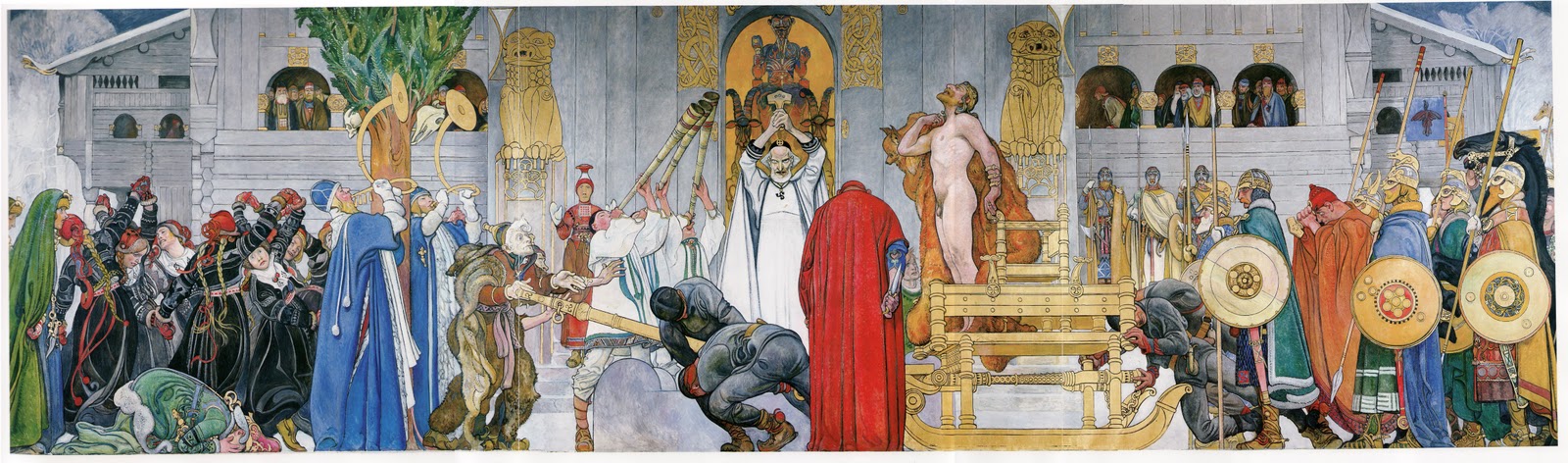
I loved the gothic element of this book.  Not just in your usual vampire way, which I suppose is what gothic has come to mean, but in the tone and the atmosphere of the island and the romantic, sensational behaviour of the people that inhabit it over the millennia.  I loved the menace that hung over certain parts of the story, the idea of souls searching for eachother over centuries and the blood sacrifice theme that runs throughout.  The victorian chapter in particular reminded me very much of The Turn of the Screw, with the framing device, the use of mournful ghosts and the element of forbidden love that unfolds itself throughout that story within the story.  Gave me shivers.

In conclusion, a beautifully written and very unusual book.  Enormously ambitious, but successful in what it attempts to do.  It really makes the reader feel like some sort of historical detective, assembling the pieces of a story that spans thousands of years in order to understand that which is impossible.  Love love loved it.

I really can't believe the quality of some of the YA fiction released in the last couple of years.
Midvinterblot by the Swedish painter Carl Larsson

Wednesday, 27 March 2013

Wonder, by RJ Palacio

Argh, where do you start with a book this good?  I'm running a Carnegie Shadowing Scheme this term, so I'm getting to read a lot of excellent YA literature.

Wonder, is brilliant.  August, the first narrator is intelligent, sensitive and funny, but he's facially disfigured which has affected his entire life.  His older sister knows she's always going to come second to her brother's needs, and what's so sad is that she totally accepts it.  Not because she's noble, or because she's a martyr but because she loves her little bro.  However much August's family might treat him like he is 'normal', and however normal August feels, in reality he sticks out like a sore thumb.  His descriptions of his first term of school are agonising- it's tough for any kid, but for somebody as eye catching as Auggie it's devastating.  He talks about the stares and the whispers, the betrayal that he experiences and his desperate attempts to fit into life in Middle school and how he learns to stand up for himself and for his friends.

The first person narrative is warm, authentic and full of a strange sort of energetic youthful intelligence.  I kept forgetting that this was written by an adult woman, the voice of August is so compelling and his story feels so thoroughly genuine.  I thought the reference to "The Cheese Touch" from Diary of a Wimpy Kid was a really nice touch, too.  The tone of the writing is pretty similar, to be honest.  Like Greg the Wimpy Kid, August doesn't want to be popular or academically outstanding, he just wants to be unremarkable, to keep his head down and get through school in one piece. The constant scrutiny and judgement, the struggle to fit in and the social minefield of being 10 is something that every person can relate to, whether they have August's condition or not.

We hear from other people in August's circle of family and friends- for a little kid he seems to have a big impact on people's lives.  There's diary entries from his handful of friends from school about their first impressions of him and how his personality and spirit won them round, stories from his sister about how August's condition has impacted her upbringing and her relationships and the struggle she has between her feelings that she has for her brother- shame, pride, love and jelousy.  Ultimately, in comparison to her brother she feels that her life is simple and that she can't complain.  We also hear from her boyfreind who is new to it all, and his sister's best friend who's known August his whole life.

It's a cliché to say it's what's on the inside that counts, but that's something that this book really drives home.  Disability of any kind has such a variety of social stigma attached to it, and as much as people are curious about people that look or act differently- the fact still remains that we are all people.  And that's pretty much all that there is to it.  It made me want to be a nicer person, which is an impressive feeling for a book to evoke.

Thursday, 21 March 2013

A Boy and A Bear in a Boat, by Dave Shelton

Hmmmm.  For the first Carnegie 2013 shortlist book I've read, it's not off to the best start.

A small boy  boards a boat captained by a bear.  A talking, rowing, boat owning bear.  With opposable oar-holding-thumbs and everything.  The origins of this remarkable creature are never revealed.  The boy never asks.  I get that it's a kid's book and animals do all kinds of crazy shiz in books, but I'm still trying to work this particular story out.  The boy, incidentally, talks about his mum, school and so on, so it's safe to assume that up until this point he has led a relatively normal existence.

Speaking of never revealed, we also do not find out where this unusual duo are headed.  The boy simply asks to be boated to "the other side".  Things that we do discover: bears like tea, but not fire.  Polish comics are indecipherable to the non-polish.  Elderley sandwiches are not appealing.  A Captain is only as good as his hat.

I can't quite decide who this book is pitched at.  (Is this one of the judging criteria?) On the surface, it's a simplistic narrative.  Nothing particularly hard to understand happens.  A sea monster, some fishing, a couple of games...I guess it is an adventure story, but it's a very mildly paced adventure story, gently pootling along.  The language is seemingly simple, the sentences are short.  However, thrown in every so ofter are random passages that are actually quite conceptual, ironic or sarcastic.  Not the sort of thing that you would find in a book aiming for the readership that this book appears to be aiming for.  The sort of thing which makes you wonder why the sentences are so short or the majority of the language very simple.  It's pretty disjointed really.

I did enjoy the role reversal that began to happen in the latter part of the book- the reluctant boy has to become brave and has to learn to be part of a team, embracing sudden leadership when the (until recently) good spirited and eternally optemistic bear has a sudden, pretty justified, crisis of confidence...

Bear. Boy. Boat. Moon.
All in all, I'm not keen.  I can see why it was shortlisted because it is unusual.  BUT.  It has no identifiable beginning, a load of random middle, and then no discernible ending.  However, the illustrations are brilliant, I do enjoy a good picture.  In all, the whole books feels like a picture book that has been extended to prose.  If it wasn't a picture book, then the author has missed a trick. 
Would probably be nice read aloud though.  But it would take quite a while.