Showing posts with label Bedtime Stories. Show all posts

Thursday, 6 November 2014

The Lost Thing, by Shaun Tan

The Book of Lost Things
I’ve read this picture book a number of times and each time I’ve decided that it’s about something different. I’m amazed at the depth of meaning that something so short, so deceptively simple can have. I can’t decide if it’s about depression, or passivity, or bureaucracy or information overload. Or just about daring to be different. It is wishing that we worried less, or cared more? It’s so rich with signs and symbols and meaning you can pretty much make it about whatever you want. The sign of an excellent and  more importanly, versatile picture book.

Shaun is wandering past the beach one day, working as ever on his bottle top collection (classification seems to be something of a national pastime) when he spots something out of the ordinary. A big, red machine type thing with tentacles is sitting on the beach looking forlorn. Nobody else seems to have noticed it. Too busy.

After playing with it for a while, Shaun realises that it is in fact lost, and attempts to find a place for it. Having found his parents’ house and their shed unsuitable (when they eventually noticed the Thing), he decides to hand it over to the authorities, the proper department of Odds & Ends. Shaun experiences a bit of a moral dilemma and embarks on a symbol-laden journey of discovery with his Lost Thing.

The artwork in this book is simply brilliant. There’s a washed out, sepia steampunk feel, the bizarreness of Dali sketched with the muted colours of Lowry, with some wacky Wallace and Gromit inventions thrown in. It’s a sterile and bureaucratic, Orwellian dreamscape, filled with signs and information and rules. The browns and beiges and reds of the world show its grimness, its lack of imagination. Shaun seems to be the only person that ever stops to wonder. He’s the only one with time.


I love the message that I think this book has. That it’s okay to see things or do things that nobody else seems so be seeing or doing. That making the right decision is important if you’re going to have to live with yourself. Though the Thing doesn’t speak or have any particularly animal or human qualities, Shaun has an obvious connection to it- a responsibility. It seems to all end well for the Thing, even if Shaun’s wonder might be slipping away from him.

It's simpy a wonderful book. The brilliantly accessible speech, the gorgeous, slightly dreamy illustrations, the symbols. It can mean anything you want it to mean, but the message is always encouraging the reader to be a better person. To engage and respond and make connections with things. Shaun Tan is simply brilliant- buy all his books right now.

See look; Dali and Lowry swirled together. It's grim, it's strange, it's busy.

Thursday, 3 April 2014

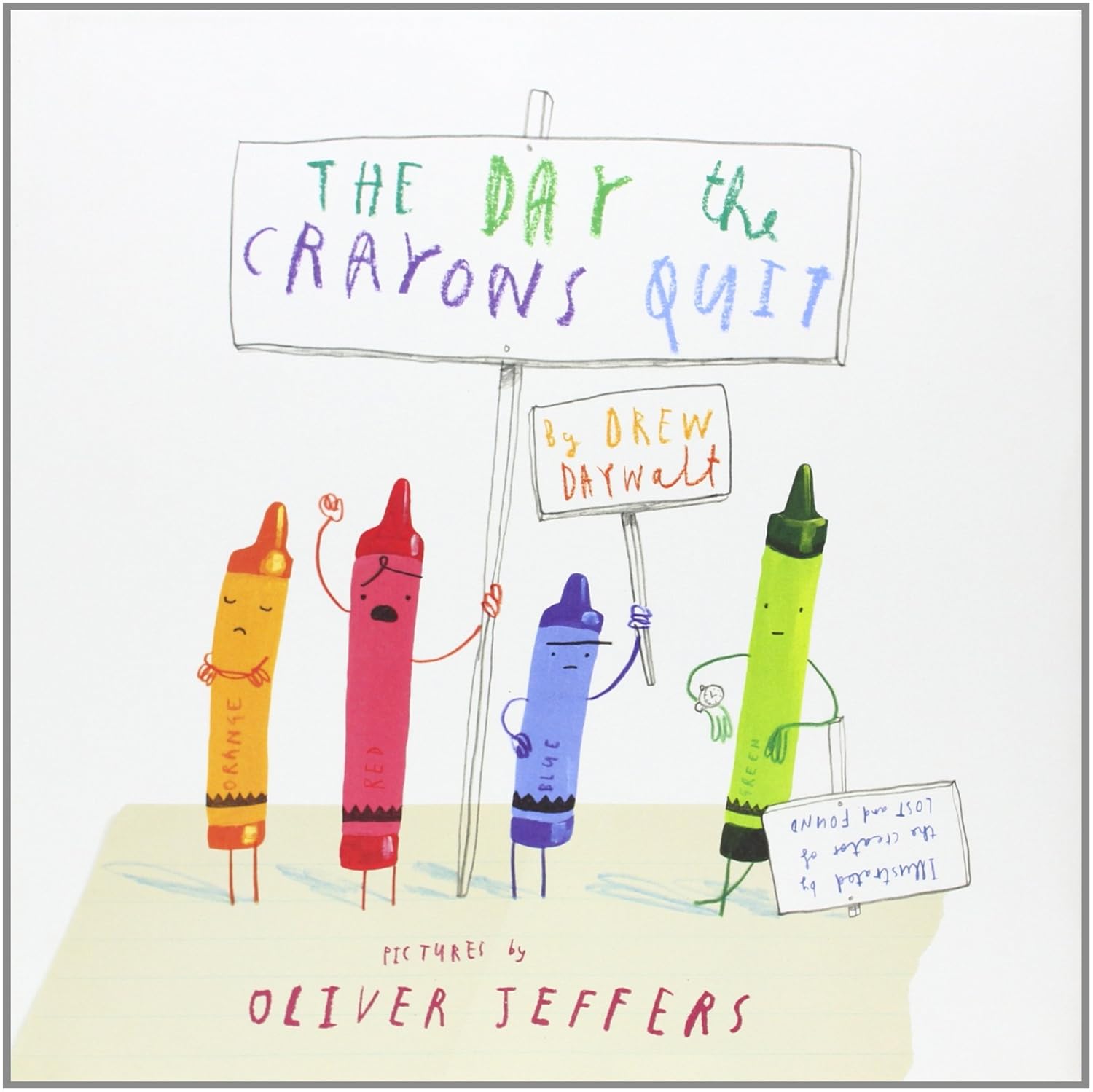
The Day the Crayons Quit, by Drew Daywalt and Oliver Jeffers

Prolific colourer-inner Duncan finds a pile of mysterious letters addressed to him, all written in different colours. They are letters from his worn out crayons and inside the envelopes they all say the same thing: they quit!

Red never gets a break, blue is overused (too much sea & sky), Pink feels left out, and White just can't see the point in himself. Beige understands that he's boring. Green has no complaints, but wishes that Yellow and Orange would just sort out their differences. And peach...well, Peach has entirely separate problems all of his own.

Firstly, congratulations Oliver Jeffers on another incredible project. Honestly the most distinctive, most consistently flawless illustrator since Quentin Blake. He has managed to make something as inanimate as coloured lumps of wax come alive with character and personality. I'm constantly baffled by the extent of his creativity and imagination, and I hope I continue to be so for a long time.

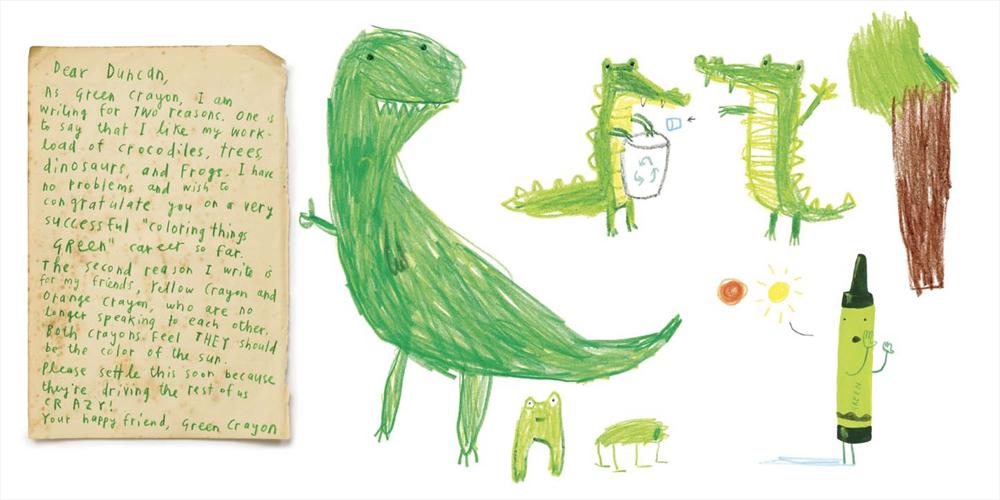
Despite being about 5 times the intended audience for this book, it actually produced an out-loud laugh from me, sat alone in an empty library. The amount of character in this story is incredible- each page is the letter from the crayon in question, angrily scrawled in its own wax (so the text is embedded in the illustration). Each is accompanied by some coloured drawings- evidence, if you like. The entire story is told through images, and each image adds more to the picture of the unhappy crayon box. Though we never see much of Duncan, we know all about him through the drawings that's he's made.

I can't see why any kid would ever not love this book. Everybody loves colouring, right? And every child imagines their possessions being alive at some point or another. I think they're going to love this. It's funny, relatable, and the drawings (dinosaurs, whales, pirates) are going to be very familiar to the aspiring illustrators that are going to be reading this.

A potential winner, without a doubt.


I love Green's conspiracy face...

Oliver, by Brigitta Sif

I can see why people have kids now. It's so they can buy them incredible picture books of joy like this. Oliver is simply a beautiful story about growing up different and the wonder of eventual connection.

Oliver doesn't like to spend time with other children, preferring to play with his puppets and stuffed animals that he carts around in a little red waggon. Nobody really bothers him about it. He is the subject of many curious glances from family, friends and other children, but lost in his fantasy world of adventure and imagination, Oliver doesn't really notice. He doesn't speak throughout the book, but neither does anybody else. Oliver is truly in another place entirely.

Beautifully illustrated in rich Earthy browns, purples and greens, the world that Oliver occupies physically is tonally very intricate and beautifully realised, but it lacks colour and wonder. It is creative in its execution, in that it deliberately points out the drudgery or real life. The reader can only imagine, from the outside looking in, what Oliver sees through his own eyes. Obviously this is not a criticism of the artwork- the illustration is stunning, I think it's a really clever way of demonstrating how detached Oliver is.

I was so happy for him by the end. There is nothing more amazing than discovering you are not the only odd person around.


Monday, 11 March 2013

The Snow Child, by Eowyn Ivey

Another Broadway Book club choice, another debut novel that I would have never usually read! This novel tells the story of a middle aged couple, Jack and Mabel, in the 1920s who, after a tragic miscarriage of a much-wanted and only child, move to the Alaskan frontier to start again.  They've grown apart over the years and their lack of children has only served to distance them more.  In a rare spell of happiness and bonding, they build a snow-child one night in their yard and after that are visited each winter by what they believe to be their snow child made real.

One of the best things about this book is the sense of place that is established.  Although, I always find that snowy locations always come alive much more easily than any other type of setting.  Independent of what is written by whom, there's a magic quality about snow that allows the imagination to really go crazy.  You would have to be a truly inept author to not manage to make snow seem real and magical.  

We did discuss this book at our meeting last week, but I'm going to limit this post to the thoughts that I had whilst reading it, or it would be huge!

I don't really believe in spoilers, but I know some people do, so:

*Spoilers*   *Spoilers*  *Spoilers*

I think the thing that annoyed me the most about this book was that it tried to be two things at one.  The author is trying to have her ambiguity cake and eat it.  Ivey goes to great length to illustrate the other-worldliness of the snow child.  She's a fairy, a nymph, a ghost or a spirit.  She describes how she appears and disappears in the blink of an eye, she's so slight and pale but is able to survive, alone and wearing only a thin dress and moccasins, the harsh and impossible winters in the Alaskan wilderness.  She wilts and overheats indoors, suggesting that she's almost made of snow.  She conjures flurries of flakes and leaves no footprints behind her in the snow.  For the first half of the book, this unknowingness is maintained.  Is Faina real or is she imaginary?  Whenever Mabel talks about her to Esther, her no nonsense, mother of four neighbour, it seems that there is no real evidence of the existence of Faina.  Nobody sees her over the course of about 8 years, she leaves no tracks, the snow angels she makes with Jack and Mabel disappear within minutes.  Esther humours her friend, but puts it down to 'Cabin Fever'.  Jack will never talk about Faina to anybody other than his wife.  This half of the novel works well.  It's never truly established either way.  BUT THEN.  We discover that Faina has a flesh and blood father.  He is dead, but he is real life none the less.  She is seen by other eyes.  She is seduced.  She becomes pregnant and produces a real-life baby.  There can be no ambiguity now.  However Ivey still tries to maintain the suggestion of other-worldliness.  But it just doesn't work now.  It can't now there is concrete evidence of her existence. 

Incidentally, the novel seemed to suggest that only by having children can a woman be made 'real'.  Esther is a productive, confident and fulfilled woman.  It seems that having 4 sons has played its part in this.  As Martha experiences her virtual mother/daughter relationship with her Snow Child, she becomes more independent, happier and productive.  She rides horses, shoots guns and plants turnips.  But it's only once she experiences a type of motherhood via Garret and Faina. Her improved relationship with her husband is attributed to the Faina factor too. On top of than, nobody sees Faina as a woman until she is pregnant.  I know it's set in the 1920s, so I guess people would've expected children, but it was written in 2012.  I'd have liked to have maybe seen a more modern attitude.   I'd like to think it's possible to entertain the possibility of a happy life without children.  Yet another reason why (in my opinion) Faina should've proven to be imaginary.  A placebo.

The first half, whist it maintains the unknown, I quite enjoyed.  I liked the relationship between Jack and Mabel, how they were slowly rebuilding their marriage.  Good friends, hard work and a new satisfaction in seeing real fruits of the labour made them into new people.  Their lives were no longer defined by void, like they had been in the past.  Their relationship with Garrett too, made good reading; how he could really flourish away from his own family and become a dependable, valued worker, friend and surrogate son.  I really liked Garret- with a bit more hardship and a bit more tragedy, he could have been from a Steinbeck novel.  Silent but self sufficient and a true outdoors man.  His whirlwind relationship with Faina in the latter part though felt laboured and unrealistic.  Like the tying up of loose ends.  He died for me as a real character as soon as he laid eyes on her.  The whole premise of the novel falls down, characters and all.

Thursday, 18 October 2012

My Life in Books...

Most people remember their favourite kid's books pretty vividly.  I suppose it's the time in a person's life when they are most likely to read or get read to.  Hopefully.  The ages of 1-10 is definitely the time that most people use public libraries.  They kind of drop off after that.

So these are some of the ones that I remember the most from having stories read to me as a kid.  My mum used to make stories up herself, which was pretty cool.  Or at least we think they were made up.  They could've been partially remembered from somewhere else and embellished.  Some of them went on for weeks too.  My dad always did voices and stuff whenever he read to me & my sister, which was pretty often, considering he worked nights a lot at that time.

This one, The Happy Hedgehog Band, I must have had out of Sutton Library about 30 times.  It had loads of noises in it that you could make a right racket with.
The Happy Hedgehog Band
The hedgehogs start a band.  Apparently hedgehogs are lacking in meaningful activity.  Gradually as word gets around, all the other forest creatures want in, providing their own instrument and vocals/noises to contribute to the band.  This is way before the days of Britain's Got Talent too.  I think everyone gets into the massive ensemble.  I also remember a dog "who was lost in the woods" that just dances.  Like a furry Bez.  

My sister was only about two when we first heard this story, and she christened hedgehogs "Tat-tat-boom"s. We still call them that, despite being in our twenties :)

Blossom Loving Mole
This one I cannot for the life of me remember the name of.
It involved a mole, who was obsessed with blossom.  He finds a 5-pound-note down a drain when wandering around one day, but all the blossom is gone.  He rips it up into little pieces and shouts "Blossom!!" and that's how it ends.  

Nail Soup
I don't know if Nail Soup, is an actual fairytale, or a filler story that just sort of bumped up the page count a bit.  This was my absolute favourite as a kid.  Probably because it was a story almost entirely about food. 
Taken from this bumper book of stories.  I think this was
re-cycled after my aunty's sons got too old for it...
Basically, an old woman takes a tramp in for the night.  Your typical handkerchief-on-a-stick, top hat that's been opened with a can-opener type jolly hermit.  He suggests he makes his special soup as a thank-you for her kindness, using only a nail and hot water.

Intrigued, she agrees.  She tells him she's not very well off and there's no food in the house to eat as an alternative.  The tramp lobs his nail in the pot and waits a bit.  He starts off by saying little suggestions, like "Ooo, have you got some salt & pepper?".  Gradually that becomes "Y'know what would really make this nice?  A couple of carrots...an onion..."  The woman keeps popping off to the pantry and bringing back increasingly numerous ingredients.  Eventually, you've got a full blown meat & vegetable stew going on, with warm bread and fresh butter and all of the best china and cutlery.  The tramp fishes the nail out and pockets it with a chuckle.

They sit down to eat their Nail Soup.  Naturally, the woman is stunned!  She can't believe that a soup made out of a single nail is so tasty and so filling.  She wants the recipe from the tramp, but he's not sharing.  This isn't  Come Dine With Me.  

Most fairytales have some sort of moral message.  I'm not sure what that is supposed to convey.  Elderly women lie about their financial situations?  The homeless are wiley conmen?  DIY supplies make excellent stocks and sauces?

Famous Five
I know they're not that popular anymore...I guess they're not that relevant.  Who'd let kids as young as 9 run around outsmarting smugglers?  Sleep outside in piles of heather?  Drink milk that has not been consistently refrigerated?  The thing is though, they were as irrelevant and ridiculous in 1995 as they are now, and that did not stop me from loving these stories.  Once I finished number 21, I'd start on number 1 again immediately after.  

For the uninitiated Julian, Dick and Ann, pictures of 1950s rural health and wholesomeness, are siblings.  One summer they go to stay with their Aunt Fanny and Uncle Quentin, and meet their cousin, Georgina, for the first time.  Georgina is George, she looks, acts and thinks like a boy and insists on being treated like one. She also has a pretty awesome dog called Timmy.  That's your Five right there.  They basically run around idyllic rural England toting picnics, wearing sandles and being quaint.  I'm not sure if the phase "lashings of ginger beer" ever actually appears in the books but as a phrase, it sets the tone.

These pesky kids though...they just fall into adventures wherever they go...Mysterious gypsies, smugging operations, ghostly steam-trains, ruined castles, dungeons, gold bullion, gun running, kidnap...it's amazing they ever lived to see another term at boarding school.  It's basically Scooby-Doo but with bonbons and rowing boats.

As a kid, it does make you question the apparent dullness of your own school-holiday life...
Obviously anybody reading this now is too old to read them for the first time (or not, go mad, whatever) I just hope you won't rule them out for your own kids, or kids that you know.

Harry Potter, the reading epiphany
I know.  It's a depressingly obvious choice to have as a formative book.  But it is toooo important to me to not feature.  The Philosopher's Stone on my shelf is my third copy.  One fell apart, one got left on a plane...
Being the super-cool kid that I was, I was pretty determined at one point to never read HP.  When Azakban came out, I was all "pffft, what?  Another of those stupid Harry Potter books? GOD!"
But then I stopped being an idiot, read the first one in an afternoon and began a (henceforth) lifelong obsession.

Lovely, lovely Harry Potter...
I was pretty convinced for a while that Hermione was based entirely on me.  It didn't seem that crazy.  My actual Hogwarts letter might have got lost in the post, but this could be me...  Bushy brown hair?  Check.  Slightly protruding front teeth?  Check.  Marginally unhealthy attitude to academic competition and rule-following?  Check!!

I was just blown away by them.  The richness of the world, the complexities of the plot, the realistic ups-and-downs of school-mates' relationships (complete with fights, silliness and co-dependence), characters that at the time seemed to be peripheral, like Snape and Dumbledore being so 3-dimensional and so full of their own personalities...it was revolutionary to a 12 year old.  It really felt that when you closed the book, Hogwarts and its inhabitants carried on with their lives and their adventures whether you were there to read about them or not.

When *THE THING* happens at the end of HBP, it's preposterous and impossible and beyond comprehension.  It.  Simply.  Cannot.  Be.  It's feels like somebody has stormed out of the page and into your life, destroyed everything that you've ever loved and left you a nasty present on your pillow.
*THE THING* was probably the thing that made me realise how powerful words on a page can be.  Despite being 17 at the time and doing A levels in Literature, I'd never been struck like that by words.  
It's happened very few times since.