Showing posts with label Forces. Show all posts

Thursday, 10 May 2018

Needful Things, by Stephen King

The sun was out this week, so, as ever, this prompted me to drop my planned reading list like a hot potato and crack out a  Stephen King in the garden. This time is was Needful Things, the last Castle Rock story. 

What can you say about Stephen King that hasn't been said before? Yes his books are about 20% too long. Yes his metaphors are crafted with the subtly of a chainsaw. And it is a truth universally acknowledged that when King writes a dog, that dog gon' die. However, nobody understands the inherent potential for destruction, the suppressed darkness of the human animal quite like Stephen King. He knows exactly how to take ordinary, unremarkable people and pinpoint the precise thing that would drive them to murder. He knows how badly people secretly want to destroy each other, how badly they want to destroy themselves. Civilisation tries to tame it out of the populace, but there is a germ of carnage in everyone and SK knows exactly how to propagate that.

So. Needful Things is the name of a new store opening in the small town of Castle Rock- a town so small town-ish that this constitutes quite a big deal. A town so small that the Sheriff's office has about 5 members of staff whose duties involve escorting a few drunks home at the weekend and issuing parking tickets. Leland Gaunt, the shops gentlemanly proprietor seems to have *just the thing* for each and every individual that tinkles the shop's bell, that elusive last piece to finish their collection, an exact copy of a treasured item lost during adolescence, the one thing that they have always wanted- and at such a bargain price. Plus one, harmless prank to be played on another townsperson. This formula is replicated all over the town over the course of a week- a normal, ordinary person buys the one Needed Thing, they get possessive and sweaty over it, convinced their nemesis is lying in wait to steal it, just to spite them. Gaunt seems to have done his homework- he knows just how each person feels persecuted, he knows just which small town grudges are held between whom, which suspicions, resentments and hatred are being nursed around the Rock. He knows who the prank-ee will blame, he knows they will be frenzied enough to retaliate. Gaunt spends the majority of the book setting up seemingly unrelated characters to escalate simmering, petty grudges to their murderous boiling points. There are murders. There is madness. There is dynamite.

Trying to work out what the hell is unfolding in the Rock is the Almost Too Good To Be True Sheriff Alan Pangborne, who you might remember from such SK adventures as The Dark Half. He has his usual protagonist baggage (dead wife and son) and a kook that might make him annoying in another context- amateur magic, shadow puppets and lithe, almost supernaturally fast reflexes. He seems to be the fly in the ointment of Mr Gaunt, the incorruptible. Along with his girlfriend, the mysterious Polly Chalmers, debilitated by her painful arthritis, they are the investigative force of the novel. 

Needful Things has a complex web of supporting and incidental characters, and whilst I struggled to remember some of them if they didn't appear for a while, they are all real and believable, each with their own flaws, secrets, jobs and resentments, eating away at them over the years. I really felt like this community was a solid, living and ancient thing. Something with its own rules, mythology and customs. Only SK could create such an apparently strange mixture of small-town normal and big-time evil working in harmonious conjunction with one another. My favourite I think was Norris Ridgewick, eventual hero of Gerald's Game and Andy from Twin Peaks doppleganger. I loved his simple goodness and commitment to his job, and the brilliant relationship he had with Sheriff P. Norris is the sort of small town good guy, unlikely hero you hope might just step up in times of crisis.

Needful Things falls into King's best category- the Supernatural Catalyst that Retreats and Lets the Humans Unleash the Havoc. It's his strongest formula- people are weak, and once they let the darkness in, the monstrous urges of human nature will out. Whether that's Demonic hotels that unlock that nature, murderous clowns, alien interference, telekinetic abilities or forbidden resurrection knowledge, the supernatural element just provides a gateway to the horror that was inside human nature all along. In this case, an omniscient demon with a repulsive touch and colour changing eyes.

Though it is not one of his strongest novels, I really enjoyed it and read it quickly. I felt invested in what happened to a lot of the characters and genuinely shocked at how quickly the dominoes fell down towards the book's firey conclusion. As a heavy handed metaphor for addiction, it works brilliantly. It demonstrates how obsession becomes all consuming, how I loved the themes of need and want, of when something stops becoming enjoyable and becomes a horrendous burden. I liked

Monday, 18 January 2016

1Q84, by Haruki Murakami

My first read from Japanese giant Haruki Murakami and ohmygod it did not disappoint. I had no idea what this novel was going to be (only that it was long), but it was a complex, masterfully spun tale of reality, enduring love and confusion. I don't want to reveal too much about this book, hard as that might be for one so lengthy, as it's an absolute joy to peer into the jumbled mess of plot and separate, order and connect the strands, the intricate plots that shoot off here and there, and grapple with the mysteries of the story.

The first two books are narrated by Aomame and Tengo, an exceptionally lithe gym instructor and a mathematician come author; though they briefly shared a moment (just a moment) of connection many years ago, the two have been strangers for the last 20 years. Over the course of the trilogy a net of circumstances closes in around the two characters, forcing them together towards their shared destiny in a world that they find themselves in by accident.

The first book begins with Aomame, done up in her finest and most profesh suit, scrambling down a rickety ladder away from stationary traffic on the express-way. Abandoning her unusually comfortable taxi, she enters a world that will become 1Q84, though does not realise at the time that she has crossed an invisible threshold. Elsewhere, very close by, Tengo is commissioned by his brash and pushy editor to re-work a very promising manuscript submitted for a début writer's prize, Written by a strikingly beautiful 17 year old school girl, Air Chrysalis is a  bizarre fantasy story about a young girl visited by Little People in a world with two moons. Imaginative, but lacking polish and storytelling style, Tengo's involvement in the story marks the moment that his life's course changes track and he heads into 1Q84 too. This sets up the chain of narrative that has Tengo at one end, Aomame at the other, and in between a cultish religion, a mysterious 17 year old with an odd turn of phrase and shadowy past, otherworldly Lilliput-sized beings, assassinations, mysterious deaths, a rich Dowager, a promiscuous police officer, an exceptionally ugly private investigator and a soft-hearted but tough as nails bodyguard in between. It's an unpredictable sort of book.

Throughout the whole series there's a lurking sense of unreality, a mysterious otherness to everything that happens and every character. There's a possibility of danger at any moment, because when one is dealing with the inhabitants and customs of another world, you never really know what to expect. 1Q84 is a baffling but inescapably gripping story about the solid, tangible lines between fantasy and reality crumbling, about how the tiniest decision or event can take a person's life in an unknowable and sometimes irreversible direction. I loved the section about the Cat Town story that Tengo reads, a mysterious but real-looking place that you can get into but never leave that's ruled by cats, and about how the elderly people's hospital where he visits his dying father is his own personal Cat Town.

Towards the third book, a third narrator is added, Ushikawa, the ugly PI. Employed by the cult to detect their leader's killer, he is the force that causes our two protagonists' paths to cross. He is irritating, but he is essential, ugly but efficient. Towards the third book there is a lot of repetition, going over old ground, particularly in the third instalment, but it kind of gives the impression of a plug hole- the plot has circled and circled for a thousand pages, and as it nears its end the circles get faster and tighter, things are gone over and then covered again. Either that or the different translator gives the third part a slightly different tone. It's hard to tell.

Anyhow, long story (very long) short, I absolutely loved this, it's my ideal type of book; wonderful characters in Tengo and Aomami and Fuka-Eri, the 17 year old novelist, head scratching themes of parallel universes and out of body experiences, metaphysical madness, a magical hallucination feel, dilemmas about doing bad things to achieve good ends, revenge, beautiful prose and twisting, knotted narratives that tie up together at the end. Loved it. I'm not sure how I've never read Norwegian Wood, but it's definitely right up there on my Stuff to Do Soon list.

Saturday, 18 January 2014

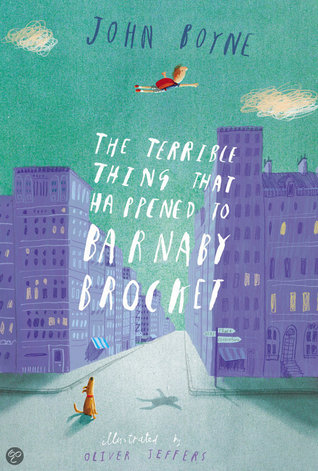
The Terrible Thing That Happened To Barnaby Brocket, by John Boyne

Born to the least imaginative, dullest, most compulsively normal parents to ever set foot on the continent of Australia, Barnaby Brocket has a problem. More accurately, he is the problem. For his normal-obsessed parents at least. Barnaby Brocket is decidedly abnormal because he is incapable of following the laws of gravity. He floats.

Barnaby's parents are appalled by their son's disgraceful lack of obedience. Convinced that he will horrify all who see him, shame their respectable family name and spoil their normality, his parents fail to notice entirely that people like Barnaby. They don't mind that he floats. After 8 embarrassing, excruciating years of un-normal-ness, Barnaby's parents decide that enough is enough.  Something terrible happens that results in Barnaby being released to the atmosphere, much to the dismay of the family dog of "indeterminate breed and unknown parentage".

Unweighted, Barnaby embarks on some enviable and extraordinary adventures around the globe. Visiting 5 continents, meeting new friends (and one old one) and helping out wherever he can, Barnaby finds others that have been ostracised, shamed or ridiculed for their differences. Barnaby, along with his new friends, proves that normal, actually, is overrated. Why be normal when you can be unique?

A beautiful story, lovingly narrated, about an 8-year-old boy who is remarkable not only in his floatyness, but in his bravery, his loyalty and his absolute compulsion to put others first. Humorous, always able to do the right thing and thoroughly good-hearted, despite the prejudiced and unfair upbringing that he had been subjected to. The book has a brilliant message about being yourself, following one's own path in life and not caring about the expectations, opinions or pressures of others. Being yourself is the best and the easiest way to be happy, not fulfilling the expectations of others. Boyne makes an excellent case for rejecting prejudice, for accepting and celebrating otherness and embracing the unknown.

Barnaby himself is imaginative, well read, full of warmth and love and good deeds. A brilliant character that is excused of his slightly surreal affliction by his complete acceptance of it. Incidentally, I think that it's because Barnaby, and all of his also-not-normal friends are so nonplussed by Barnaby's floating that this novel feels strangely and unexpectedly realistic.

This book made me want to be a bit more like Barnaby. To always help out where I can, to be upfront and to look for the best in everybody, no matter what others see in you.

Tuesday, 19 November 2013

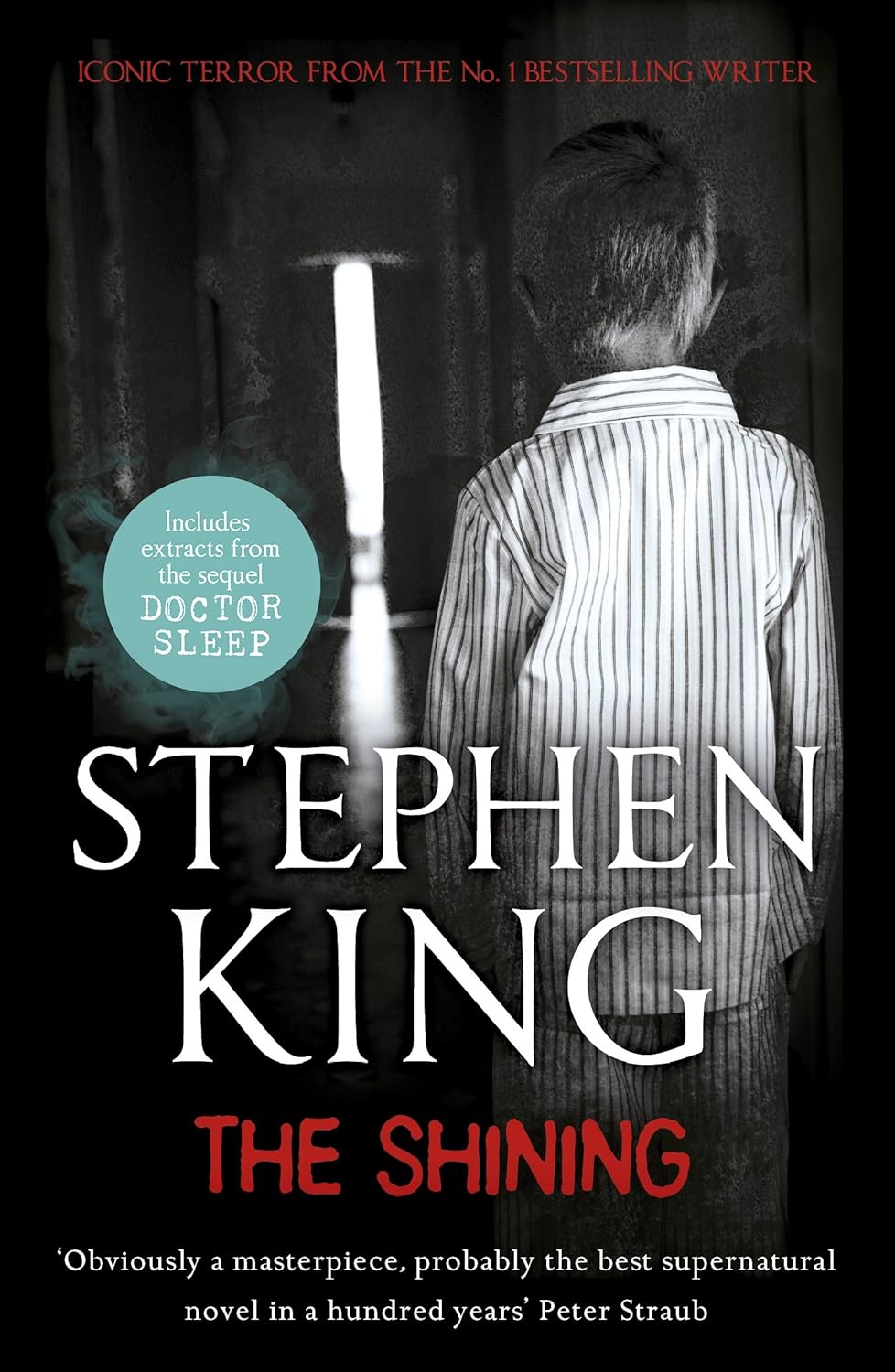
The Shining, by Stephen King


I'll start with a confession.  This is the first Stephen King novel that I've read.  I don't know how or why it's worked out that way, but it seems so.  Will definitely be reading more though- what a master.  I could not put this down.  I watched the film straight after and was staggered by how disappointing it was in comparison.  Despite the "Come play with us", the "All work and no play" bit and the "Here's Johnny" being inventions of Kubrick (Or Nicholson), the book just maintains the feeling of suspense so much better.  The family's relationships with each other and their understanding of the Hotel and of any Supernatural influences is managed with so much craft.

Firstly, the prose is fantastic.  Thoughts, actions, dreams and flashbacks are blended together with such skill that within about 50 pages, the reader has a profound understanding of each of the characters, what makes them function and what each of them fear.  The reader understands the motivations of Jack, for needing his family to go with him to look after the Overlook Hotel.  His shame, embarrassment and pride all play a part, but at the end of the day he is a husband and father trying to take care of his family.  They know that too, but their misgivings are made clear and their reasons are shown. Their Nothing is hidden from the reader, which just makes the tension so much higher.  You know more or less what's coming, thanks to Danny's premonitions, dreams and nightmares, but you are never sure to what extent they are accurate and more importantly when they are coming.  Neither does he.  

I loved the investment that the author makes in his characters.  Jack Torrence could easily be the textbook psychopath, but King makes him into something much more. He's a real person with his own demons, a struggling recovered alcoholic, disgraced academic, frustrated writer and custodian of a pretty nasty temper. He's flawed, he's troubled, but he loves his wife and son and that's made crystal clear.  His mental deterioration throughout this book is only partially supernatural, the signs are there from the first page that this is a man on the edge.  Wendy Torrence too is so much more engaging than the screaming, Phoebe-running doormat of Shelley Duval.  She's torn between her responsibilities to her son and to Jack, and lives in terror of becoming her mother, jealous of the father/son bond between the two of them. 

A lot of the time, I find child characters annoying.  They are often a bit of a liability or just badly written, but Danny is so mature and has such a good grasp on the world that he's practically a small adult.  He's resourceful, undeniably weird, sensitive in an uncloying way and just wants to keep a lid on all the crazy that's kicking off.  But without making a fuss.

Secondly, the way that the author combines the psychological and the paranormal is flawless.  Danny's powers are made evident, though his parents seem semi-aware they don't understand the extent of his abilities, his ability to feel their emotions and to understand their thoughts.  Neither does Danny, really.  Though they play a big part in the plot and in the characterisation of himself and his family, his psychic powers seem more than merely a plot device.  Danny's "Shining" acts as a sort of catalyst and power source for the Overlook Hotel, allowing the shadows and the smoky wisps to become solid, rational and able to inflict harm.  It's hard to tell what's real and what seems real through the power of suggestion, which is something that the reader and the characters struggle through together.

I can't honestly say that this book is terrifying, but it's so soooo compulsive.  As Jack pours his interest and his attention into the Hotel, the building sort of steals it, and pours some of its malevolent self into him.   Seeing the change in the character and the onset of madness is really compelling and makes for a pretty breathless read.    Loved it.  Went out and immediately brought Cujo, The Green Mile, The Stand and Under the Dome.  Just to make sure that Stephen King is as good an author as his squillions of dollars suggest that he is.

Friday, 9 August 2013

Zombies and Forces in Motion, by Mark Weakland

Another brilliant series from the Graphic Library Collection- I can't recommend these enough.

This series uses various monsters and phenomena to explain scientific theories, the full list is pretty impressive;
  • Aliens and Energy
  • Bigfoot and Adaptation
  • Frankenstein's Monster and Scientific Methods
  • Ghosts and Atoms
  • Mummies and Sound
  • Vampires and Cells
  • Vampires and Light
  • Werewolves and States of Matter
  • Zombies and Electricity
  • Zombies and Forces and Motion
Note they have correctly gone for "Frankenstein's Monster" instead of Frankenstein.  19th Century lit pet peeve right there.

There is no excuse for not revising when it's explained like this!  Hopefully I'll be able to buy the rest of the series this year, because these really are brilliant.  This particular edition uses a zombie attack to demonstrate the effect of various forces and how they might be utilised on the undead.  Having a thorough knowledge of the function and application of the forces of gravity, the first law of motion and resistance are going to be nothing but helpful in the event of a zombie invasion. 

Dangle them off planes, shoot them out of cannons, slide them around in the back of a pick-up truck. As long as you're remembering why and how these poor Zombies are being flung around in such hilarious ways, then it's all good.

It's like if Bill Nye the Science Guy got put in charge of directing an episode of the Walking Dead. Awesome, right?