Showing posts with label Missions. Show all posts

Thursday, 26 February 2015

The 100, by Kass Morgan

Following a Nuclear disaster (known afterwards as the Cataclysm) the remnants of the human race escaped the uninhabitable Earth for a new life in the stars. 90(ish) years later, a group of 100 juvenile criminals are being sent back to their deserted planet to explore and to determine whether or not it is now safe for re-settlement. Kind of like Wall-E, but with shady teens instead of adorable robots.

The inhabitants of the crumbling space colony live miserable lives governed by The Council- the judges, juries and executioners. They are divided into three sub crafts that are joined by bridges; Phoneix houses the social elite (scientists, doctors, politicians), Arcadia is the sort of middle class and Walden houses the families of the lowest social order. The population is strictly controlled as food, water, materials and oxygen are in low supply. The Council have taken to issuing incredibly harsh punishments on anybody they deem to have threatened to social order or the survival of the human race. Usually it's death. Life on the decaying space-city is becoming more and more unbearable and brutal.

The narrative follows several dispensable young convicts destined for Earth, whether they want to go or not. Clarke is a trainee doctor condemned for Treason- she's angry and she has secrets. Wells is the Councillor's son, who deliberately jeopardised the colony in order to ensure a one-way Earth trip. He feels guilty for landing Clarke, the girl he loves, in prison and has vowed to protect her. Glass escapes the Earth shuttle at the last minute, making a break for her boyfriend Luke- love's star crossed young dream. The last protagonist is Bellamy, a muscled hot-head who forces his way onto the mission to protect his little sister, Octavia.

The plot jumps back and forth, revealing the secrets of each character as they explain why they were confined and the circumstances of their arrest. And they do explain it. It's not slowly and naturally discovered over time through a well crafted structure- it's pure exposition. Massive chunks of flashback in each character's story- Here be Secrets. The narrative  moves around, showing the perspective of the four protagonists, but it's still told in the third person. I found that the tone and the style of the writing never really changed to suit the subject, so it was hard to tell at the beginning of each chapter who we were following. The third person style meant that there was no real character coming out of these sections as the reader never gets a proper insight into the characters' heads. We don;t get to hear the story told in their voices and that kind of bugged me- having to constantly check who I was following all the time.

I really, really like the concept of this novel. So the re-settlement of an abandoned Earth isn't a new idea, but sending out a bunch of condemned teens, alone and frightened, as the first scout group seemed to have loads of potential. I was anticipating a tense survival scenario full of drama, cavernous ruins of well-known landmarks, division and friction and themes about the nature of power and the responsibilities of leadership. The very elements that make Charlie Higson's The Enemy series so ridiculously compelling. Once the 100 get to Earth, there's a faintly Lord of the Flies-esque battle for power with some of the more Alpha lads, Clarke whizzes round patching people up and Bellamy struts around being muscly and bad tempered. Where the plot should have really picked up the pace- it just sort of fizzled out and became a flaccid love triangle dilemma for Medic Clarke. They marvel at the weather and the naff musical hyperbole reaches a deafening crechendo. See what I did there.

It is the beginning of a series, so the ending is left open. Well. To be honest there isn't an ending. The first book in most series' is self contained, but not this one. It's not the first of a trilogy, it's the first third of a story. I don't think I'll be bothering with the rest.

Wednesday, 11 February 2015

Rocket Girl, by Brandon Montclare and Amy Reeder

I think the story of this comic is that a teen NYPD cop from 2014, Dayoung Johansson needs to go back in time to the 1986 to sabotage/prevent a scientific breakthrough at Quintum Mechanics. If she's successful, her technologically advanced future world will cease to exist because the tech that the world is based upon will never have been invented. It should never have been invented. 2014 shouldn't look like it does. She doesn't seem massively fazed by her task of destroying everything she's ever known in life, but maybe that will come later.

A bit of a fish out of water, Dayoung needs to do some serious damage to Quintum Mechanics' R&D and avoid getting arrested by the 1986 police. There might even be time for a spot of damsel-in-distress rescuing and some superheroics. I loved the end couple of pages where Dayoung gets her 1980s outfit on and really digs in to life in the virtual stone age.

The style of the book is incredibly kinetic and the artists have created the movements of Rocket Girl's jetpack beautifully, the lights of New York (both overground, underground, present and future) whizzing by in a blur- but I found the pace and the movement kind of made the story hard to follow. In places the panels kind of jump around all over the place, all different shapes, sizes and orders and I had to go back in several places and re-read parts.

I found myself too noticing more and more the amount of open mouths in the artwork- and the more I noticed, the more I looked for, and the more I found, the more it irritated me. Totally irrationally, of course. Other than that, the artwork is gorgeous- moody blues and purples and I loved the contrast between 1986 and 2014 New York. Though 27 years have dramatically changed the appearance of the city, all its technology doesn't seem to have gone far to solving its social problems.

If I'm honest I don't think the story or the concept really grabbed me- I get that it's a vol 1, so things are only just getting started, but I'm not sure if I'd go looking for vol 2. I didn't really understand Dayoung as a character, so I struggled to warm to her really. A beautiful looking book, but I can't sat it's one of my favourites.

Thursday, 6 November 2014

The Lost Thing, by Shaun Tan

The Book of Lost Things
I’ve read this picture book a number of times and each time I’ve decided that it’s about something different. I’m amazed at the depth of meaning that something so short, so deceptively simple can have. I can’t decide if it’s about depression, or passivity, or bureaucracy or information overload. Or just about daring to be different. It is wishing that we worried less, or cared more? It’s so rich with signs and symbols and meaning you can pretty much make it about whatever you want. The sign of an excellent and  more importanly, versatile picture book.

Shaun is wandering past the beach one day, working as ever on his bottle top collection (classification seems to be something of a national pastime) when he spots something out of the ordinary. A big, red machine type thing with tentacles is sitting on the beach looking forlorn. Nobody else seems to have noticed it. Too busy.

After playing with it for a while, Shaun realises that it is in fact lost, and attempts to find a place for it. Having found his parents’ house and their shed unsuitable (when they eventually noticed the Thing), he decides to hand it over to the authorities, the proper department of Odds & Ends. Shaun experiences a bit of a moral dilemma and embarks on a symbol-laden journey of discovery with his Lost Thing.

The artwork in this book is simply brilliant. There’s a washed out, sepia steampunk feel, the bizarreness of Dali sketched with the muted colours of Lowry, with some wacky Wallace and Gromit inventions thrown in. It’s a sterile and bureaucratic, Orwellian dreamscape, filled with signs and information and rules. The browns and beiges and reds of the world show its grimness, its lack of imagination. Shaun seems to be the only person that ever stops to wonder. He’s the only one with time.


I love the message that I think this book has. That it’s okay to see things or do things that nobody else seems so be seeing or doing. That making the right decision is important if you’re going to have to live with yourself. Though the Thing doesn’t speak or have any particularly animal or human qualities, Shaun has an obvious connection to it- a responsibility. It seems to all end well for the Thing, even if Shaun’s wonder might be slipping away from him.

It's simpy a wonderful book. The brilliantly accessible speech, the gorgeous, slightly dreamy illustrations, the symbols. It can mean anything you want it to mean, but the message is always encouraging the reader to be a better person. To engage and respond and make connections with things. Shaun Tan is simply brilliant- buy all his books right now.

See look; Dali and Lowry swirled together. It's grim, it's strange, it's busy.

Thursday, 31 July 2014

Stormbreaker, by Anthony Horowitz

I'm attempting to read at least the first volume of as many major Middle Grade and Young Adult series as I can manage, just to get the gist of what each series is about. First up is Stormbreaker, the first instalment of the Alex Rider series.

The book begins with super rich kid Alex Rider (14) learning of the death of his uncle and adopted parent, Ian Rider. The official story is that Ian (not Uncle Ian, never, ever Uncle Ian) died from being in a car accident where he was not wearing a seat-belt, which Alex and his American housekeeper (turned permanent babysitter) find strange, Ian being a seat-belt obsessive. He doesn't seem enormously cut up about it, if I'm honest...At the funeral of his uncle, Alex is introduced to the boring and mostly described as 'grey' Alan Blunt, who appears to be devoid of most personality traits- he identifies himself as a colleague of Ian's from 'the bank'. Suspicions aroused, Alex cuts school and decides to investigate- learning in a single morning that Ian Ryder was murdered, 'the bank' is actually an elaborate ruse for an MI6 spy operation and they want Alex to pick up where his uncle left off.

Alex is informed by his new bosses that successful Lebanese businessman, Herod Sayle, has built a revolutionary supercomputer and intends to donate one to every school in England. Suspicious of his over-philanthropic too-good-to-be-true vibes, they want Alex to dig around and find out his motives. Armed with a couple of gadgets and his wits, Alex sets off to Stormbreaker HQ in the guise of a computer genius competition winner, Needless to say, things get a little bit perilous for Alex down in Cornwall and he has to use every trick in his 14-year-old spy child book to survive his trip.

Alex Rider is basically little boy Bond. The villains (even individually) are very reminiscent of various Bond villains and the evil scheme that underpins the whole plot is dastardly to the Blofeld degree. There's tanks of dangerous sea creatures, hidden floor panels and underground lairs hidden in disused mines, helicopter fights and attempted murder by quad bike. There are gadgets and witty retorts and some spectacular escapes and explosions. The plot is absolutely ludicrous, but it's so fun to read that it never really matters. 

Despite its frequent deferences and cap-doffing to the Bond franchise, it never really feels like a rip off. Horowitz is evidently a huge Bond fan and a masterful storyteller, and his love and enthusiasm for the books is evident in every scene. Stormbreaker feels like it could be a Bond film, rather than a sequence of already-seen-before Bond moments strung together and repackaged. The plot is original enough to escape being called a reproduction, but the spirit of Bond (the action and the silliness) runs through it. It's pacey, exciting and filled with suspense and action, so it's hard to argue with.

Wednesday, 2 July 2014

Dorothy Must Die, by Danielle Paige

Amy Gumm, high school student and Kansas trailer park resident endures her unremarkable life with a sort of grim defeat. Her pink hair and slightly sullen attitude has not won her any admirers, her mother is permanently in a semi-comatose state of pill and alcohol dependency and she resignedly lets the school's dim heart throb copy her homework, knowing already that he's blown his chance of a sports scholarship. And she's just been suspended from school for picking a fight with a pregnant girl despite not actually hitting her. Things are looking bad and they only get worse- that night a tornado sweeps through the park whirling Amy, Amy's mum's pet rat Star and their trailer home away- away to Oz.

Kansas girl swept away to a strange and magical land called Oz. Pretty familiar, right? Amy thinks so too, only this isn't the Oz that she remembers reading about. Its magical inhabitants live in constant, intense fear, petrified of the insane wrath of their leader, the maniacal Dorothy. The magic is gone, mined by hoards of slaves on the princess' orders and forbidden to everyone else. Dorothy rules her kingdom with an iron fist and the help of her devoted followers- the mad scientist Scarecrow, the walking implement of torture and High Inquisitor, the Tin Man, and the ravenous, deadly lion. The rest of the population either cowers in terror or is brainwashed into acceptance, even pleasure, at their good fortune to have such a beautiful, wise and generous ruler. The wicked have turned good and the good are causing a lot of problems.

Being from "The Other Place" too, hopefully therefore able to understand their feared dictator, Amy is Oz's best chance to end Dorothy's reign of terror. Forging an unilluminating allegiance with a mismatched band of Wicked Witches and learning their magic, defence skills and their powers and secrets of concealment, Amy sets out to infiltrate the Emerald City and bring about an end to Dorothy's reign. She must get close to her, learn her ways and her habits but remain undetected- because if the Magic is ever going to be allowed to return to Oz, Dorothy Must Die.

A twisting fantastical story of power and corruption, Dorothy Must Die pits a whole host of new characters against some old and familiar (but not as you remember them) faces. It's definitely an intriguing concept and is bound to appeal to fans of Wicked and Grimm. It's full of nasty surprises, gruesome detail and debunks the idea of the magical Ozian Utopia completely.

I grappled with this book . I was impressed with the story's beginning that saw Amy battling prejudice and bullying at her high school; she came across as a really admirable character, empathetic yet defensive and brave and she was really easy to relate to. However, once she got to Oz, I felt that the plot became a series of perilous events that brought her closer and closer to the Emerald Palace and into the household of Dorothy, without really developing her character much. I couldn't really understand Amy's motivation for most of her behaviour. I found that Amy became very invested in the population and the fate of Oz incredibly quickly, despite her earliest encounters with its populace being quite hostile, but nothing really provided an answer as to why. It wasn't vengeance, nor greed, she had no score to settle. She put up very little fight at the idea of becoming an assassin for a cause she previously had zero knowledge of. As the book went on, Oz Amy was barely recognisable from the endearing high school loser. Maybe it was supposed to be a transformational journey, but I liked her much better in the beginning.

I'm afraid it wasn't just Amy that I struggled to comprehend. Despite never being a huge Dorothy fan myself, I was a little confused by this new version of Dorothy Gale. I just didn't feel that the author utilised much of the original Dorothy's character in creating the power-crazed version. A version based on an exaggerated aspect of herself might have worked, but Dorothy seemed to have had an entire personality/interest/memory transplant. Why did she suddenly become so power hungry? How did she manage to seize control of Oz so effortlessly? Some of the best supervillains have always had the source of their hunger for power rooted in loss, seeking to redress unbalance, righting imagined wrongs or in some other quality that would usually be an asset but in excess is dangerous...I just didn't think evil Dorothy worked as a character, and without that buy in, the whole book kind of  falls down.

I really liked the idea of the decrepit, mouldering Oz, starved of the Magic that keeps it alive, but once Amy enters the Emerald Palace, then the Oz setting becomes forgotten. The surreal landscape is brilliantly described to begin with, but then even that fizzles out towards the middle of the book, replaced with the luxury of the palace. The concept sounds so brilliant and I was really looking forward to reading this,  but I was ultimately disappointed with this novel's plotting and characters. As this is the beginning of a series, there's still hope! I'd love to see Amy reconcile her real and Oz selves a little more- to use her upbringing and the injustices and neglect that she's suffered to fuel her mission in Oz. I'd like her to gather her own parallel band of followers, rather than seeing her raving about how few people she can trust and about how uninformed she is. I'd like to see her out and about in Oz a little more, bringing uncharted Ozlands to the reader and gathering her own indigenous army. I want the Wizard to turn out to be either insanely important or woefully unimportant and I want Oz to fight back. There's hope and resilience in its population that is just waiting to be tapped into further down the narrative line. As a concept, it's got huge potential, and I'd certainly be interested in reading further installments to see if any of the aspects that frustrated me during the first book were worked out.


Friday, 9 May 2014

The Undertaking, by Audrey Magee

Peter Faber, a Nazi solder on the Russian front marries a photograph in a ceremony conducted by an army chaplain. Hundreds of miles away in Berlin, Katherina Spinell marries a photograph of the soldier. They meet for the first time when the lice-riddled Peter is given honeymoon leave in Berlin. Leave for him, a widow's pension for her in the event of his death. Also the possibility of a new German baby to continue the empire, which obviously every German has the God-given right to produce. Expecting a marriage of convenience, both Peter and Katherina are surprised by the strength of their attraction to each other and the passionate intensity of their relationship. After his leave, Peter returns to the Eastern front with Katherina's promise that she will wait for him.

This book handles the idea of trial by separation (and subsequent proving of the marriage bond) in an unusual way. Peter's promise to his new wife protects him, gives him a reason to drag himself outside in the morning and the courage to shoot Russian old ladies and drag screaming children from their homes because he's doing it to create a better world for his wife (and eventual child). But the reader is constantly aware of the fact that his marriage is a lie really, part of the Nazi agenda.

I've read narratives featuring Nazis before, but almost always these stories feature the politicians or soldiers. Magee writes of the ordinary people in Berlin, sitting out the war and hoping for the best. Not Katherina and her parents though. All fully buy into the Nazi ideals, swallowing propaganda as gospel and believing themselves entitled to whatever they like simply because they are German. They're vain, greedy and shameless social climbers. Her father, Gunther is an associate of the notorious Doctor Weinart whose mysterious nocturnal business involves raiding the homes of Jews and deporting them, taking the spoils for himself and his circle of friends. Katherina's family grab greedily at all the privileges and tidbits that the Doctor offers them, basking in their raised positions.

The style is sparse, detached. Functional. The narrative places the victims at arm's length so the shootings, pistol whippings and the cruel evictions are experienced through the eyes of the German soldiers, simply tasks to be done, obstacles to remove. They complain among themselves of the frustration and discomfort of being stuck in Russia, but it's mixed in with their intense feelings of pride and elation at the thought of being national heroes, expanding the reach of the great German Empire one meter at a time.

This novel made me wonder at the motivations of German soldiers (or pretty much anybody that decides to fight a war for a cause). Does an individual lace his boots and pick up his gun because he truly believes in the cause he is fighting for? Or does he eventually condition himself to believe in the cause to justify his war atrocities? To explain his behaviour and absolve his guilt? And with the Nazis in particular, did they ever doubt themselves? Did the party news of victory after victory, of triumph and entitlement ever seem even for a moment to be too good to be true? Peter and Katherina both suffer horrifically, and it's almost possible to feel sympathy for them at times. But their suffering does not change them as people, merely makes them bitter. They seem to really believe that they were right.

I really enjoyed reading this book. The eastern front from an Axis perspective is a voice that I've never experienced before and the dialogue heavy structure gave the narrative a detached immediacy. It was horrific at first, but the reader quickly becomes hard to shock. It's just the way of war. Peter and Katherina could be anybody. The narrative does not go into their inner worlds too much, but sticks to descriptions of their movements and widely-held opinions. It is not a very personal story at all and that is what makes it so thought provoking.


Tuesday, 18 March 2014

Tiger Wars, by Steve Backshall

Saker, a highly trained and dangerous teen warrior is on the run from the only life he has ever known. When an attack of conscience during a 'job' causes him to question the motives of the mysterious "Clan" to which he has always belonged, Saker must flee for his life. Riddled with amnesia and pursued by mercenaries and assassins, hunting dogs and other Clan members, they will not stop until he is caught- and his former friends are every bit as trained and as deadly as he is.

After accidentally kidnapping Sinter, the feisty daughter of a tea plantation owner, Saker's memory begins to return in lumps and patches. As he shares his history and his reasons with Sinter, her hostility and haughtiness begins to melt away. Aligning herself to his cause, their shared mission takes them both from humid India to the magnificent Himalayas and the highest settlements of Tibet. Using all the survival skills, knowledge and bravery they possess between them, Saker and Sinter must risk everything to save Asia's most fearsome and majestic (not to mention unfortunately valuable) of predators- the Tiger.

Tiger Wars is the sort of book that combines pretty complex emotional themes seamlessly with moral themes, all wrapped up in action, suspense and interesting characters. The plot is full of peril, danger, terrible decisions and breathtaking escapes but also makes a huge effort to celebrate the power of friendship, the strength of overcoming adversity and bravery. It also has a really vital conservation message that focuses on the protection of the last of the world's wild tiger population from the illegal Asian medicine trade. So all in all it has a lot to say, a really engaging voice with which to say it.

Firstly, I loved the setting of this novel. It's an arm-chair tour of some of the world's most hostile but beautiful territories. Saker and Sinter's flight takes them through dense forests, dusty cities and impassable mountains into some of the most inhospitable and isolated areas of the world. The reader learns a little of the culture of these places and the challenges that their inhabitants face. The unusually exotic locations make a really welcome change to the Victorian London or the English Secondary School setting that feels so prominent in Middle Grade fiction. Reading it, I felt I had been somewhere new.

Another of the book's strengths was the detailed and intricate characterisation of the two main characters. To begin with they are thrown together by circumstance and bad luck, nobody is particularly happy and both want to scarper as soon as possible- but a mutual respect and understanding soon develops. Eventually, Saker and Sinter prove to be a formidable and unbreakable team- each bringing their own skills and unwavering loyalty and determination to the duo. Both are displaced and alone; Sinter is fleeing an arranged marriage and a future of unfulfillment and servitude and Saker has known nothing but life in the Clan, which until recently seemed fun but now is filled with deadly enemies.

One of the most appealing aspects of the book is the sheer enthusiasm of the author. Steve Backshall's love for nature, for the environment and for the wilderness is infectious. What's more he knows his stuff. Backshall skillfully sprinkles the story with facts and information about survival skills, ecology, geography, Asian spirituality, geology and natural history, so I think this book will also appeal to fans of non-fiction- there's plenty of quiz friendly trivia in here. These additions are genuinely interesting, they work within the context of the narrative and add weight and authenticity to the book. It also proves you're never too old to learn new things!

In conclusion, I was immensely impressed with this book and look forward to the rest of the series. It has good characters who share a strong, genuine bond, loads of action and danger and a really pacy story. It's an inspiring tale about doing the right thing even when it seems impossible and about caring for the natural world, as well as the transformative power of friendship. Top stuff.

Thursday, 30 January 2014

The Rig, by Joe Ducie

15 year old convicted criminal and serial escapist Will Drake has slipped the bars of some of the World's most secure prisons. His efforts have earned him a cell on 'The Rig' a disused oil rig since transformed into a a high-tech super prison for young offenders. Ran like clockwork by the demented Warden, the Rig is stranded in the middle of the freezing Arctic Ocean and only accessible by chopper, so swimming is definitely off the cards.

Confident that he won't be there long and compelled by his survival instincts and inconvenient moral compass, Drake doesn't exactly keep his head down. It's not long before his status as a 'Special Case' has attracted the attention of some of the Rig's more psychotic hard-man inmates and the sadistic military guard force. After hatching some rough escape plans, digging some dirt and vowing to escape the Rig if it kills him, Drake is convinced that all isn't as it seems on the Rig. What were those mysterious blue lights that Drake saw shining from the depths? Why are those psychopath inmates so inhumanly strong? And where do they disappear to for weeks at a time?

Working, eating, sleeping, his tracker noting his every location, Drake knuckles down, biding his time.  Falling short of his own rule, he befriends his computer genius cellmate Tristan and a healer girl, Irene from the other wing. Between them they might be able to discover the secret, sinister purpose of the Rig- not that being a floating Hell of 24 hour GPS tracking and frequent beating aren't sinister enough. Maybe one they've found out what goes on under the seabed- what keeps the Warden so smug and the bullies so strong, then they can plan their escape for good. No prison can hold Drake for long.

The Rig is set in a near future where the majority of the World is ruled by the sinister Alliance in which all resources, funds and rules are controlled by one powerful man. An absolutely brilliantly written, slick prison heist novel with a breathless plot, the Rig is one of the best stand-alone YA action novels I've read in ages. It's intricate, clever and has some truly memorable characters. Gradually wising up to the horrific secret buried under the sea, the reader unravels the mystery along with the characters, so expect to have to keep up. Drake makes an excellent protagonist; funny. charming, mysterious. Though it's not narrated in his voice, the reader still experiences his thoughts and feeling, even if they do not have access to his past. The way he slowly but meticulously adds the pieces to his mental map of the prison was done with style and in a way that really ramped up the suspense and revealed Drake's intelligence, survival instincts and impressive eye for detail.

One of the novel's greatest achievements is the strength of its characters. Each of the principal three are reluctant to open up about their crimes and convictions, each wants to preserve themselves from the pain of friendship and trust, wanting to go it alone. Drake, Tristan and Irene all have their own quirks, motivations and a unique and powerful back story, gradually demystified as each of the characters (and the reader) gets to know each other better. All are essentially huge inconveniences to the Alliance and need to be holed up out of the way. The characters are engaging, funny and convincing and they have a great rapport- they talk like real teens, which is hard to pull off. It's very easy to care about them, despite their obvious heroism. Even the villains are well crafted- sparse on the detail and wildly mysterious, as befits a private military. They seem genuinely evil, and delight in their cruelty. The book raises a few questions about corruption, doing the right thing and the needs of the many versus the needs of the few, which was interesting, and it makes it crystal clear which side Drake is on.

I'm not sure if the younger year groups will appreciate the novel's complexity, and there are a few swears, but overall a pacey, intelligent and incredibly slick YA novel that I think is going to be wildly popular. I certainly enjoyed it. I can see it making an absolutely cracking film one day. Will Drake is such a memorable character, like Jason Bourne meets Artemis Fowl.  I look forward to Joe Ducie's next release!

Monday, 27 January 2014

Island of Thieves, by Josh Lacey

Sent to stay with his Uncle Harvey whilst his parents enjoy a child-free holiday,  Tom Trelawney thinks he's in for an exciting week in London.  What he doesn't expect is a whirlwind trip to Peru, thrown into a dangerous and highly unstable situation with gangsters, thugs and thieves.  Convinced he's on the trail of something valuable, Harvey has just one problem (aside from a gang of ruthless criminals on his trail)- the document that he's convinced is a treasure map doesn't actually describe the location of the gold.  So, his first task is to track down the rest of the journal that describes the voyage of the Pelican, the ship of the famous explorer Francis Drake.  But where is the rest of the journal?  After 400 years will the treasure still even be there?  And can Tom and Uncle Harvey evade Peru's most notorious criminal  long enough to actually find the gold?

I really enjoyed Island of Thieves- it reminded me a bit of one of my favorite guilty pleasure films, National Treasure- an unlikely treasure hidden behind riddles preserved in a historically significant document. It's well written, narrated by the likable Tom who can never quite believe what he has gotten himself messed up in- resigned to his demise one moment, determined to accomplish his mission the next.  Quite cinematic in style, the book doesn't focus excessively on description, choosing instead to focus on the action and on Tom's thoughts and feelings, which means that the reader feels like they get to know him well.  The book feels like a re imagining of some of the old fashioned swashbuckling adventure stories, but with guns and organised crime instead of swords and the British Navy.  The author strikes an excellent balance between exciting peril and unraveling mystery, but without too much suffering and violence which I think would give it a broader appeal.

Tom makes an interesting and likable narrator and a good character overall.  Getting stuck into the biggest adventure of his life and then kind of regretting it when it looks like he will probably die (by accident, then murder) and probably never being found by his parents at all.  As the storyteller, his thoughts are readily available to the reader, his admiration for his uncle, as well as his concern for his apparent lack of common sense or sense of adult responsibility are expressed well and does a lot to flesh out the characters of Tom and Harvey at the same time.  Harvey, the reckless but charismatic adventurer that can talk his way out of anything finds his nephew an unexpected asset on the trip, and the two of them make a good (if unlikely) team. The bad guys are stock pantomime villains and a bit two dimensional, but it's not really about them and they do serve a purpose, even if it is to be menacing and villainous.

Another really enjoyable adventure story- I haven't read a good buried treasure story for ages!  A slightly far fetched but swift and twisty plot that that is delivered a way that doesn't seem too absurd at the time.  I loved how Tom's research and reading of the journal brought history to life right infront of him and how excited he was as he made discoveries and connections that went back to the 1500s.  It was refreshing to read something that was simply an exciting adventure, rather than a book that tackled an issue or taught a lesson.  Don't get me wrong, I like lessons and issues, but a book that is just fun is sometimes very welcome.

Monday, 6 January 2014

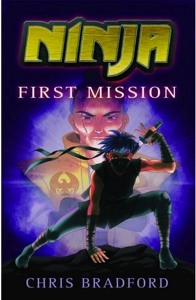
Ninja: First Mission, by Chris Bradford

Taka, a 14 year old trainee ninja must risk his life on his first proper mission- to retrieve his Clan's sacred scrolls from their Samurai enemy, the fearsome Lord Oda.  Taka has yet to complete his training fully, failing time after time to pass the final test, much to the amusement of bully Renzo.  At the time the sacred scrolls are stolen, Taka and the acrobatic Cho are the only ninjas not occupied on other missions, so it falls to them to embark on this dangerous rescue attempt.  Will Taka remember his training and can he learn from his mistakes?  Will he earn his black belt after all?

Through the likable Taka, the book deals with coping with failure, feelings of inadequacy and learning from mistakes.  Insecure and a bit down at the mouth about his constant lack of ninja skills, Taka demonstrates resourcefulness and resilience, overcoming his problems in the end.  His companion Cho, is a strong, intelligent female character (not a love interest, which is refreshing) is a brave and quick-witted ninja who teaches Taka quite a lot about attitude and belief that helps him to achieve his ambitions, as well as saving his life.  It's a simple to read but action rich story of justice and perseverance, set in an exotic historical location and featuring characters that are more three dimensional than your average less-than-50-pages-to-tell-a-story novel.  It's fluent, well written and not over complex in terms of its language or themes.

The illustrations and layout of the book are excellent, very dyslexia friendly (as are the off white pages) and they really help the reader to imagine the action.  They're not too Manga either, which I have found in some cases to deter some struggling readers.  My only worry with this novel is the use of some pretty alien terms, particularly the names of weapons, which might be a bit off putting for readers of this ability.  I'm also not sure how wide an appeal ninjas and samurai have at the moment...

Thursday, 24 January 2013

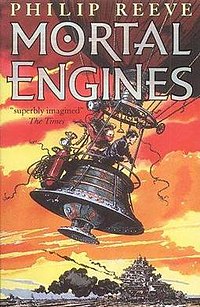
Mortal Engines, by Philip Reeve

Such an unusual and ingenious concept for a novel.  Large, preadatory cities traverse the bare and empty earth looking for smaller cities (prey) to 'eat'.  Their reason is to capture their population as slaves to work their engine roomes and to scavange their fuel, resources and technology.  Municpial Darwninism, Reeve calls this, the survival of the fittest, most technically advanced settlements.

London, the city we deal with primarily, is one of the more kitted-out cities.  Its population is divided into guilds, who work to improve and advance their city.  The engineers, the most renowned and admired, study pieces of 'old technology' from the 20th century in the hope that one day they will be able to regain the weaponry and technology of the 1900s and 2000s.  The Historians and archaeologists record and store relics of historical importance and the aviators and navigators steer the giant city on its way accross the hunting grounds.  The story begins when Tom Natsworthy, an apprentice historian who has always daydreamed of adventure, finds himself cast out of the city of London into the outside, static world.  For the first time in his life he is on terra-firma with only a horribly disfigured and emotionally unstable assassin girl, Hester Shaw, who has just failed to murder one of London's most respected and important Historians (and also Tom's hero), the influential explorer Thaddeus Valentine.

I really do think that this is YA writing at its best.  You know you're on to a winner from the first sentence...
“It was a dark, blustery afternoon in spring, and the city of London was chasing a small mining town across the dried-out bed of the old North Sea.”
Not only is the world so brilliantly created, Mad Max via Dickens' London, but the characters are crafted to perfection; flawed, complicated and on most occasions stuck between a rock and a hard place. Which members of a post nuclear society have it easy?  There really is no difinitive line between good and evil, there are only decisions and their consequences.  The adult characters are exciting and full of stories of adventure, they're charming and energetic, but are almost always proven to be not what they seem.  What does it take to trust a person? 

We oversee a moral education, thanks to the unexpected experinces of Katherine Valentine, micro-socialite daughter of Thaddeus.  She learns to question her sheltrered, comfortable life and begins to learn about the death and exploitation of the disadvantaged for the comfort and health of those of a higher social standing, the horrors that result from the over consumption of resources and the dangers of greed, technology and entitlement.  She also learns about sacrifice and about living with the consequences of out actions.

I really did enjoy this a lot, Reeve's an excellent storyteller.  He reveals just enough information at just the right time to keep you wondering and he has a very streightforward but engaging style of writing.  It's certainly fast paced and full of advetnure and mystery, full of action, fights, chases and flames, revenge- also, PIRATES!  If you like steampunk, Phillip Pullman, Cybermen, the futuristic dog-eat-dog survival element of the Hunger Games and/or monster wheeled cities wheeling around the desert, you will probably like this.