Showing posts with label Alternate History. Show all posts

Friday, 20 April 2018

La Belle Sauvage: The Book of Dust vol 1, by Philip Pullman

I was kind of apprehensive about reading La Belle Sauvage, because His Dark Materials holds an incredibly special place in my heart and revivals, retcons and prequels are rarely good. This is not the place for that list.

I was just so happy to be going back into this world, with young Coram and Sophonax, and the chugging of tokay, and the glow of anbaric light and the Daemons and Dust... I did get the unusual feeling, however, that despite LBS occurring earlier in the timeline, the world just felt more modern than the almost-19th-century of Northern Lights? Just the way people spoke and behaved felt much more contemporary. The "otherness" of Lyra's universe has always felt very palpable, but in this book I found that whilst many elements were the same, I got a much more modern vibe from the environment. It's hard to explain. The world of LBS felt both familiar and altered at the same time.

La Belle Sauvage charts the journeys and adventures of 11 year old Malcolm Polstead of the Trout Inn, near Oxford. Friend to nuns, clearer of glasses, canoe skipper extraordinaire. Whilst exploring the riverbanks one day, Malcolm and his daemon Asta accidentally intercept a coded message hidden inside a wooden acorn- apparently a method of passing information used by secret organisation Oakley Street. This leads him into a friendship with Alethiometer-reader and scholar Dr Hannah Relf, and to her engaging him as a sort of protégé scholar-spy-book-reader and eventually into inevitable danger and adventure. Malcolm has also befriended a baby in the stewardship of the nuns, a 6 week old called Lyra who is apparently unwanted by her mother and both  inconvenient to and endangered by her father. When a deluge unlike anything ever seen before is foreseen, most people choose not to listen. Once the river rises, taking much of the surrounding towns and villages with it, Malcolm, baby Lyra and Alice, a surly nemesis of Malcolm's from the Inn are stranded in the canoe, the Belle Sauvage. Nothing remains but to get Lyra to Jordan College, to claim Scholarly Sanctuary.

I did quite like this book's darker tone. The 1984-esque informant culture of Malcolm's school, of the teachers that refuse to tow the line disappearing overnight. The oppression and the creeping fingers of religious indoctrination, guilt and a sickening sort of righteous patriotism begin to strangle society. It felt like the beginning of something, a foreboding prelude to bigger, scarier things. The parallels with today's unsettling climate of Nationalism and a slide into dangerous far-right discourse and attitudes cannot be ignored. There is one of the creepiest, most skin-crawling villains in a long time, deeper exploration of the fantastical elements of the World, including an River God, a pretty terrifying baby-snatching, Rumpelstiltskin-esque enchantress and a mysterious twilight world of opulence and ignorance, and plenty of river-based adventure.

It was an unusually speedy read for me, I was absolutely swept up in Malcolm and Alice's endeavour. I loved their changing relationship and their familiarity as heroes- Malcolm is capable and mature, intelligent and curious, dependable and honest to a fault. He is a traditional Hero in the most complimentary sense of the word. Not invincible, but he pushes his homesickness and his doubts and any trepidation about being 11 and having too much responsibility here to the back of his mind and Gets Things Done. Alice is surly and bitter, she has weathered a less comfortable upbringing than Malcolm and sees little opportunity available to her. She too is competent and loyal, she is tough and courageous, capable of looking after herself and anybody she feels protective of. Though I read the book quickly and thoroughly enjoyed it, looking back I think I would struggle to fully explain what happened in any meaningful way- criticisms of it being episodic are difficult to deflect.

I think we are all lying to ourselves if we claim this is as good as His Dark Materials, but it is nonetheless an absolute joy to be permitted to revisit Lyras world, to spend some time with the people that were instrumental to her early life, whether she will turn out to remember them or not. Also, the concept of baby daemons? Cutest thing I've ever read in my whole damn life.

Monday, 18 January 2016

1Q84, by Haruki Murakami

My first read from Japanese giant Haruki Murakami and ohmygod it did not disappoint. I had no idea what this novel was going to be (only that it was long), but it was a complex, masterfully spun tale of reality, enduring love and confusion. I don't want to reveal too much about this book, hard as that might be for one so lengthy, as it's an absolute joy to peer into the jumbled mess of plot and separate, order and connect the strands, the intricate plots that shoot off here and there, and grapple with the mysteries of the story.

The first two books are narrated by Aomame and Tengo, an exceptionally lithe gym instructor and a mathematician come author; though they briefly shared a moment (just a moment) of connection many years ago, the two have been strangers for the last 20 years. Over the course of the trilogy a net of circumstances closes in around the two characters, forcing them together towards their shared destiny in a world that they find themselves in by accident.

The first book begins with Aomame, done up in her finest and most profesh suit, scrambling down a rickety ladder away from stationary traffic on the express-way. Abandoning her unusually comfortable taxi, she enters a world that will become 1Q84, though does not realise at the time that she has crossed an invisible threshold. Elsewhere, very close by, Tengo is commissioned by his brash and pushy editor to re-work a very promising manuscript submitted for a début writer's prize, Written by a strikingly beautiful 17 year old school girl, Air Chrysalis is a  bizarre fantasy story about a young girl visited by Little People in a world with two moons. Imaginative, but lacking polish and storytelling style, Tengo's involvement in the story marks the moment that his life's course changes track and he heads into 1Q84 too. This sets up the chain of narrative that has Tengo at one end, Aomame at the other, and in between a cultish religion, a mysterious 17 year old with an odd turn of phrase and shadowy past, otherworldly Lilliput-sized beings, assassinations, mysterious deaths, a rich Dowager, a promiscuous police officer, an exceptionally ugly private investigator and a soft-hearted but tough as nails bodyguard in between. It's an unpredictable sort of book.

Throughout the whole series there's a lurking sense of unreality, a mysterious otherness to everything that happens and every character. There's a possibility of danger at any moment, because when one is dealing with the inhabitants and customs of another world, you never really know what to expect. 1Q84 is a baffling but inescapably gripping story about the solid, tangible lines between fantasy and reality crumbling, about how the tiniest decision or event can take a person's life in an unknowable and sometimes irreversible direction. I loved the section about the Cat Town story that Tengo reads, a mysterious but real-looking place that you can get into but never leave that's ruled by cats, and about how the elderly people's hospital where he visits his dying father is his own personal Cat Town.

Towards the third book, a third narrator is added, Ushikawa, the ugly PI. Employed by the cult to detect their leader's killer, he is the force that causes our two protagonists' paths to cross. He is irritating, but he is essential, ugly but efficient. Towards the third book there is a lot of repetition, going over old ground, particularly in the third instalment, but it kind of gives the impression of a plug hole- the plot has circled and circled for a thousand pages, and as it nears its end the circles get faster and tighter, things are gone over and then covered again. Either that or the different translator gives the third part a slightly different tone. It's hard to tell.

Anyhow, long story (very long) short, I absolutely loved this, it's my ideal type of book; wonderful characters in Tengo and Aomami and Fuka-Eri, the 17 year old novelist, head scratching themes of parallel universes and out of body experiences, metaphysical madness, a magical hallucination feel, dilemmas about doing bad things to achieve good ends, revenge, beautiful prose and twisting, knotted narratives that tie up together at the end. Loved it. I'm not sure how I've never read Norwegian Wood, but it's definitely right up there on my Stuff to Do Soon list.

Wednesday, 11 February 2015

Rocket Girl, by Brandon Montclare and Amy Reeder

I think the story of this comic is that a teen NYPD cop from 2014, Dayoung Johansson needs to go back in time to the 1986 to sabotage/prevent a scientific breakthrough at Quintum Mechanics. If she's successful, her technologically advanced future world will cease to exist because the tech that the world is based upon will never have been invented. It should never have been invented. 2014 shouldn't look like it does. She doesn't seem massively fazed by her task of destroying everything she's ever known in life, but maybe that will come later.

A bit of a fish out of water, Dayoung needs to do some serious damage to Quintum Mechanics' R&D and avoid getting arrested by the 1986 police. There might even be time for a spot of damsel-in-distress rescuing and some superheroics. I loved the end couple of pages where Dayoung gets her 1980s outfit on and really digs in to life in the virtual stone age.

The style of the book is incredibly kinetic and the artists have created the movements of Rocket Girl's jetpack beautifully, the lights of New York (both overground, underground, present and future) whizzing by in a blur- but I found the pace and the movement kind of made the story hard to follow. In places the panels kind of jump around all over the place, all different shapes, sizes and orders and I had to go back in several places and re-read parts.

I found myself too noticing more and more the amount of open mouths in the artwork- and the more I noticed, the more I looked for, and the more I found, the more it irritated me. Totally irrationally, of course. Other than that, the artwork is gorgeous- moody blues and purples and I loved the contrast between 1986 and 2014 New York. Though 27 years have dramatically changed the appearance of the city, all its technology doesn't seem to have gone far to solving its social problems.

If I'm honest I don't think the story or the concept really grabbed me- I get that it's a vol 1, so things are only just getting started, but I'm not sure if I'd go looking for vol 2. I didn't really understand Dayoung as a character, so I struggled to warm to her really. A beautiful looking book, but I can't sat it's one of my favourites.

Friday, 12 September 2014

Things We Didn't See Coming, by Steven Amsterdam

Things We Didn't See Coming starts with the 9 year old narrator being hastily packed into his parents' car on New Year Eve 1999, fleeing the disaster that his father is sure will come. Everybody else seems to be overlooking impending doom and celebrating as usual. They alight at his Grandparents' house and he sneaks off at midnight to be with his evidently quite paranoid father in the woods.

The story skips forward some years into a changed landscape. The urban and rural communities are segregated, each with their own problems and struggles. When the narrator's mentally ill, bedridden Grandma suddenly comes to her senses one day, he takes her and Grandpa on a Sunday drive, talking their way into the countryside. He teaches them to steal, they live a lifetime in a day and he leaves alone...

The narrative continues in this fashion, breaking off for years at a time and rejoining the narrator at some undisclosed year, in some undisclosed area of what was once probably England. He utilises the skills gained through his modest criminal record; thievery, deceit, selfishness, to survive a varying wasteland of perils. Flooding, drought, some sort of corrosive rain, pollutants and bad air, plagues, disease and hunger. Each time he seems to have a different companion, a different job and a different danger to face. He lives (at different times) a nomadic life of scavenging, a criminal life of opportunistic theft and a semi-settled one in sort of new-age hippie alternative medicines community that believes in the power of nature to heal.

The last section that sees the narrator guiding terminally ill and cancer riddled patients on around the world experience tours particularly stood out to me. The author (as palliative care nurse) has done an incredible job of detailing the care of end of life patients. I think these fleeting characters were in a way much more real than the narrator. They came across simply as a mess of contradictions- they're happy to be spending their final days entertained, but they complain about the activities. They grumble about little things and ignore what's killing them. They're full of camaraderie and sadness and exhilaration living against the clock. The first and the last chapters definitely represented the best of the author's prose and depth.

Whilst I liked this novel, I never really felt like I got to know the narrator or understood what the book was trying to do or say. The fragmented, jumpy timeline is easy enough to follow, but it's the absolute lack of any geographical consistency that's a little disorientating. Every five years the world seems to change completely. New governments, new improvement schemes, new landscape, new agendas and new expectations. The world doesn't seem to gradually improve, nor decline...Each chapter opens on a completely different scene. Maybe that's the point, I don't know. Maybe the world can change as much as it cares to- people will always be the same. Maybe we a the reader are supposed to feel as adrift and as unattached as the narrator.

I felt it was quite unusual as far as Apocalypse scenario novels go. We never find out the nature of the disaster. We never experience the panic and the social collapse that follows. There's no group of survivors fighting the elements and the odds to rebuild a safe haven. There's none of that. It's just one guy, turning up all over the place and getting by.

It's an odd one, with an unusual structure and a dreamy style. It reminded me of what an entire person worth of memory must look like, written down. Bits that you remember vividly, wooly bits- whole years where you can't remember anything of note. Bits you'd rather not remember. Worth a read simply for its uniqueness.

Wednesday, 2 July 2014

Dorothy Must Die, by Danielle Paige

Amy Gumm, high school student and Kansas trailer park resident endures her unremarkable life with a sort of grim defeat. Her pink hair and slightly sullen attitude has not won her any admirers, her mother is permanently in a semi-comatose state of pill and alcohol dependency and she resignedly lets the school's dim heart throb copy her homework, knowing already that he's blown his chance of a sports scholarship. And she's just been suspended from school for picking a fight with a pregnant girl despite not actually hitting her. Things are looking bad and they only get worse- that night a tornado sweeps through the park whirling Amy, Amy's mum's pet rat Star and their trailer home away- away to Oz.

Kansas girl swept away to a strange and magical land called Oz. Pretty familiar, right? Amy thinks so too, only this isn't the Oz that she remembers reading about. Its magical inhabitants live in constant, intense fear, petrified of the insane wrath of their leader, the maniacal Dorothy. The magic is gone, mined by hoards of slaves on the princess' orders and forbidden to everyone else. Dorothy rules her kingdom with an iron fist and the help of her devoted followers- the mad scientist Scarecrow, the walking implement of torture and High Inquisitor, the Tin Man, and the ravenous, deadly lion. The rest of the population either cowers in terror or is brainwashed into acceptance, even pleasure, at their good fortune to have such a beautiful, wise and generous ruler. The wicked have turned good and the good are causing a lot of problems.

Being from "The Other Place" too, hopefully therefore able to understand their feared dictator, Amy is Oz's best chance to end Dorothy's reign of terror. Forging an unilluminating allegiance with a mismatched band of Wicked Witches and learning their magic, defence skills and their powers and secrets of concealment, Amy sets out to infiltrate the Emerald City and bring about an end to Dorothy's reign. She must get close to her, learn her ways and her habits but remain undetected- because if the Magic is ever going to be allowed to return to Oz, Dorothy Must Die.

A twisting fantastical story of power and corruption, Dorothy Must Die pits a whole host of new characters against some old and familiar (but not as you remember them) faces. It's definitely an intriguing concept and is bound to appeal to fans of Wicked and Grimm. It's full of nasty surprises, gruesome detail and debunks the idea of the magical Ozian Utopia completely.

I grappled with this book . I was impressed with the story's beginning that saw Amy battling prejudice and bullying at her high school; she came across as a really admirable character, empathetic yet defensive and brave and she was really easy to relate to. However, once she got to Oz, I felt that the plot became a series of perilous events that brought her closer and closer to the Emerald Palace and into the household of Dorothy, without really developing her character much. I couldn't really understand Amy's motivation for most of her behaviour. I found that Amy became very invested in the population and the fate of Oz incredibly quickly, despite her earliest encounters with its populace being quite hostile, but nothing really provided an answer as to why. It wasn't vengeance, nor greed, she had no score to settle. She put up very little fight at the idea of becoming an assassin for a cause she previously had zero knowledge of. As the book went on, Oz Amy was barely recognisable from the endearing high school loser. Maybe it was supposed to be a transformational journey, but I liked her much better in the beginning.

I'm afraid it wasn't just Amy that I struggled to comprehend. Despite never being a huge Dorothy fan myself, I was a little confused by this new version of Dorothy Gale. I just didn't feel that the author utilised much of the original Dorothy's character in creating the power-crazed version. A version based on an exaggerated aspect of herself might have worked, but Dorothy seemed to have had an entire personality/interest/memory transplant. Why did she suddenly become so power hungry? How did she manage to seize control of Oz so effortlessly? Some of the best supervillains have always had the source of their hunger for power rooted in loss, seeking to redress unbalance, righting imagined wrongs or in some other quality that would usually be an asset but in excess is dangerous...I just didn't think evil Dorothy worked as a character, and without that buy in, the whole book kind of  falls down.

I really liked the idea of the decrepit, mouldering Oz, starved of the Magic that keeps it alive, but once Amy enters the Emerald Palace, then the Oz setting becomes forgotten. The surreal landscape is brilliantly described to begin with, but then even that fizzles out towards the middle of the book, replaced with the luxury of the palace. The concept sounds so brilliant and I was really looking forward to reading this,  but I was ultimately disappointed with this novel's plotting and characters. As this is the beginning of a series, there's still hope! I'd love to see Amy reconcile her real and Oz selves a little more- to use her upbringing and the injustices and neglect that she's suffered to fuel her mission in Oz. I'd like her to gather her own parallel band of followers, rather than seeing her raving about how few people she can trust and about how uninformed she is. I'd like to see her out and about in Oz a little more, bringing uncharted Ozlands to the reader and gathering her own indigenous army. I want the Wizard to turn out to be either insanely important or woefully unimportant and I want Oz to fight back. There's hope and resilience in its population that is just waiting to be tapped into further down the narrative line. As a concept, it's got huge potential, and I'd certainly be interested in reading further installments to see if any of the aspects that frustrated me during the first book were worked out.


Thursday, 3 April 2014

Earth Abides, by George R. Stewart


Earth Abides is the story of the almost extinction of the human race due to a deadly contagion, and the eventual rebirth on human civilisation. Said to be at the head of the Post-Apocalypse novel family tree, the book follows the path of a Californian man and his attempts to continue civilisation in any way that he can.

When Isherwood Williams emerges from his geographical studies in the Californian mountains and he returns to find the town deserted, dogs roam the streets, cars line the sides of the roads and all the newspapers re dates two weeks ago. Foraging for his food and making use of the city's stores of electricity and water, Ish considers himself fairly well suited to isolation. Socially awkward, a bit introverted, prone to spending weeks alone in the mountains and even minus appendix; he seems the ideal candidate for "last man alive". Seeing as there is nobody to prevent him from doing so, Isherwood decides to take a road trip across America, heading for New York, Chicago and other big cities to see how many stragglers make up the remainder of the human race and to decide what to do with the rest of his life...

Upon his return (plus canine friend), Isherwood establishes "the tribe"- an assortment of friendly local people, strangers initially, that establish a comfortable but simple way of life amongst the empty streets of the town. Living communally and making decisions together, the old world adults build a stable but isolated community. As their community is swelled by children and grandchildren, Isherwood tries his hardest to keep 'civilisation' alive, trying to promote reading, democracy and practical skills.

The novel raises some interesting questions about religion and the skillset and legacy of mankind. Isherwood, one of the last remaining Americans, is a professor and so values learning, books and academic pursuits. His children and grandchildren don't- they fidget through school and want to run wild outside. It makes the reader wonder 0from which stage in human history the second era of humanity might have resumed if the group had had different skills, or if it was composed of other randomly spared individuals. A farmer, for example might have continued from the stage of the agricultural revolution, advancing the community by several thousand years. As it is, humanity returned in San Francisco to a hunter gatherer lifestyle- scavenging for tins and dry goods and relying upon what was left behind from the 1940s and resorting later to hunting for cattle and mountain lions.

Isherwood actively scorns religion throughout, scoffing at the children's primitive superstitions and their half made, improvised belief systems- he believes new humanity will be better off without religion. The construction of new systems of belief is something that the book observes and wonders at frequently. Isherwood is stunned and intrigued by what appears to be an entire religious system, complete with gods and holy symbols germinating in the consciousness of those born after the disaster. Its culmination at the end of the book is almost tragic- Isherwood has truly become the last American and now he has no control over what comes afterwards, or how others will remember him in the future...

There are some really beautiful descriptions throughout this book- simple but evocative. The empty glass and concrete of New York's deserted skyscrapers, the musky silence of the University library and the precious knowledge and human history that it preserves, the gradual decay of the human world as nature reclaims the country. The shepherd free sheep roaming the fields and the re-establishment of a natural food chain. The Golden Gate Bridge looms over the tribe's settlement, reminding all who remember of the once great capabilities of the human race. It's quite a powerful thought- the hard work and progression of almost two million years lost in two generations.

Though it is not a pacey book by any means, I really enjoyed this novel. Isherwood is an interesting protagonist, and the reader really gets to understand him and the motivation behind his behaviour. His frustration at his inability to steer his tribe in the direction that he thinks best is understandable, and his persistence is impressive, his decisions often difficult. It's easy to become invested in his survival and the survival of the tribe, though none of its members are characterised enormously. There's something about the isolated community living off the land that really appeals to me. Bring on the demise of the human race.

Thursday, 27 February 2014

Life After Life, by Kate Atkinson

Life After Life begins in November 1930 with Ursula Todd pointing a gun at Hitler in a crowded pub. She pulls the trigger. Darkness descends. How has this happened? Who is this woman? How will history look without the evil shadow of Hitler looming over it? From the first page this novel asks questions, and it doesn't always answer them.

Ursula is born on the 11th of February 1910 as the snow falls outside, barring the doctor's way to the house. Within minutes of birth she is dead, strangled by her umbilical cord before she could take her first breath. 11th of February 1910 again. Ursula is born, but a pair of scissors are standing by to cut the cord. Each time Ursula dies during this novel, this is where it starts again. Fox Corner, blanketed in snow. A fresh start for another life and another story to be written. Some elements are the same on each occasion and marginal differences shape the way that life is to be this time.

I love Atkinson's style of prose- it's gently atmospheric, sweeping the reader through woodlands and regency revival dining-rooms, the comforts and fashions of a large Edwardian family of the upper middle class. Her family will prove to be one of the most crucial constant forces in Ursula's many versions of life. Maurice, her brother is always cruel and cold, sister Pamela always opinionated and strong. Her little brother Teddy is everybody's favourite, sweet and loved by everyone. The reader really gets a sense of 'home' from Fox Corner; the love of the family, the abundance of nature. It's a happy place and the warmth shines through, anchoring Ursula to the World in every life she lives.

Death comes in a variety of ways for Ursula throughout the course of the novel, as "Darkness Falls" at the end of each section. She is reborn to die and die again, always starting on the same snowy night in February. She drowns on a beach, slips from a frosty roof, and dies of Spanish flu in the post War celebrations. On her 16th birthday, a naive Ursula is raped on the landing by one of Maurice's friends. Pregnant, she is shunned by her mother and flees to London for an illegal abortion. This Ursula, subjected to unwanted sexual attention from a colleague, wonders if there is something unseen to her but obvious to others that attracts this kind of behaviour from men. This section was beautifully and heartbreakingly written, highlighting the downward spiral of a woman crippled by low self-esteem as a result of abuse. It makes it clear that it can happen to anyone. Lonely and ashamed she turns to drink for comfort until the illusion of love comes along. Another betrayal, Ursula is married to a misogynist and a liar.

In another life, Ursula avoids the rape. Empowered, feisty Ursula lives abroad, has affairs, a daughter in one case, adventures. In others she is embroiled in Nazi politics. Repeatedly bombed in the Blitz. I loved the Blitz section; the assembly of characters that Ursula lived and worked alongside in the 1940s provides so much colour and life to the destroyed London. The attitude and the stoicism of the Wartime Londoners comes across beautifully and each event that befalls Ursula is written with sensitivity, a degree of charm and in some cases a fatalistic resignation. This section feels exhausting, infinitely dangerous and its presence overshadows the rest of the books somewhat. Interestingly, the Blitz leads down some very different paths to similar deaths. The skill of the storytelling in this section is incredible, all the loose ends tied up in the repeated fates of sometimes strangers and sometimes acquaintances in London.

I absolutely adored this book. I could not cram the words into my eyes fast enough. Beautifully written, full of engaging characters and a truly heroic protagonist. It's part family saga, part historical whilwind and it's dizzyingly impressive. I love the idea that even chance encounters and happenstance can have enormous, often fatal effects on the course of a life. The idea too that sometimes our lives are determined by our choices, sometimes it's the choices that others make that affect us and sometimes it's the lack of choice that leads down a certain road. Everbybody has those "What if?" moments in their lives. Sometimes it's not until time has elapsed that you realised how much of an impact certain past decisions have made to turn a life in any given direction...

Ursula is semi aware of her position (in some lives) occasionally feeling intense dread at pivotal moments when her paths diverge. She has disturbing dreams and Déjà vu, remembers things that never happened. This is woven beautifully into the philosophy and the behaviour of Ursula who seems dimly aware of the power of this prior knowledge. I love the partial awareness she has of her opportunity to live life again and the action she takes to steer her course, however better or worse it may turn out. The reader is really in quite a powerful position, able to see from their vantage point the web of choices available to Ursula and the ultimate end point of each of these paths. Thought provoking, immersive and incredibly well written with immense skill, warmth and craft.

Loved it. Everybody should read it.

Tuesday, 21 January 2014

Monster Odyssey: Eye of Neptune, by Jon Mayhew

Prince Dakkar, an heir to the Indian throne in an alternative 19th Century, is sent to England by his father to learn how to be a fearsome ruler and leader of people. His mentor and host, Count Oginski, a brilliant but unconventional inventor and engineer is determined that the Prince will not escape from him, as he has from every other school he has ever attended, gradually earning the Prince's trust over a period of years.

However, Dakkar is not the only person that is interested in the genius designs of his mysterious memento. When Oginski is kidnapped in the night and their housekeeper murdered, Dakkar vows to rescue to only friend he has ever had.  Commandeering his latest invention, a submersible clockwork sea-craft, Dakkar takes to the sea.  Braving gigantic sea squids, pirates, the formidable British Navy, sharks, giant, genetically modified monsters and the feisty temper of his discovered-along-the-way friend and accomplice Georgia.  Together, Dakkar and Georgia take on everything the ocean and its various inhabitants have to throw at them using the handy arsenal in their prototype submarine in their quest to rescue their brilliant mentors from the most dangerous man on land or sea.

I thought one of the particular strengths of this novel was the characterisation, which is really well developed and easy to relate to- both characters are convinced it's their mission and the other is the sidekick, which works well, both Dakkar and Georgia are not afraid to put themselves in danger and get their hands dirty- together they make quite an effective team.  They both learn a lot from each other and form a genuine bond that (thankfully) is never undermined by any sort of romantic element.    Dakkar, entitled and a bit egotistical learns the value of friendship and humility, as well as learning how to understand people and power, not just seizing it.

A really good, engaging and wonderfully old fashioned swashbuckling adventure story that is quite obviously inspired a good deal by Jules Verne.  Sea monsters, pirates, sword fights, explosions, unsavoury rogues and double (even triple) crossing.  The Eye of Neptune has an understandable, episodic narrative that sees Dakkar and Georgia stumbling pretty much from one deadly peril to another- it's definitely a page turner right up until the final showdown in an underground volcano with an evil megalomaniac intent on ruling the seas and lands of the world.

Whilst the book was enjoyable and fun, featured a really strong female character and had positive messages about doing the right thing, bravery and democracy, I can't help but have doubts about how popular it would prove with its target audience.  Though personally I found it charmingly old fashioned, I'm not sure if that would be a bit of a put-off to today's 11 year olds as the pirates or steampunk (or a combination of the two) isn't any kind of trend at the moment that I've noticed.  I hope I'm wrong though.

Friday, 13 December 2013

The Testament of Mary, by Colm Tóibín

I’m a bit late to the Booker Prize Shortlist, we all know who won, but I’m still hoping to make my way through the list anyway.  Starting with this one because it’s the shortest and I read it in an evening.

The Testament of Mary is a stream of consciousness, recounted to the reader by Mary (as in the Virgin one, mother of Jesus and that) as she looks at her life, switching between descriptions of her current situation and vivid memories of her past and culminating in the shocking and barbaric crucifixion of her beloved son on a hill in Calvary.  As with many works of fiction that tell biblical stories, it is not the familiar version of events that we are accustomed to hearing.

The novel is a flowing exploration of loss, rage, exhaustion, grief and incomprehension and the sketchy relationship between truth and faith.  It’s a swift read, but a fluid one that manages to transport the reader to back to the first century by creating a sort of silent, unknown community.  I got the impression of dusty bustle and heat, Mary traipsing back and forth through the towns and villages on her mission, though the surroundings are not explored in any great detail.  I suppose most people know them well enough, so a population of characters is all we need. 

Mary is beautifully lyrical in her lamentations, describing her love for her son who she sees as being vulnerable and exploited, in over his head and surrounded by dangerous and untrustworthy men.  She recounts her happy memories of her son’s childhood and her contentment on Sabbath days of the past.  But she’s incredibly bitter at the same time- bitter about the situation in which she now finds herself, bitter at the thought of what has become of her family and her reclusive and sullen life in the shadows.  She constantly tortures herself wondering if there is anything that she could have done or said to have changed the course of events despite knowing deep down that there is nothing that could have been done, something that I’m sure that every reader can relate to.  I really enjoyed the contrast between the two sides of Mary: she is certainly much more human, with more depth than the angelic stained-glass, weeping and praying Mary that is obviously more familiar to us.  Neither is she as sedate or as demure as the gentle mother Mary that rode to Bethlehem on the donkey- at one point she threatens two disciples at knife-point.  The ravages and the conflict of grief were depicted effortlessly and I was enthralled by the fleshing-out of one of the most famous but pretty underdeveloped characters in literature.

Throughout the book, Mary is at a loss to explain why her son, once so much a part of her, has behaved in such a way that has resulted in the most agonising and violent of deaths, ignoring the desperate warnings from herself.  Pretty much ignoring everything she’s said throughout all interactions depicted in the novel.  Jesus comes across as kind of arrogant, though it’s evident in the way that Mary speaks of him that she doesn’t think so, she sees him as lost and dangerously misguided.  The difference between what’s actual and what’s perceived is a prominent theme throughout the novel and it’s something that Mary, bastion of truth that she is, is not immune to confusing.  She seems aware throughout that she is only offering a version of events and that there are bound to be many more.

At present, Mary is elderly, living in exile and is constantly attended by two unnamed men.  They interview and interrogate her daily, demanding that she relives and recounts the days and hours leading up to the crucifixion.  They are not interested in facts or eyewitnesses accounts.  They want Mary to remember their versions of events, the version that they are writing into the Gospel.  I loved Mary’s tone of defiance and of gentle un-cooperation.  The two men were desperate to hear from her mouth the fiction that they had created, but Mary would only give them the fact, and found a rebellious pleasure in doing so.

I really enjoyed this read- it was intense and slightly overwhelming at times, but the presence and the weight that Mary’s voice, so full of anger and grief, succeeded in to carrying the narrative in a way that made it very compelling.  The pace of the book is surprisingly fast for a story that is in reality quite short.   I loved the lyrical language and the gifting of a voice to one of history’s most silently humble figures.  As a lifelong atheist, I really enjoy the idea of literature that offers alternative versions of the Bible stories that we are force-fed as schoolchildren.  I think any re-workings of myths just have that extra flavour to them that comes from playing games with what’s familiar.

If you liked this, I would also recommend the amazing The Good Man Jesus and the Scoundrel Christ by Philip Pullman, which also casts a new, more Earthly eye over the life and story of Jesus, his family and contemporaries.

Wednesday, 1 May 2013

Maggot Moon, by Sally Gardner

Maggot Moon is the story of Standish Treadwell, zone 7 resident and probable orphan.  His parents 'disappeared' months ago, but that makes them as good as dead.  Now now he lives in a tumbledown house in a derelict street with his Gramps.  Brutal, cruel and ruthlessly ambitious, The Motherland, a Nazi-esque totalitarian state has no place for people like Standish, with his odd eyes and his dyslexia.  He is imperfect, something that he is made aware of every day.

Dyslexia is a bit of a structural influence in this novel, as well as a character trait.  Gardner herself is dyslexic, and here has written a novel and a character that proves that the condition makes you anything but stupid.  The fact that people constantly underestimate the illiterate Standish only makes it easier for him to do the right thing and make a difference.  Proof that dyslexia does not stand in the way of making a person remarkable.  The novel's structure, 100 very short (sometimes not even a whole page) chapters make this book a lot more accessible for struggling readers.  The shortness of the chapters and the brutality of the setting and some of the events that Standish witnesses is made all the more shocking by Gardner's beautiful writing.  She obviously has a very special understanding of language.

The story is set in 1956, but the social decay and the neglect make Standish's world feel much more dystopian than alternate history.  We hear about the corruption, institutionalised bullying and espionage that happens as a matter of course at Zone 7 school.  Standish's school experience culminates in an exceptionally violent scene where his psychopathic teacher savagely beats one of his classmates and nobody can do anything about it.  The main story begins shortly after, when new neighbours move into Standish's parents' old house. For the first time, Standish has a friend, Hector, and he and his Gramps are no longer alone. They might have to look over their shoulders wherever they go and whatever they do, but there are now other people in their lives.  When Hector and Standish discover something that they are not supposed to know- something that could possibly topple the Motherland forever, life in Zone 7 gets all the more impossible. It's up to Standish to bring the Motherland's regime to the eyes of the World.

I don't usually quote from books online, but I do record passages that I think are outstanding in my book journal- I feel compelled to share one quote.  Standish describes his relationship with words- though he can't read or write, he has an almost multi-sensory understanding of language and understands even foreign tongues implicitly.  He explains "I collect words - they are sweets in the mouth of sound." Amazing writing.  Such a short sentence, but it's stayed lodged in my head ever since.

I loved Standish's voice in this novel- how he could remain so innocent with such an uncurbed imagination despite the brutality of the world that he lives in and how the goodness and the bravery that he is able to exhibit is never broken by the Motherland's rulers.  The character of Gramps is also beautifully written, quietly enraged at the inhumanity of his world, decent to his core and incredibly resourceful, fixing and re-fixing things that are useful with his big, safe hands that "make whole all that is broken".  I just desperately wanted Gramps to be safe and it's obvious that that's what Standish wants too.

I don't want to give too much of the plot away, but it's a carefully crafted story, very imaginative but disturbing in places.  Maggot Moon is both heartbreaking and uplifting, using the themes of imagination, friendship and bravery to prove to the reader that you do not have to be perceived as remarkable to do remarkable things.

Thursday, 24 January 2013

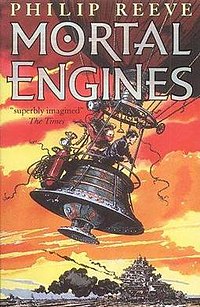
Mortal Engines, by Philip Reeve

Such an unusual and ingenious concept for a novel.  Large, preadatory cities traverse the bare and empty earth looking for smaller cities (prey) to 'eat'.  Their reason is to capture their population as slaves to work their engine roomes and to scavange their fuel, resources and technology.  Municpial Darwninism, Reeve calls this, the survival of the fittest, most technically advanced settlements.

London, the city we deal with primarily, is one of the more kitted-out cities.  Its population is divided into guilds, who work to improve and advance their city.  The engineers, the most renowned and admired, study pieces of 'old technology' from the 20th century in the hope that one day they will be able to regain the weaponry and technology of the 1900s and 2000s.  The Historians and archaeologists record and store relics of historical importance and the aviators and navigators steer the giant city on its way accross the hunting grounds.  The story begins when Tom Natsworthy, an apprentice historian who has always daydreamed of adventure, finds himself cast out of the city of London into the outside, static world.  For the first time in his life he is on terra-firma with only a horribly disfigured and emotionally unstable assassin girl, Hester Shaw, who has just failed to murder one of London's most respected and important Historians (and also Tom's hero), the influential explorer Thaddeus Valentine.

I really do think that this is YA writing at its best.  You know you're on to a winner from the first sentence...
“It was a dark, blustery afternoon in spring, and the city of London was chasing a small mining town across the dried-out bed of the old North Sea.”
Not only is the world so brilliantly created, Mad Max via Dickens' London, but the characters are crafted to perfection; flawed, complicated and on most occasions stuck between a rock and a hard place. Which members of a post nuclear society have it easy?  There really is no difinitive line between good and evil, there are only decisions and their consequences.  The adult characters are exciting and full of stories of adventure, they're charming and energetic, but are almost always proven to be not what they seem.  What does it take to trust a person? 

We oversee a moral education, thanks to the unexpected experinces of Katherine Valentine, micro-socialite daughter of Thaddeus.  She learns to question her sheltrered, comfortable life and begins to learn about the death and exploitation of the disadvantaged for the comfort and health of those of a higher social standing, the horrors that result from the over consumption of resources and the dangers of greed, technology and entitlement.  She also learns about sacrifice and about living with the consequences of out actions.

I really did enjoy this a lot, Reeve's an excellent storyteller.  He reveals just enough information at just the right time to keep you wondering and he has a very streightforward but engaging style of writing.  It's certainly fast paced and full of advetnure and mystery, full of action, fights, chases and flames, revenge- also, PIRATES!  If you like steampunk, Phillip Pullman, Cybermen, the futuristic dog-eat-dog survival element of the Hunger Games and/or monster wheeled cities wheeling around the desert, you will probably like this.

Thursday, 17 January 2013

Hope: A Tragedy by Shalom Auslander

One of the benefits of being in a book club (The Broadway Book Club, to be precise) is that you are encouraged to read books that you would never normally have read.  I rarely read anything be people that are still alive, let alone debut novelists.  It's a mixed bag, really.  I'm not saying that you have to be dead to be good, but comparitively few contemporaty authors have set my world on fire.

Shalom Auslander is no different, really.  I enjoyed the book, it raised the odd titter, but I'd never make an effort to seek out any of his future work.  It's just not the sort of thing that I usually go for.  The essayist/short story writer sort of comes through- it's conceptual, kinda like an essay, but the feel of the book has more than a sense of a funny short story that's been expanded to novel length.

Auslander raises some interesting points about the nature of hope, dissappointment and expectation, perceptions about how society interprets the behaviour of certain social groups towards one another,  the errrm flexability of history, the nature of martyrdom in various forms and the constant presence of death, and people's way of dealing with mortality.  Solomon Kugel, opetmistic nihilist, is someone who handles mortality in pretty unusual ways.  Not particularly helpful ways, really.

It's an unusual book, written from an intensely Jewish perspective, which is something I've not really expereinced before.  Not being of any religion myself, I found it weird how much being Jewish appears to affect every single aspect of narrator Sol's life.  It's almost like he's a Jew, first and foremost, and a person, husband, father, son next. So he can't possibly evict the decrepit, intensely disgusting Anne Frank who's been living in his attic for the last few decades.  Can you imagine what the papers would say?  And his martyr of a mother?  After all she falsely claims to have experienced in German death camps? As the concept for a novel, you can't fault it for its outrageous originality.  Or its capacity for accusations of 'offence' or 'poor taste'.  Personally I've never been offended by the concept of offenciveness.  In imaginitive works, anything goes really.  If you don't like it, put it down and walk away.

Moving on to mamma Kugel, who definitely steals many of the novel's scenes.  Fraudulently claiming to have survived horrific ordeals at the hands of the Nazis (but actually enjoying an idyllic upbringing in the more suburban part of Brooklyn), Kugle's cantankerous, given-two-weeks-to-live-a-year-ago mother is initially a very funny character, who becomes sort of tragic for inexplicable reasosns.  She must behave like she does for a reason that's never really explored.  She appears to be unhappy, but nobody seems to be bothered.  She's frustrating, invasive and hard work, but the reasons for her behaviour are only ever hinted at, as Sol's so wrapped up in his own problems.  He's a Jewish Basil Fawlty, or a fictional Woody Allen.

In conclusion, Hope: A Tragedy is unusual.  It has a strong, consistent life philosophy of "Don't worry too much about what you can't change, see what happens, it probably won't be too bad."  It's a tragical farce, which won't be to everyone's taste.  I still can't tell if it was to my taste or not!  It's not supposed to be realistic, but I'm not sure what it is supposed to do...it's not that it's dull, or badly written, or annoying...it just didn't produce much of a reaction from me really.