Showing posts with label Decisions. Show all posts

Friday, 28 September 2018

You Only Live Once, by Jess Vallance

I loved this book! It was just what I needed to get out of my reading slump. Seriously funny, the exciting beginnings of a cute F/F romance that feels like any other teen YA romance, a likable protagonist with Lessons to Learn that does a bunch of dumb things and becomes a better person.

Gracie Dart is one of the best characters I have encountered in YA for ages. She was a model student at a bit of a crossroads in her life. She had always assumed she'd ace her A Levels, go to one of the good Unis and do something like Business, intern in London, get a good job and charge around with a coffee cup and go for loud After Work Drinks on Fridays. Her best friend Till wants to be a plumber based on an eyewateringly impressive emergency plumber bill she once had to pay. They are really different as characters, but it's a friendship that works and I loved how in sync the two were.

After a dramatic near death experience, Gracie decides that her summer of revision, highlighting and cramming was a waste of precious life and resolves to be less boring, less predictable and less afraid. She is going to Say Yes to stuff, Live A Life and Have Experiences. Because YOLO. Also, she can put it all on Instagram. Because, as the kids day, Pics or it Didn't Happen.

The book is basically about the lessons that Gracie has to learn about loyalty, responsibility, real life vs instagram, balancing friends, being decent to family and just being honest about how you feel and what you want. Just general life balance. Stuff that's still hard in your 30s and that you probably never really learn entirely tbh.

Highlights included: Nan in Paris. Amazing. Hilarious. A real example of the true Gracie just doing something nice for someone else and finding it a meaningful experience.
The excruciating gig and subsequent cute.
Gracie's flustered and unnecessary Coming Out to her super supportive and already onboard with G being gay parents.
Gracie's first proper talk with her brother in ages. It's not so much that it's funny, just really a really sweet moment.

The cover says it's for fans of Geek Girl, which is a sensible play, but YOLO feels much more modern and savvy than Geek Girl, and Gracie is a much more relatable character, in my old lady opinion. I think more readers will relate to feeling frustrated with your own perceived lameness and striving to be more interesting and more outgoing than accidentally becoming a model.

Loved it. Will definitely be on the lookout for the next one. Also, if you don't follow Jess Vallance on Twitter and Instagram, you are missing out on additional hilarity. Although if this book teaches us anything, it's that that is not a 100% accurate reflection of a person's life.

Monday, 5 March 2018

The Immortalists, by Chloe Benjamin


Four New York siblings visit a Romany fortune teller during the hot summer of 1969. A word of mouth rumour, she is reputed to be able to tell you the exact date of your death. Daniel, Klara, Varya and Simon, all under ten (ish) the Gold children scrape together their pocket money to visit this mysterious woman, drawn by their desire to Know.

They are fascinated and horrified by what they learn. Torn between dismissing it as nonsense and clinging onto the superstition, concealing their dates from one another and never mentioning it until adulthood…the Gold siblings are burdened with a knowledge that hangs over every hour of every day, a knowledge that threatens to make their choices for them and forces them to make the most of every opportunity
.
The book scrolls through the lives of the four Gold siblings in the order in which they die. We start with Simon, youngest Gold and heir to the family’s drapery business. Knowing that he will die young, he runs away to San Francisco with his wayward sister Klara and throws himself head first into living fast; the famous Gay Scene, night clubs, drugs, ballet, sex and hedonism and eventually romantic love. His date turns out to be true.

Essentially estranged from the rest of the family through a mixture of distance and flighty waywardness, Klara dedicates herself to becoming an illusionist and vaudevillian like her Hungarian grandmother. Perfecting her signature death-defying stunt, the Jaws of Life, the trick is that there is no trick, just strength and will and guts. Her secret shame is the guilt she feels at being the one that convinced Simon to come to San Francisco, she feels responsible for his death and that guilt plays a large part in the road to her death.

After Klara's death, unsure if her unknown date was accurate or not, Daniel, the sensible Army doctor sets off to find the fortune teller- gradually  becoming more and more obsessed with making her pay for the deaths of his siblings. This section ends with a slightly out-of character Thriller--esque showdown...The final Gold standing, a genetic researcher and OCD sufferer Varya is the last to narrate, the only one granted the gift of old age. Her life’s work is to extend the natural human life, but the price to pay is that her (long) life is fairly miserable, a grey existence of controlled calories and hermetic environments. Like her sister she too is defying death, but through a microscope rather than on stage. She's probably the hardest Gold to warm to- somewhat passionless and calculated, she resented her siblings their freedom and now finds herself without any of them.

I love multi-narrative books and books about siblings, so this ticked a lot of boxes for me- I loved the themes of self-fulfilling prophecy versus fate, how knowing what’s around the corner might influence and affect the decisions we make and the direction that our lives take. It’s fairy usual to discuss what we’d do if this was our last day on Earth, and we’re all familiar with the saying of “Being here for a good time, not a long time”, and this book asks whether we’d live differently, make different choices, take risks, set goals, try harder if we knew when we were going to die.

It’s concerned too with the idea of free will, and whether by setting a date in stone and obsessing over it, a person inadvertently fulfils these prophecies with their obsession, or whether it is in fact pre-determined, and the only unusual factor is the awareness of the date, a date and an event that cannot be deviated from…

The Immortalists a wonderful story about family and loss and choices, and how we decide on our life’s priorities. Is it better to live a short life full of joy and love and impact? Or is it better to live a long, safe life, controlled and protected. The dynamics of the family as they grow apart and are forced back together, a smaller circle every time is heart breaking and relatable and tragic. They are all so tortured by the awareness of their own failures; failure to act, failure to reach out, failure to try and understand. People are strange creatures and whatever we choose, we can never really win.

Very much recommended.

Thursday, 28 September 2017

History of Wolves, by Emily Fridlund

Ahhh, the first bum note of the Booker Shortlist 2017.

Normally, narratives about cults and communes are right up my street. Coupled with the isolated woodlands of Minnesota, I was fairly confident that this was going to be a winner for me. How very wrong I was.

Linda, aka Mattie aka Madeline, now 37, remembers a pivotal summer when she was 14. The summer the Gardners moved into the neighbouring cabin on the lake. Apparently the perfect city family, glamorous Patra and toddler Paul are awaiting the arrival of husband/father Leo when Linda initially befriends them. Part babysitter, part governess, Linda teaches the upfront, oddly serious three year old about the woods, survival and nature, as well as keeping him out from under his parents’ feet. Leo is a controlling and manipulative Astronomer, dubbed a genius by his doting, fawning wife. A wife that is 11 years his junior and a former student.

It is hinted at, then referred to as the book goes on that there is something wrong with Paul, something that, in the future, Linda will be quizzed about. Her actions, responses and thoughts will be analysed and assessed in minute detail. These later events break into the summer narrative periodically, recounted by a much older Linda.

During her narrative, Linda bounces from topic to topic, from decade to decade. There’s a teacher arrested on pedophilia charges; her 20s spent living with a Canadian girl, a mechanic boyfriend; the summer she babysat for the Gardners; lots of meandering through the beautiful but somehow uninteresting forests; writing to the pervert teacher; a sudden death. I did find it quite hard to keep track of what age Linda was supposed to be in which scenes, perhaps because the storytelling was kind of sloppy, perhaps because I wasn’t super bothered.

Even the woods were stripped of their magic by the detached Linda and her unvaried treks through familiar trails. The lakeside woods were simply an unremarkable reality, her known landscape. No more unusual or noteworthy than buildings or roads. The same cycles went round and round, bringing their own tasks, challenges and temperatures.

I found this book dull and pretentious- there was no atmosphere, no suspense. I don’t know what the wolf business was about. The subplot with the teacher and Lily was entirely divorced from the Gardner’s plot.. The structure was abrasive, the characters forgettable, dull and lacking in any kind of agency. Linda was incredibly irritating, her inner monologue unbearable. She seemed periodically obsessed with Patra, with classmate Lily, with Wolves...all intense but transient. She had no motivation, no interests, no convictions, no opinions, no identity. She seemed thoroughly damaged, fantasizing about doing something (anything) shocking or inappropriate, then invariably standing there like a silent lemon wrestling with her thoughts. She’s socially awkward, emotionally distant from her family. She seems to have no friends, and she delights in pranks and stunts, cruel or inexplicable letters. She was obviously very lonely and isolated, left behind with her presumed parents after the breakdown and drifting off of their commune community. I just couldn't care about her at all. An unlikable character is not always a deal breaker, but I didn’t find the prose particularly beguiling and I was glad to finally have done with this tedious story.

Friday, 17 March 2017

We Come Apart, by Sarah Crossan and Brian Conaghan

A verse novel that alternates between two very different voices of two narrators that have been brought together via the same crime, but from very different backgrounds. Jess is in trouble quite a lot- caught shoplifting, third offence, she is sent on a reparation scheme to 'give back to society'. Nicu is caught once, but perhaps due to him being a recent Romanian immigrant, seems to find himself on the same scheme. They form an unlikely bond, one that doesn't quite spill over into school immediately, but one that makes Jess re-think what she wants from friendship. It makes he reassess who she is, why she behaves how she does and surrounds herself with toxic people.

There are no chapter headings, but it's always easy to tell who's narrating- one, because it's so well written, and two because the voices are so distinctive. Not only because Nicu's broken English is quickly identifiable, but because the characters' personalities are very evident from what they say and think. The reader gets such an instantaneous, illuminating glimpse into these teens' heads. Nicu is fun loving, romantic, goofy and keen to please. He just wants to make friends, be liked and get people to smile back at him. He knows that as a Romanian in England the deck is stacked against him. It's quite heartbreaking how low he's set the bar for acceptance. He's like a beaten up little puppy that still wants to see good in everyone. Jess is literally the opposite. Cynical, angry, powerless; she lives with her doormat mum and her abusive stepdad and feels complicit in her mother's abuse as she is unable to stop it. Jess doesn't trust anybody; her dad left her, her brother left her. She is afraid to show any kind of vulnerability or weakness. It's fairly plain to see what Vile Terry's ling term goals are for Jess. She sees no realistic future for herself so despite her cocky attitude, her self esteem is dangerously low.

Though bullying, prejudice and  small-town Brexit-based hatred are prominent themes throughout, it remains a story about friendship. Nicu is head over heels for Jess pretty much on first sight, but it's a slow burning relationship that has to overcome trust issues, secrecy and the vile attitudes of Jess' 'friends' and stepdad. It's hard to watch Nicu be slandered and bullied- he stays so calm and dignified while Jess stays silent. It's interesting to see how social influence, power and acceptance shifts, changing the characters as it settles.

Through their friendship, though support and trust in one another, each character grows in confidence and self worth. Naturally, it's too good to last. Tragic, somewhat inevitable bad decision is made, one of those sorts of wrong place, wrong time, unfair little life wreckers that you cannot win either way. It's an emotional narrative, full of injustice and powerlessness, where the reader just has to wonder why we spend such time and effort being assholes to one another. It's short, bittersweet and thoroughly captivating- a modern tragedy of a beautiful friendship that society just refuses to allow.

Friday, 10 March 2017

The Hate U Give, by Angie Thomas

I have tried to write this review so many times and nothing feels right. So. I am just going to go a bit off piste, format wise, and post the blurb, then simply rave about all of the different reasons why this novel is amazing and why you should read it. It has temporarily suspended my ability to be anywhere close to articulate when it comes to trying to describe this book. So the blurb:
Sixteen-year-old Starr lives in two worlds: the poor neighbourhood where she was born and raised and her posh high school in the suburbs. The uneasy balance between them is shattered when Starr is the only witness to the fatal shooting of her unarmed best friend, Khalil, by a police officer. Now what Starr says could destroy her community. It could also get her killed.
It's easy as a white, British person to feel like this can't be real life. Our Police for the most part don't even carry firearms. How can this happen? But it does; "Unarmed Black Man" has been heard enough to become a stock phrase. We have seen the hashtags on twitter. Seen the footage online. It's simply baffling to think that a person can be pulled over for a rear light being broken and end up dead. How?

This is such a powerful, important, vital story inspired by the Black Lives Matter movement. It's blood-running-cold kind of powerful that leaves the reader brimming with impotent rage at the injustices of judicial systems. Infuriating and baffling, yes, but it's also beautifully crafted- brilliant storytelling filled with wonderful prose. I flat out refuse to believe that this is a first novel, because the hand that has written it is nothing short of masterful.

Moving on to the characters. The protagonist is amazing. Starr Carter is fearless (even when she's scared, she carries on). I cannot emphasize enough how fully-realized and complete Starr was as a person. Her inner monologue, her double life, the fears of being labelled a girl from the ghetto, but feeling conflicted about betraying her race and her upbringing are presented in such a way that it impossible to not be affected by her situation. It must be exhausting to have to be so many things to so many different people, to live up to or defy their expectations. She's real, likable, easy to root for. She talks like a real teen! So many writers get teen language and dialect wrong- there's always some veneer of 'something' that prevents if from feeling real. As adults it's hard to become the voice of teens authentically, but AT pulls it off beautifully. I loved the quips about Future Husband Drake and Cousin-by-Marriage Beyonce. Realistic dialogue is my Holy Grail with YA- it's hard to find, but when you do, it is such a pleasure to read. Obviously this book addresses a really serious theme, but it also manages to be unexpectedly funny, and full of quips and verbal sparring and witty, playful dialogue. Because even when horrible things happen, people still sometimes say funny things.

So not only is Starr the most lovable protagonist I've encountered in ages, there is also a brilliant cast of supporting characters, all of whom have their own struggles, passions, lives and personalities. Even story lines. DeVante, Seven, Uncle Carlos- all proper, rounded characters that exist beyond the pages of a book, beyond the scenes in which they feature. Out doing their own thing. I loved too that the novel showed married 40 something parents that are in love, respectful, supportive of one another. So may YA contemporaries feature broken homes, step-parents, drama, breakups, divorces. It is wonderful to see such a strong family unit full of such well crafted secondary characters. Yes, the Carters aren't perfect, but they make it work and they work hard doing so. I love that Starr has learned how to be treated by a man from her dad's good example. I loved that Starr calls her parents her OTP. It's just too adorable.

On top of the obvious essential social issue context, it is also simply an amazing contemporary novel. The Hate U Give also looks at coming of age, boyfriend issues, female friendships, school, family dynamics, community. Many YA contemporaries struggle to tell even a straightforward frenemies in high school story; with this novel you kind of get that for free, served on the side of a story of injustice, bravery and rage.

I especially loved how Garden Heights and its inhabitants were depicted. Obviously it's a problematic neighbourhood, but the sense of community was so evident. People looking out for one another, cooking food for each other, looking after one another's kids. Despite this, it's easy to see how characters like DeVante and Khalil fall in with bad crowds when there are no opportunities, no accessible role models, no money and no futures available any other way. Even though it's a serious novel about injustice and prejudice, it's also full of hope and courage and inspiring people.

THUG Forces the reader to think about their own prejudices and wonder what they'd do in the same situation. Not just how you'd react in Starr's position, but the conclusions that might be jumped to when seeing news reports or police incidents. It reminded me a bit of the brilliant Asking For It by Louise O'Neil; the assumptions about the victim eclipsing the crime committed against them, that some crimes are justified by the appearance and past behaviour of the person against whom they are committed.

It left me pretty numb to be honest. It's a thoroughly engrossing, emotional and should be essential reading for literally every person, but most especially anyone that has ever said "All Lives Matter". It's so easy to just ignore issues that don't impact upon you personally; to not even have to think about how they won't ever impact upon you. It is privilege in action. The Hate U Give left me asking myself "How can I be better at not being a well meaning but clueless white person? Is there any little thing I can do or change or say to make even a tiny flake of difference?"

This book is going to be massive, should be massive, and Angie Thomas deserves every breath of praise that she gets. The emotional labour of getting a story like this on paper must be pretty huge.

Thank you so much to Walker Books for the review copy and thank you for helping to put this book out there. I still feel like I've not even managed to convey how incredible it is.

Wednesday, 18 May 2016

The Glorious Heresies, by Lisa McInerney

I had been waiting for this book to come out in paperback for ages, and was delighted to see it make the Bailey's Prize shortlist, as that made it much more likely that I'd actually manage to read it. In short, I had greatly looked forwards to reading this début novel from Irish blogger and all round Sweary Lady Lisa McInerney. But now having finished it, I really don't know what to think.

The story follows various figures of Cork City's criminal underworld. Seedy and grim, TGH paints a picture of a decaying Ireland very different from the Emerald Isle depicted in the tourist literature. This is a damp and resentful Ireland, wounded by its religion, betrayed by its lawmakers and crippled by financial collapse. The book opens with Maureen, the recently retrieved, butter-wouldn't-melt estranged mother of Cork's leading gangster Jimmy Phelan. Maureen harbours her own grudge against her country; forced to relinquish her born out of wedlock son 40 years ago and exiled to London, she's bitter about the disproportionate amount time paid versus the sin committed. She's owed some bad behaviour really, paid on credit. Son Jimmy, raised a pillar of the community by his grandparents, has recently retrieved her from London and had installed her unceremoniously in an empty brothel.

Maureen has just accidentally killed a trespasser in her dingy flat, conking the intruder on the head with a garish religious trinket. Jimmy, called in to make the deceased disappear subcontracts the job to one of his men- one time pal Tony Cusack, a violent drunk, distraught widower and father of 6. This accidental, almost farcical murder has repercussions for all the novel's characters that span the next five years. The deceased is Robbie O'Donovan, half arsed pimp, waster, junkie and general layabout. He will be vaguely sought by his junkie, prostitute girlfriend Georgie for the next couple of years. Tara Duane, the Cusack's next door neighbour is a grotty gossip monger there to poke the embers when it looks like the flames of implication might be dying down and the shabby glue that holds the characters' fates together.

Our main protagonist is Ryan Cusack, 15 years old at the beginning of the book, he is the son of a violent drunk and desperate to avoid turning into one himself. He graduates from small time dealer, to juvenile prison, to more illustrious networks of criminals, swapping the piano for decks along the way. It's his descent from resentful punchbag to actual angry criminal that is perhaps the most arresting of the book's plots. We see the decisions he makes and the lack of real options open to him. His relationship with his girlfriend (from the age of 15-21) is interesting, quite sweet really, that they stay together through prison sentences and various assorted infidelities, but they seem to swing between genuine, affectionate love and blind seething hatred. They show quite nicely how toxic influences will poison even the most stable, loving (if slightly unlikely) relationships. As the years go on, Ryan's field of vision begins to narrow and his options, never exactly myriad to begin with, seem to decrease in quite an alarming, suffocating way.

Though well written and full of sharp wit and head turning turns of phrase, I never really got my eye in for this book, never hit my stride with it properly. I've really struggled to identify what it was that didn't chime. I was determined to plough through, as I'd heard such promising things and been looking forward it reading it for so long! I guess it just didn't work for me. One thing I will say is that I did struggle with the jumbled chronology- perhaps if I'd felt more immersed this would've come more naturally and presented less of a problem. I know the out of sequence narrative is not an especially complex or new idea, but in this case I just found it made the novel that little bit tougher. I guess I just got a bit left behind- McInerney I found be kind of of prone to hyperbole and a couple of times I'd get to the end of a paragraph and realise that I had no idea what I'd just read...

I honestly don't think this is a bad book, not by any means. It's funny, smart and a really fascinating study of the grotty criminal networks that exist in the festering decay of small, neglected cities. I liked the unsympathetic but recognisable cast of characters, I liked that none of them were really looking for redemption- that none of then would recognise redemption if they should see it. I liked seeing a depressing, seedy city filled with grotty characters that know there's no getting out of rock bottom. I'm sure this is a very recognisable world to many readers, and not just to the Irish.

It just didn't work for me and I'm kind of sad about that.

Wednesday, 20 April 2016

The Improbability of Love, by Hannah Rothschild

A lovely, lovely gem of a book that refuses to be closed for even a minute. It begins with an auction- a lost masterpiece of the 18th Century by French painter Jean-Antoine Watteau, the guy credited with founding the Rococo movement. The glamorous, the filthy rich and the hangers on are all on the prowl determined to own a piece of history that once hung on the walls of Katherine the Great and Madame de Pompadour. Hundreds of Millions of pounds to prove to the world that you have taste and class and most importantly, deep pockets.

The narrative then backtracks to reveal how the painting came to be re-discovered after being happened upon in a grotty junkshop by Annie, an almost destitute aspiring chef. She forks out the last £70 she has to buy it as a birthday present for an unsuitable man met at a singles' art dating event. He stands her up and so her fate (and that of many others) becomes tangled with the painting.

It's such a readable book- despite its genteel façade, it's incredibly action packed. It's not long before the reader is drawn into whirlwind of authentication and research; down at the Wallace collection where she meets Jesse, a lovestruck guide and part-time painter; some long-shot detective work as Anna pores over sketches and monographs in the British Library, trying to determine if her painting is a worthless copy or something else. She totes it around London in a carrier bag, to her day job cooking steamed fish and wilted spinach for the Winkleman dynasty, a family of ruthless Art dealers with a dodgy past. In a 400 page novel we are lavishly treated to Louis XIV style banquets, musings on the nature and subjective worth of art, legacy destroying secrets, Nazi loot, royal scandals, lots of detective work, shady cloak and dagger murders and a desperate dash for evidence and acquittal. We see the coiffured, silken lives of the disgustingly rich and the Spartan lives of the modern artist. It's quite the whirlwind.

I loved the characters in this book- they were so easy to care about. The heart-broken starting-again Annie and her sumptuous banquets of art-inspired food, her alcoholic mother who shows up just in time to ruin everything, sweet, awkward Jesse who is head over heels for Annie within seconds of meeting her. And Rebecca Winkleman, the insecure ice-queen dominated by her patriarch father, schooled in Art History from nursery age, ruthless and steely who thinks nothing of sending an innocent employee to prison to keep the family reputation intact. Most notable perhaps is the voice of The Painting, the Improbability of Love itself. Sassy, sarcastic, kind of pretentious and hugely characterful, the painting gets the chance to tell its own story, of camel caravans, looting and theft and royal palaces and all the things its seen in its 300 years on walls. It knows and revels in its power to inspire love (it has quite the track record) I loved this idea- a completely new perspective of history that nobody living could ever recount.

I really liked the book's musings on the value of art, how subjective art is and the contradictions around its purpose and worth. It argues that art is an indicator of good taste; some people will buy a painting owned by a king of a queen and congratulate themselves on sharing the impeccable, refined tastes of a dead monarch. They will pay record breaking sums to be part of the club. But art has intrinsic value too; it's a window into human emotion. Recurring themes of misery, pursuit, suffering, rapture, love and lust (unrequited or mutual) have been depicted since mankind first figured out how to smear pigments on cave walls. The modern viewer, looking at any given painting hung in any gallery in the world is reminded that whatever it is they're going through, it's all been suffered before. There's also the argument that art exists to be beautiful, to inspire emotion and joy. Art exists because somebody is compelled to create it. Art exists to make money. I loved how much time and room the book laid aside to talk about the different routes and reasons that might one day see at artwork fetch a record price at auction. It shows that whatever art is to *whoever* wants to define it, it's never possible to truly explain what art is and why it matters. I like that.

I'm convinced this book has an unusually broad appeal and manages to make the unlikely jump from literary or contemporary fiction to casual readers, beach readers and romance readers alike. It's got beautiful prose, a satisfying if slightly inevitable romance plot, a devastating fa
mily secret that threatens the very foundations of the art world and a whistle stop tour of some of the lesser known masters of the 18th century art world. Personally I'd never heard of Watteau, but I found myself falling into a Wikipedia wormhole of 18th century art, seeing who painted what, who their contemporaries were, where these painting are now (hopefully a national collection) and the scandals and history of their creation.

Books like this make me wish I knew more about art, they make me wistful for travel to go and see some of these creations in the flesh (in the oil?) and it makes me really think about the legacy of the human race and our need to create. I love books about artists and the creative process. The Improbability of Love is a glorious read, an unlikely thriller (look, I'm a librarian, I find research and discovery thrilling) and a beautifully paced, intricately and artfully written novel about art, love and food. I will be recommending this an awful lot, and I genuinely fancy its chances for the Bailey's Prize.

My one singular gripe is that you would never get a librarian giving out patron data or info to anybody, no matter how eccentrically charming or ingeniously excused. Wouldn't happen.

Friday, 11 March 2016

Jessica's Ghost, by Andrew Norris

A sweet and uplifting story about battling depression and loneliness and thriving through being different, Jessica's ghost tackles some pretty grim, upsetting subjects in a way that is accessible, relateable and quite enjoyable to read. It reinforces, as does much YA, the merits of being able to be yourself. It shows the liberation of realising that people's opinions don't matter, that none if it matters, as long as there are people in your life that care and that encourage you to be yourself.

Francis, sitting alone on a bench one frost break time is abruptly joined by Jessica, a ghost about his own age who up until now, has not been seen or spoken to, by anyone, in the year since she died. Needless to say, she is surprised to find that Francis can see and hear her. A lonely boy due to his interest in fashion and sewing, Francis and Jessica quickly become inseparable. Francis doesn't really have any friends in school and Jessica is just relieved to have somebody that can see her.

Their happy duo becomes a trio when Francis' mum inadvertently arranges for her son to befriend a newcomer to the street. Andi, thought initially to be Andy, is a rough and ready tomboy, expelled from her last school for fighting and adamant that she will not go to another. After meeting Francis and Jessica (who she too can see), Andi experiences a sudden, dramatic personality change. Her general fascination in Jessica and the fact that she is a ghost creates an instant bond between the three of them and new friends are able to ease her anxiety about school. She goes from being angry, sullen and violent to being reasonable and co-operative, almost over night. For once, she has got people that are willing to accept her, and it makes all of the difference to her outlook and behaviour.

After the miracle that Francis worked on Andi, he's recruited by a second mum, who wants Francis to talk her son Roland into getting out of his room and going to school. Intrigued by Jessica (whom he can see too), it's not long before the trio is a foursome, and Roland is enrolled at their school, much to the amazement of his mum. It's a sweet story really, with Jessica's ghost as a good-deed dooer bringing together three lonely, desperate teenagers, each one of whom has considered suicide. She's hung around after death, convinced that there is something that she's supposed to do but not sure what.

I liked this book's portrayal of depression and found it to be quite realistic and sensitively done. I liked that it raised the idea that depressive thoughts can strike absolutely indiscriminately- no warning, no causes, no pattern and apparently no way out. Jessica talks about falling into The Pit, about how some days a person can feel fine, convinced that the pain and misery was just a blip and it's all sorted now...only to be plunged into despair the next day, thoroughly certain that there is nothing that anybody could do, even if they wanted to, to help. I liked that it acknowledged the difference between the rational, everyday thought process and the thought process of a depressed mind.

Standing out can be painful and alienating and scary, but as long as there are one or two people that you can truly be yourself around, being different becomes liberating. Celebrating each other's weirdness is a powerful thing. I really, really liked this book, but I found it to be thematically quite similar to We Are All Made of Molecules (lots of combating bullies, celebrating what makes us different, anxieties about being weird or standing out, fixing life's issues with the careful application of good friends and family) so it's unlikely that they'll both make the shortlist. I enjoyed this book a lot and thoroughly loved the character of Francis, the dressmaking silver-tongued rescuer that can make all the difference to the life and outlook of a desperate person just by being nice and by being himself, and, of course, encouraging everybody else to do the same.

Friday, 19 February 2016

The Rest of Us Just Live Here, by Patrick Ness


Narratives are full of heroes saving the day, of beautiful teenagers that sacrifice themselves for the good of the World, only to find some sort of deadly-peril-loophole and live to fight another day. World intact. Films, TV shows, books; they're all about the righteous, the brave, the heroic young things with the fate of the World at their feet. Not this one. Though that is going on, somewhere (in the brilliantly tongue-in-cheek chapter previews, a beautiful-but-doesn't-see-it Indie kid named Satchel fights for the souls of Earth and the hearts of Finns 1 and 2, Dylan and an alien Prince) this book follows the more ordinary kids. The ones who want to graduate high school before it gets blown up and go to prom and not die. The kids who worry about their own futures and their families and are vaguely aware of the paranormal weirdness that goes on from time to time but aren't really involved. If you're in your 20s (edit: or 30s!) it's this; it's the story that belongs to all those anonymous kids that Buffy Summers went to school with. The ones in their funny 90s jeans and too-big, too-bright t shirts that carry folders around the corridors, hang out near the lockers, vaguely wonder why Buffy and her crew spend so much time at the library but never pass any classes and why do they always look so worried and go running off into the woods at the drop of a hat. Also remember that time a snake ate the principal?


Narrated by Mikey, a senior year student with some debilitating OCD issues and tendencies, he recounts the events of his last few weeks at school with his sister Mel (recovering anorexic), Henna (beautiful Finnish-African-American, totally in love with her) and Mikey's BFF Jared, who's a lovely, caring gay footballer player and 1/4 God. So it's a pretty mixed bag, character wise. It's very much emphasised throughout that everybody has their things that they need to deal with; pushy parents, alcoholism, mental health issues, illness, religion- and for an individual floored by circumstances, coping with the every day can be just as daunting and impossible as actually saving the world. I loved these characters and desperately wanted them to be happy. Despite the somewhat odd things happening off in the background somewhere, I loved how ordinary they were, how they worry about keeping in touch and who get to find out secrets first. Their friendship was so completely believable and the reader really understands the intensity of teen cliques, the dependency of each person on the support and presence of one another. At its heart it's a story about life changing friendship and being able to love people, flaws and all.

As far as plot goes, there isn't really an epic narrative...well there is, there's a potential apocalypse of blue light and body-stealing aliens developing off-stage, but Ness doesn't follow that story; we know it already. What we follow is a bunch of teens coming to terms with the end of school, the end of their group and the start of something new and scary and unknown. It's the end of life as it's always been. That's a tough time for any teen, even without anxiety issues and eating disorders and all of the insane things that parents get up to to make things even tougher, like running for State Senate. I loved the empathy that was so apparent amongst the characters, how sensitive they were to each other's moods and needs, but definitely okay with pointing out who's being a diva and who needs to get over themselves on this occasion. So definitely completely realistic and true to life and just so, so relatable.

It's no secret that I'm a huge Patrick Ness fan. The way he can weave the reader's emotions into whatever fabric he wants is remarkable. His characters are always believable; flawed, empathetic, heartbreaking in the way they struggle through the difficulties they face. Not always in a "put-upon hero" way, but also in an "I'm doing my best with what I've got, leave me alone" kind of way too. His characters are survivors, even when they feel crap and are at their wit's end and have a bit of a cry. There is so much for readers of all ages and experiences to take from his characters and his stories; everyone can find somebody who is a bit like them in a Patrick Ness book. How valuable and incredible is that?

It's a novel very different (plot wise) to anything Ness has done before, but many of his themes of loss and strength and coming to terms with internal demons are all present and correct. It's an ingenious concept, that you don't need to be The Chosen One to have a story worth telling and to have a meaningful, important life. It's also very funny, and you will think "OMG YES THIS, EXACTLY THIS" so often that you will begin to annoy yourself. If you enjoyed this book, I'd also recommend All of The Above, by Juno Dawson for another mismatched bunch of BFFs trying to live life as best they can, baggage and all. I'd certainly recommend Buffy the Vampire Slayer, seasons 1-7 also, because it's amazing and just ignore the rubber monster costumes.

Thursday, 18 February 2016

The Butcher's Hook, by Janet Ellis


The Butcher's Hook tells the story of 19 year old Anne Jaccobs, the eldest and until recently only daughter in a wealthy Georgian family. Having recently lost a beloved infant brother to fever, Anne is an odd, solitary young woman, morbid and content with her own company. Her ailing mother is confined with a new, sickly baby (a sister that Anne finds it so desperately hard to care about) and her callous, pompous father is at the stage where he is so wearied and inconvenienced by Anne's existence, he's willing to marry her off to creepy old men in a pretty mercenary fashion. Anne shares with the reader certain secrets that explain her aversion to older men...could these secrets also explain Anne's later-in-the-novel actions?Unwilling to be sold off quietly, Anne strikes up an acquaintance which quickly becomes a passionate affair with Fub, the butcher's dark eyed apprentice.

Consumed with desire for Fub, Anne will go to surprising lengths to satisfy her addiction to her boy. He becomes her world, her whole reason for existing. To begin with he seems quite sweet, a rough but delicious type that dotes on Anne and their snatched hours together...she seems naïve and quite reckless, but for once she is happy. Her world experiences something of a seismic shift. She loses all sense of reality and prospective, losing herself in her passionate fantasies of Fub and their breathless, clandestine meetings. The first half of the story is a fairly recognisable tale of a young woman being steered into a horrendous marriage to a genuinely creepy character, one that seems to openly gloat in his ensnaring of her against her will. Love or social position: so far, so familiar. What sets The Butcher's Hook apart from more regular domestic tales of marriage and misery in the 18th century is the unexpected trajectory of Anne's character.

Throughout the second half of the story both central characters undergo some surprising and very skilfully managed transformations that leave the reader's head spinning. I really couldn't tell where the narrative was heading. The evolution of the characters was one of the elements of the novel that I was most impressed with- how the reader's perceptions of Anne and Fub change. I couldn't be sure if Fub's character actually become more duplicitous, whether his more unsavoury character traits overtook his charm, or whether Anne's changing feelings towards him affects our view of him too; either way, it was subtly and expertly achieved. I loved how infatuation and obsession is depicted as something that be one minute thoroughly enthralling, then can disappear without warning like a candle being pinched.

I really felt like I saw the world through Anne's nihilistic eyes; she's a dark, damaged and unforgettable young woman. Ellis does a remarkable job of building our sympathy for the character; unguided, alone, apparently unloved. She's invisible within her family and objectified, abused and confused by those she trusts. We see her fight against her familial and social obligations for a chance to make her own decisions. Ellis carries the reader along on Anne's errands, her lover's escapades and schemes and on her later deeds. Anne's narration is precise and unflinching, what she is doing seems to make so much sense, seems so obviously simple to her, that it almost rubs off on the reader. I kept catching myself almost agreeing with her logic, which was quite disturbing. I was completely absorbed into Anne's mindset.

I was incredibly impressed with Ellis' prose- beautiful in places and shocking in others, she displays a real grasp of  language and knows the shocking power of a well-placed, incongruous simile or a wicked thought. A couple of times I had to re-read a line just to check I'd seen the right thing...her intricate and complicated characters are spellbinding and she has the readers eating out of her hand-the way that the our opinions and perceptions are played with and bent into and out of shape is brilliant. I loved how the novel was able to surprise me and kept me guessing not only about the plot but about the characters. Though I'd describe the novel as sensational and slightly unlikely, it was an enjoyable, twisted journey nonetheless, a gripping whirlwind of passion, debauchery and moral vacancy which I'd thoroughly recommend.

Monday, 18 January 2016

1Q84, by Haruki Murakami

My first read from Japanese giant Haruki Murakami and ohmygod it did not disappoint. I had no idea what this novel was going to be (only that it was long), but it was a complex, masterfully spun tale of reality, enduring love and confusion. I don't want to reveal too much about this book, hard as that might be for one so lengthy, as it's an absolute joy to peer into the jumbled mess of plot and separate, order and connect the strands, the intricate plots that shoot off here and there, and grapple with the mysteries of the story.

The first two books are narrated by Aomame and Tengo, an exceptionally lithe gym instructor and a mathematician come author; though they briefly shared a moment (just a moment) of connection many years ago, the two have been strangers for the last 20 years. Over the course of the trilogy a net of circumstances closes in around the two characters, forcing them together towards their shared destiny in a world that they find themselves in by accident.

The first book begins with Aomame, done up in her finest and most profesh suit, scrambling down a rickety ladder away from stationary traffic on the express-way. Abandoning her unusually comfortable taxi, she enters a world that will become 1Q84, though does not realise at the time that she has crossed an invisible threshold. Elsewhere, very close by, Tengo is commissioned by his brash and pushy editor to re-work a very promising manuscript submitted for a début writer's prize, Written by a strikingly beautiful 17 year old school girl, Air Chrysalis is a  bizarre fantasy story about a young girl visited by Little People in a world with two moons. Imaginative, but lacking polish and storytelling style, Tengo's involvement in the story marks the moment that his life's course changes track and he heads into 1Q84 too. This sets up the chain of narrative that has Tengo at one end, Aomame at the other, and in between a cultish religion, a mysterious 17 year old with an odd turn of phrase and shadowy past, otherworldly Lilliput-sized beings, assassinations, mysterious deaths, a rich Dowager, a promiscuous police officer, an exceptionally ugly private investigator and a soft-hearted but tough as nails bodyguard in between. It's an unpredictable sort of book.

Throughout the whole series there's a lurking sense of unreality, a mysterious otherness to everything that happens and every character. There's a possibility of danger at any moment, because when one is dealing with the inhabitants and customs of another world, you never really know what to expect. 1Q84 is a baffling but inescapably gripping story about the solid, tangible lines between fantasy and reality crumbling, about how the tiniest decision or event can take a person's life in an unknowable and sometimes irreversible direction. I loved the section about the Cat Town story that Tengo reads, a mysterious but real-looking place that you can get into but never leave that's ruled by cats, and about how the elderly people's hospital where he visits his dying father is his own personal Cat Town.

Towards the third book, a third narrator is added, Ushikawa, the ugly PI. Employed by the cult to detect their leader's killer, he is the force that causes our two protagonists' paths to cross. He is irritating, but he is essential, ugly but efficient. Towards the third book there is a lot of repetition, going over old ground, particularly in the third instalment, but it kind of gives the impression of a plug hole- the plot has circled and circled for a thousand pages, and as it nears its end the circles get faster and tighter, things are gone over and then covered again. Either that or the different translator gives the third part a slightly different tone. It's hard to tell.

Anyhow, long story (very long) short, I absolutely loved this, it's my ideal type of book; wonderful characters in Tengo and Aomami and Fuka-Eri, the 17 year old novelist, head scratching themes of parallel universes and out of body experiences, metaphysical madness, a magical hallucination feel, dilemmas about doing bad things to achieve good ends, revenge, beautiful prose and twisting, knotted narratives that tie up together at the end. Loved it. I'm not sure how I've never read Norwegian Wood, but it's definitely right up there on my Stuff to Do Soon list.

Thursday, 17 December 2015

Remix, by Non Pratt

Remix is a whirlwind weekend for school leavers Ruby and Kaz who are looking for an opportunity to blow of some post GCSE steam and to get over some ex boyfriends. Ruby is looking to forget all about her tattooed, pierced and be-biceped bad boy Stu, who is generally acknowledged at this stage to be a bit of a scumbag. Kaz is hoping to bump into rugby playing, short-trouser wearing Tom, who has inexplicably dumped her after years of being one half of love's young dream. The pair's favourite band Gold'ntone are playing, there will be bands, there will be boys, there will be booze. Obviously things don't go entirely to plan. Kaz and Ruby have their friendship tested over the course of the weekend by intruders (in the shape of hanger-on Lauren, Tom's secret new girlfriend hell bent on befriending Kaz) Rockstars that aren't all they've cracked up to be, exes showing up where they're not planned, brothers having strops, secrets, lies and gossip.

I've been to 5 festivals in my life, so I'm not exactly Kate Moss in Hunter Wellies, fringe and artfully dishevelled "Festival hair"/flower crown, but I've been to enough to totally identify with Ruby's initial experience. Well, some of them at least. The whole 'I get these people, these are my people' thoughts. Like normal life isn't quite real, and all the people at this festival are somehow part of your tribe and now the mother ship has called you home and you're all going to live forever more in this mud and bunting Utopia. I really liked how authentic that felt and it kind of made me yearn for all the gross fun of festivals.

There were loooooads of things I loved about this book. I loved that it was mostly about friendship and the ups and downs that come with intense relationships. Yes there is romance involved, but the plot focuses more on how romance affects friendship, how mates react to their friends dealing with mistakes and heartbreak, and how messed up everything can get when things aren't talked about. Ruby and Kaz were brilliant characters and I totally loved them both. Shout out also to the brilliant supporting cast, especially Ruby's bro Lee and his boyfriend Owen, who brought so much more to the story. They made it also about brother/sister relationships, and sister/brother's BF relationships and the whole massive web of connections and links that ripple out and out across everybody in a person's life. Not just about teen romance and love triangles but the whole domino effect.

Although I loved the story and all its drama, I found to my surprise that I found it quite difficult to keep the characters of Kaz and Ruby separate in my head...Though the girls themselves are very different (Ruby is obviously much more boisterous and outspoken, wheras Kaz is measured and day-dreamy) their style of speech was quite similar. And both characters still had dialogue in the other one's sections, so I found myself constantly thinking- whose bit is this? Whose thoughts are these? Though it was the same technique employed in Non's earlier book Trouble, I felt that I slipped into the minds of Hannah and Aaron much easier, and could keep their unique voices completely organised in my head. Though Ruby and Kaz are chalk and cheese, I think the voice is similar...and that made me struggle with this book more than I had expected.

I really liked this book, and would definitely recommend it to older teens- I just think they'd get the most out of it. Though other girls nicking your bestie is a popular theme in Middle Grade fiction, I feel it's seen less often in YA, which often has more of a romance-related-peril tone. I think Non has really channelled 16 year old brains here- she's really captured how important and identity-defining music is at 16, how desperately we cling to friends at that age, how much we dread them finding someone better. It is after all much easier to share a BFF with a boyfriend than it is to share them with another friend, again something that is explored beautifully in this story.

So maybe it doesn't have an overtly happy ending, but it's a positive ending. The book shows that people can make stupid mistakes and not be awful, terrible people. It shows that sometimes you can be wrong about people. Sometimes you can come back from mistakes and sometimes it's best to just write it off and move on. Families are complicated, friendships are complicated and being a teenager is impossible because you're never really entirely sure what you want, what to do when you've got it, or if it's worth what it cost to get it. A really, really enjoyable read that I hope will start a trend for more brilliant books about female friendships and the things that test them.

Wednesday, 14 October 2015

One, by Sarah Crossan

One is the story of 6 months in the lives of Tippi and Grace, 16 year old conjoined twins living in New Jersey. Two heads, four arms, two hearts, two legs; they are joined at the hip. Though they share a body, Tippi and Grace have vastly different personalities, though luckily they get on most of the time. The book is narrated by Grace; quieter, more thoughtful and less antagonistic than her twin, she sometimes struggles to assert herself against her sister, often leaving the talking to Tippi. Personally I think telling the story from the perspective of the quieter twin was inspired, as the reader gets to see the strongest character, the brash, opinionated, sassy Tippi through the eyes of the one person in the world who truly knows her the most. A person that has literally never left her side for a second.

The twins fight everyday to be accepted as individuals, while at the same time living with the difficulties and the logistical impossibilities of inhabiting the same body. What if one chooses to smoke and the other doesn't? What if one gets ill and is bedridden? Though each has their own hobbies, opinions and personality, they come as a package and their bond is more than just skin and bone. Theirs is a literal, unbreakable bond that runs even deeper than sisterhood or love; it’s at the core of who they are. It's interesting to see them as individuals but also as two members of a team that need to work and live together. I loved Grace's musings on all the potential crimes she could hypothetically commit, knowing she could never be imprisoned as Tippi would have to go to prison too, making any conviction illegal. I was charmed Grace's romanticism, her loyalty and her dry sense of humour.

Having previously always been homeschooled, Grace and Tippi are enrolled in High School for the first time when their mother loses her job and their already unemployed father falls further and further into alcohol dependence. Though they make friends (brilliant, wonderful friends in Jon and Yasmin, by the way, glorious, foul-mouthed weirdo outcasts) being out in public is a harrowing experience; as well as the stares and the comments, there are the blatant photos and covert recordings wherever they go. As if being a new kid in school isn't horrible and difficult enough. When the family's financial situation gets desperate, Tippi and Grace decide to do what they'd always sworn not to; sell their story, their lives, their privacy to a documentary film-maker, who records around the clock.

I really liked that the rest of the family is unfolded through this documentary too- we get to see the effects of having conjoined twins in the family through grandma, mum, dad and younger sister Dragon. Dragon especially must have it tough- the third wheel, the one that has to make the sacrifices for both sisters, and does so without resentment. We might witness Tippi's therapy sessions (though not hear them- headphones) and we have a front row seat for Grace's sessions, but there seems to be very little outlet for the rest of the family. Where do they go to talk through the strain? The cost of the medical bills, the weight of the worry? We see what a responsibility Tippi and Grace inadvertently, but inescapably are on the family, how they try to keep everything together for the sake of their version of normal. It made me furious to see how Grace's family struggled financially, like being a conjoined twin was an extravagant lifestyle choice.

A few months into the semester Tippi and Grace are faced with a life altering decision. Following a bout of Flu and a couple of blackouts, Grace contracts an infection that means her heart has stopped functioning properly. The twins need to decide- do they attempt a surgical separation, and risk dying? Or do they stay as they are, together until the end- an end that is a certainty and not very far away at all. Watching them have to make such a decision is heartbreaking, and really makes the reader think about the random, mysterious pot-luck that is life, and all of the unfair, unlikely and unknowable things that happen along the way to people that just don't deserve it.

The end section is so unbelievably sad- the verse just makes it even more so. With verse, there's no need to conform to normal storytelling, no need to be tied to the narrative or the restraints of what makes sense and what doesn't. What the verse allows, at the end, is just pure, overflowing raw emotion, and it's perfect. It really is a beautiful, extraordinary book. To be able to tell such an affecting, emotional and complete story with so few words is an incredible achievement. Every word, every line is essential and the whole narrative is alive with this delicate, lyrical poetry that makes reading this novel a truly illuminating experience. We understand what it might be like to live a life without ever having experienced a moment of privacy or isolation, even if we have never been there ourselves.

I really loved The Weight of Water, and while Apple and Rain was good, I felt it lacked the emotional punch of the former. One packs that same punch. Probably a slightly weightier one. I'm getting ahead of the game and putting this down as a certainty for next year's Carnegie. After two shortlistings in the last 3 years, I think 2016 is Crossan's year.

Tuesday, 14 July 2015

We Are Not Ourselves, by Matthew Thomas

We Are Not Ourselves is a family epic that spans three generations of Irish Immigrants living in Brooklyn in the post war years. As a child, Eileen was mystified by her charismatic Irish father and cold, unaffectionate mother. Each turning to alcohol at some point to endure their lives, school-aged Eileen takes management of the household; cooking, cleaning, bundling her inebriated parents into their separate bedrooms. Her Catholic upbringing and turbulent family train her from an early age for the vocation that she will grow up to fit into- nursing.

The bulk of the narrative follows Eileen’s adulthood with her husband, brilliant neuroscientist and thoroughly respected community college teacher Ed Leary. Introduced as blind dates at a New Year's Eve party, their attraction is instant and mutual and it's not long before they're married. As a new graduate he seems luminous, filled with light and life and brilliance, and they seem happy. Properly, Hollywood film happy. They have a son- a hard won son in a family troubled by miscarriages and Ed adores him, though Eileen feels strangely excluded- removed from the bond her son and his father share. Eventually Eileen becomes frustrated by her husband’s lack of ambition- he seems to have no aspiration to rise through the ranks at work, to move to a more prestigious role at fancier NYU or to re-locate from their increasingly multicultural neighbourhood. Always with her sights set on the next life goal, Eileen sees the plush furniture and sleek furs of some of her friends and former acquaintances and longs for an equally impressive standard of living.

Towards middle age, at the peak of his modest-by-choice career, Ed starts to change. Slowly, at first. He’s cruel sometimes, obsessive. His periods of frantic, desperate work are followed by long periods of sullenness or violent outbursts. He yells at Connell, his son, he starts listening to opera around the clock. It gradually dawns on the reader at the same pace that it occurs to Eileen that her husband’s increasingly erratic and uncharacteristic behaviour might be down to something more than over work or a mid-life crisis. We find out early in the narrative that it’s early onset Alzheimer’s, its voracious progress through Ed’s body and brain is ruthless, but never insensitive in its telling. Ed’s character is revealed all the more clearly through his gallant battle with the disease- we understand him more as his understanding slips away.

It’s a devastating but beautiful book that really brings home the commitment and sacrifice it takes to persevere with a marriage knowing that it will just get worse and worse, that the person you married is gone forever. The worst parts are the occasional, more lucid days of Ed’s illness, where Eileen glimpses shadows of the husband she remembers in the ruined body that he’s become. Widowhood has a name, divorcée has a name. There’s no name for what Eileen becomes.

The book really makes the reader think about the fragile delicacy of the human brain and the fine thread that anchors our memories and personalities to us. It’s a complex and emotional book about grief and sacrifice, shouldering or shirking responsibilities, the need to keep buying grander houses and newer cars, earning bigger wages and gathering more respect, rather than being happy with what we have. I really liked Eileen as a character, and I understood her need to better herself, to reward herself for her hard work and to luxuriate in the things that she’d earned. I suppose it’s inbuilt into first and second generation immigrants, the need to improve, to climb and to prove you belong. But it’s clear that she’d do it all again differently in hindsight, and it’s the hindsight that’s so heartbreaking.

Eileen is a brilliant creation- she begins as a bright, attractive and strong willed nurse that’s ardently ambitious, strong willed as single minded. It feels an act though- she suppresses so much of her own emotions, coming across sometimes as cold and unfeeling. Her true test comes later in the book, and the reader forgives all. It’s devastating to watch her struggle with her husband’s illness, desperately holding off the moment when she must relinquish control. It’s hard to watch the subconscious guilt and shame that she’s carried around for years catch up to her later, when she becomes buried under worry, rattling around in a too-big house with a son on the other side of the country. As a character, Connell is possibly less realised than either of his parents, but he his perhaps characterised by this lack of character, at least in a moral fibre and personality sort of way. He struggles to find his identity and it’s only really in maturity that he learns to face who he is. I’d like to know more about Connell- the son that was so close to his father, so understood by him that eventually became so horrified at the thought of what his father became.

It’s strange that in a novel so full of degeneration, desperation and sadness, that it’s not an especially downbeat book. It’s even guiltily and unexpectedly funny in places. It’s about the unnavigable, unknowable, suck-it-and-see quality of life that everyone experiences. There’s no guidebook or game plan, and degenerative diseases aside, there’s no telling the direction a life can take. Sometimes two lives lived together can diverge along different routes. It’s uplifting in a way, because the take home message is about living for today and enjoying the small things, about savouring love and life and not taking things for granted. It's about learning not to listen to regrets, because it's impossible to take back what was done at the time- especially if decisions were made for the right reasons and in good faith.


Simply an incredible debut- a sensitive and emotionally involving study of a small, ordinary family as they try to keep their heads above the water. There is some truly beautiful writing in this novel, many lines that stand out in their punishing clarity, even from prose of such quality. 

Tuesday, 21 April 2015

A God in Ruins, by Kate Atkinson


A God in Ruins, the furiously anticipated sister novel to one of 2013's best books is out at last. Here the reader revisits the Todd family of Fox Corner and delves this time into the life and times of Ted, the second youngest of the brood. The narrative jumps back and forth through the 20th century honing in on different periods of Teddy Todd's life. In Life After Life various versions of Ted go off to fight in the Second World War, always waved off at the station by various versions of his sister Ursula. Some scenarios see him safely home, some see him lost in a downed plane on a bombing raid.

Ted recounts some events of his life more fondly than others but it's difficult to tell how he feels about his life- he's of the generation that bottles up feelings and sees no sense in regret or complaint. We see him during the war and his time as a RAF bomber pilot; his idyllic childhood at Fox Corner with his sisters; his uneventful marriage to the stoic Nancy; extreme old age; the inception and adventures of his alter ego Augustus; his cantankerous elderly years as he's ferried from sheltered living to care home; the years he spent as a single father, struggling to raise his wayward only child Viola; we see him bickering with a middle aged Viola, taking care of his abandoned grandchildren as she swans off on yet another hippy world-saving crusade...

The book not only fills in the gaps in the life of the prodigal son, but it expands it too, as he outlives most of the characters that we are familiar with. Ted has led an ordinary post-war life of kindness and quiet contemplation, appreciating nature, trying to love his family, forgiving the Germans and living silently with the guilt and turmoil of his war deeds.The narrative also slips occasionally into other family members' stories. Nancy becomes the narrator in a few chapters, as does daughter Viola (late middle age) and grandson Sunny (as a child). It's interesting to see such a familiar, beloved character (beloved by the reader as well as his adoring family) seen through the eyes of a daughter that seems so angry and disappointed with him.

Essentially it's a story about complicated families and making mistakes, then living with the consequences of the decisions we make. In many ways it's the antithesis of its sister novel. Whereas Ursula had many chances to change the outcome of her life, consciously or not, Teddy is stuck- torturing himself by wondering what he's done wrong in his lifetime. The choices he made and all the 'what if's that might have existed. All he ever did was his best for the people he loved, but it's second nature to second guess. I never got the impression that Ted led a melancholy or regret-filled life, he just never seemed to be able to reach the potential that a background like his suggested. Perhaps the war ruined potential for a whole generation.

I did enjoy this novel, but it I didn't feel myself spellbound in the same way as with Life After Life. With absolutely sky-high expectations, it was going to be difficult to pull off a sequel to what is probably one of the best books in the last two decades, and that always skews things slightly. Atkinson's prose is as luminous as ever, conjuring up so many memorable images and scenes- she writes so beautifully and with such emotion and understanding. Whereas the previous book allowed the reader to decide which life Ursula truly lived (or whether she lived them all in fact, over and over) this book seemed, in comparison, to settle on too definite a course. Until it was all was  possibly called into question. All those wonderful uncertainties that made Life After Life  so unique and so unforgettable were decided on in this book. We know what happened to Ursula- she was a civil service worker and never married. We know what happened to Teddy. Pam. Winnie. Nancy. All of them. I'm afraid that I found the various episodes of one life to be less enchanting than a myriad of versions of another.

I think really, if I'm being fussy, I would ask why A God in Ruins truly needed to share characters with Life After Life. I think I would have liked it more if the same story were told with a new cast- another RAF veteran who had other sisters and lived somewhere else. There could have been cameos, he might have flown a few times with Teddy Todd...After all, RAF bombers are something featured in many of Atkinson's books- the War scenes were some of my favourite from Behind the Scenes at the Museum. There's a lot of distance between the AGiR and LAL books, but some links remain. I would've felt better, I think, if those links were severed entirely. But that's just me. It's still an incredibly absorbing and emotional read.

Wednesday, 15 April 2015

The Mountain Can Wait, by Sarah Leipciger

Tom Berry is a stoic and dependable man- a man that can kill an adult buck and butcher it in the field and fix pretty much anything without even having to think about it. He's a mountain man through and through and lives immersed and in awe of nature. Tom spends half of his year running a small planting outfit in the remote Canadian logging forests, a rag-tag bunch of gap year types, oddballs and drifters. The other half he spends with his his family- a fairly low maintenance daughter, Erin in her early teens and Curtis, a misfit on the brink of adulthood with a few bad habits and a self destructive streak. The reader gets the impression (as do his kids) that domestic Tom is a badly fitting disguise, compared to the more comfortable loner wilderness man. Raising them as a single father Tom has always done his best. He's proud of their quiet independence and fortitude, qualities that he has imparted on them. He's ever watchful for signs of darkness and depression in his daughter, for the illnesses which drove his wife to her desertion and ultimately to her death.

A good and wholesome man, Tom channels the quiet, fatherly patience of Atticus Finch for the early part of the book. He lets his children make mistakes (and makes them himself), comfortable in the knowledge that they will learn from them. Until the incident where it's an irreversible, life-destroying mistake that can never be undone. The plot begins with a fatal accident, a hit and run on a dark mountainside. When he learns of this accident (news is slow and sparse in the wilderness) Tom must leave his forestry outfit early and seek out his missing son. As he does so, the backstory of his family is filled in- the struggles and hardships that he's endured for the sake of his family, the difficulties of single fatherhood. A family he never really wanted, but cannot imagine life without now- he loves them fiercely, despite the emotional distance he maintains. The effects of the accident have effects for both Tom and Curtis, raking up some buried ghosts of the past and unexpectedly helping both men to understand each other better. Long-held grudges and misplaced bitterness are brought out into the light and addressed at last.

I loved the sense of place that was so beautifully and so thoroughly painted in this novel. Leipciger's prose is so sensory and evocative, it really is quite stunning. Her style of writing is quite unusual- breathlessly intense in places and gentle and subtle in others. The reader feels almost telepathic, picking up forest smells and sounds that can't possibly be in the text. The mind-bendingly immense wilderness of Canada is almost unimaginable to someone from the UK. This distance between outposts of civilisation, the isolation and just the sheer amount of nothing just doesn't compute. 

The Mountain Can Wait is a small and self contained novel about family duty, very personal conflicts and the delicate and inexplicable dynamics of complicated families. It's not a fast paced book, but it's gripping and it takes its time to build and define its characters.  Their personalities, pain and confusion pour out of the pages in a way that is captivating and immersive.Though it has a small cast, it is a vivid and detailed one, full of confusion, love and choices. The personalities are strong, whole and relatable and the reader feels truly invested in the lives of the Berries. Despite its modest plot, the climax is both emotional and inevitable, we see it coming, but there is nothing that can be done to change it.

It's a beautifully crafted novel that really takes the time to shape and study its characters, examining every choice that they have made to find themselves at their present hardship. It's an intimate story that fills the reader's senses with woodland scents and light, and conveys the trauma and struggles of its characters in beautiful and heartbreaking detail. Definitely an author to keep an eye on.

Thanks to Tinder Press and Headline for the review copy.

Tuesday, 24 February 2015

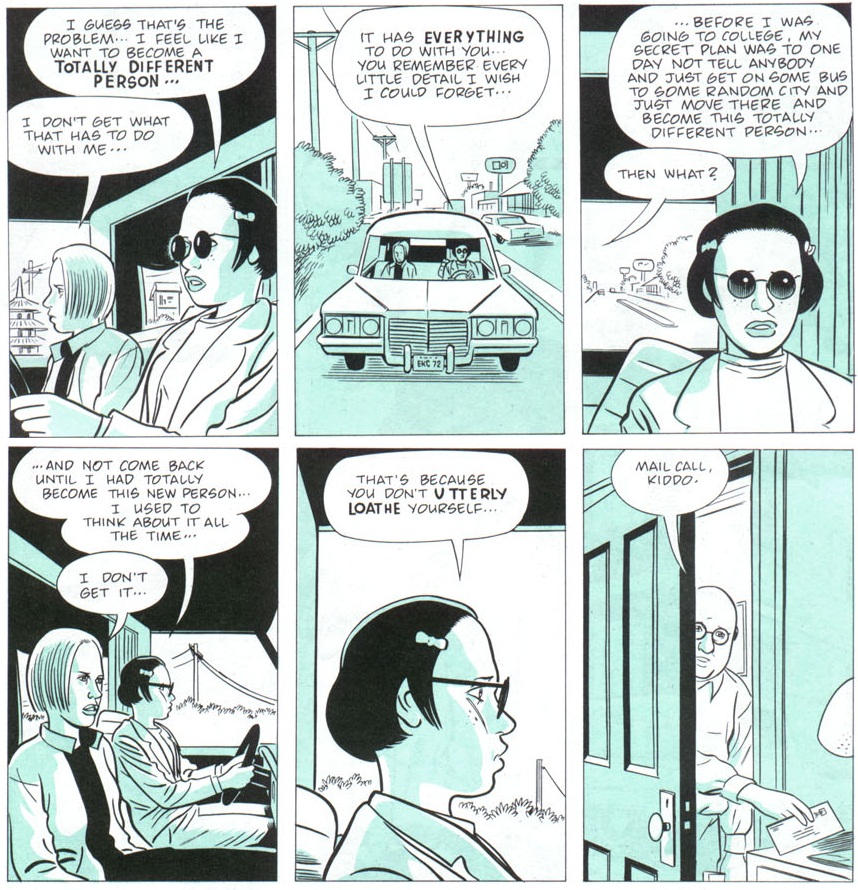
Ghost World, by Daniel Clowes

The problem with being relatively new to a medium is catching up on all the 'Cannon'. I think Ghost World is quite comfortably in that zone. It tells the story of two off-beat, intelligent and acidly sarcastic high-school friends who are languishing at home, not really knowing what to do next in that awkward phase where it feels like your childhood is over, but your exciting, exotic adult life seems kind of slow to get going. Sometimes it's too many options that freaks a person out, sometimes it's the lack of any options at all and sometimes it's the very idea of an important decision.

Enid Coleslaw is cynical and impulsive and best friend Rebecca Doppelmeyer is more mainstream; blonde and responsible, with less anger and resentment. Together they spend their empty days wandering around their anonymous American town full of strip malls, burger joints and record stores, slagging off popular culture and making fun of the people they encounter while contemplating what they will do with the rest of their lives. As the story begins, they are inseparable; they know all of each other's embarrassing stories, crushes and sexual encounters, all of each other's secrets and histories. They speak every day and depend on each other for support with pretty much everything. There's something incredibly self indulgent about them, a lack of attention to consequences and effects. It's a last fling with youth, and it's very bittersweet.

A love triangle of sorts emerges between the girls and their mutual friend Josh, an easygoing lad whom they enjoy teasing and sparring with. They both seem casually interested in him, but also playfully entertain the notion that they might be gay. For fun, if nothing else. Themes of identity are pretty important to the book. The idea that identity is flexible (Enid goes through many, many looks and claims to loathe herself) and that it can evolve over time. 

As the story unfolds Enid and Rebecca start to develop tensions over boys, ambitions and life in general and they drift apart. Enid thinks perhaps she'll go to college. Becky isn't sure. Everything that once seemed solid doesn't look so stable anymore. The friends struggle to build identities separate of one another, until the day that it finally happens and the intimacy they once shared is gone. 

The artwork is a really classic black, white and turquoise-y green that gives it a really stark appearance, but really helps to anonymise the town, to characterise the identity swapping Enid and create a really mundane world. It's not fussy and it allows the reader to focus on the characters and their lives.

It would be quite easy to dismiss Ghost World as being morbid or bitter, but I think there's something pretty universal about it that appeals, and not just to the ennui-leaden. It's about change, really. How inevitable change is and how confusing it is when it happens. Everybody has that friend that they thought they would be friends with forever, but who drifts off into obscurity, and that's really relatable. It's not an uplifting read, but it's clear that there's a future for them both, and potential. And that's about the best one can hope for.


Wednesday, 11 February 2015

Trouble, by Non Pratt

Trouble is the story of 15 year old Hannah Sheppard, an ordinary year 11 girl that's currently grappling with physics and French, spending her weekends getting drunk with her mates at the park and flirting with anything that moves. Joining her as co-narrator is Aaron Tyler, the mysterious new boy who transfers, suspiciously, in the middle of his GCSEs to Hannah's school. He's promised his parents he'll try to make an effort to make friends and be normal, but he just wants to keep his head down and get through year 11. It's obvious he's running from something, but he hides his secrets well.

Hanna's normal teen life goes up in a haze of smoke when she finds herself pregnant, single and in quite a lot of trouble. An embarrassing situation for the daughter of a Family Planning Nurse. The book follows her through her pregnancy as she navigates the minefield of hormones, antenatal classes and English Language exams and learns some choice lessons about loyalty and friendship. Not least when Aaron, whom she has slowly been growing close and closer to, steps in and untruthfully declares himself the baby's father. Or "Her fake baby daddy", as Hannah likes to call him.

I loved seeing Hannah and Aaron's relationship develop- they're so different as people but both have such bravery and strength. They're incredibly compelling characters and it's evident from the start how much they need each other to battle through their teen years. They both have secrets that they're withholding, but it's not the mystery of these secrets that keeps the reader enthralled; it's the characters. The dual narrative is brilliant and works wonderfully. Each character has an identifiable voice and personality- you don't really needs the names or the use of a different font for each character as you can tell them apart easily. Hannah is sarcastic and chirpy (until she realises she is pregnant, obviously) when she becomes kind of nihilistically droll. Aaron's intelligence and heart show through his narration easily; he's wonderfully cynical and manages to be mature and naïve at the same time. He has a strength of character that is a joy to read and both of them genuinely made me laugh out loud. I loved just how recognisable and mundane their everyday dilemmas were; parents that care too much it seems like smothering, flaky mates, being too fat to retrieve your flip-flops...It's so easy to feel like you know these kids and you've either been there or are currently going through something similar.

An honourable mention has to go to the supporting cast too; supporting in every sense too in this case. Dirty Old Man Neville was a creation of comedy genius- it's nice to see that some of life's most valued and most trusted friends crop up in strange circumstances. Ivy, Hannah's nan was just the nicest and most supportive Nan ever; she held everything together the whole time. Little sis Lola was adorable too. Trouble proves that minor characters don't need to be cardboard cutouts. Hannah's family felt believably dysfunctional and flawed, and as characters they were incredibly well developed- just enough, choice details, leaving the reader to fill in the gaps with bits from their own families. Genius.

For me there were two main things that really stood out of this book- one is how dead-on the representation of teenagers is. It doesn't try too hard to be gritty or sexy, it's just normal. Teens reading this will instantly recognise pretty much all of the characters and a great many of the situations they find themselves in. Adult readers will just be glad they're not a teen anymore, because ugh. Like The Inbetweeners, this book shows that teens are not some mysterious, unknowable sub-species of adults, but they are quite often scared, usually under pressure from somewhere, insecure and bit lame sometimes. Pratt really nails the language and behaviour of real teens- it doesn't try too hard to use slang and texting or anything like that, which so often unravels a book- but the cringes, the cliques and the schoolyard politics are referenced enough to be real, but subtly enough that it's not actually about being a teen. It's about growing up and facing your responsibilities and that usually happens long after teen-dom. The other thing that I actively noticed whilst reading is the tightness of the structure. The prose never seems sparse, far from it, but there is no fat to be trimmed at all. The plotting is tight and punchy and never for a single moment does the reader wonder why this paragraph exists or why this character is mentioning this event, or what the point of this character is. There's no dead weight at all and I think for a debut novel that is pretty remarkable.

To sum up Trouble then; it's an incredibly tightly written, compelling story about making tough decisions and growing up instantly. There are some excellent, memorable characters and it's consistently (very) funny and moving. I loved Hannah and Aaron, loved how they developed and what they managed to do for each other- it's not a morality tale and it's not a fairy story either, it's a genuinely touching story about families and friends sticking together and being supportive.
 It's not by accident that it's been nominated for everything; the Branford Boase, the Carnegie Longlist, the YA Book prize either. Brilliant- I'd recommend to any readers over the age of 14 (because it's a bit sweary in places and a bit TMI in others- not unrealistically, but y'know. Some things you don't want to be explaining to a year 7...

Tuesday, 27 January 2015

The Girl on the Train, by Paula Hawkins

Girl on the Trian cover
I'm not normally a crime or thriller reader, but this book has been absolutely everywhere this January so I thought I'd see what all the fuss is about and give it a go. Radio 2 have chosen it as one of their Book Club choices and Mr Mayo is normally on the ball when it comes to spotting a future bestseller.

The premise of this book fascinated me. Rachel, the Girl on the Train, passes the same row of houses every day on her commute from Buckinghamshire to London. Stopping at a signal, her stationary train normally looks out into the gardens of the street where she once lived with her husband Tom. He lives there still with his new wife Anna and their baby. Unable to look at her old (and only real) home, she instead focuses on the one a few doors down, home to a beautiful, happy couple she names Jess and Jason in her head. She daydreams about their perfect lives, their blissful happiness and their fulfilling jobs. One Friday she catches a glimpse of something that shatters her daydream- and the following day 'Jess', real name Megan, disappears.

Rachel's memory from that Saturday night is non-existent. She knows she was there when Megan disappeared, she was on that street; there was blood (hers?), the underpass, a woman in a blue dress and a train man with red hair that keep emerging, confused and hazy in her mind. Convinced that 'Jason' (who turns out to actually be Scott) would never harm the wife she imagines he was devoted to, Rachel goes to the police, determined to give them the information that she has. They dismiss her as an unreliable witness; at best a desperate rubbernecker, at worst a drunk with a malicious revenge motive on her ex husband's new family.

The narrative is split between three women who all speak in the first person. Mostly it's Rachel; she struggles with alcohol and jealousy, is prone to drunk dialling and harassment and suffers from huge, gaping blackouts. Her lifestyle is depressing and unflinching- the stair-vomit, the urine soaked jeans and boozy oblivion makes her a fairly unusual main character. We also see from Anna's perspective- her baby bliss, her frustration at having the husband's ex hanging around all the time, the gooey isolation of new motherhood. Finally we see from Megan's angle in the months up to her disappearance and the conflicts and struggles she undergoes in her own head.

I liked how frustrating Rachel was as a character. She's self-destructive and pathetic, depressed and quite spiteful at times. But she gets better. As the book goes on, more of the more seemly characters are revealed to be less pleasant than they appear. The more Rachel finds out about Megan the less she likes her. The more the reader hears from Anna, the more she seems a smug, troublemaking little madam. Scott and Tom, the husbands, get less charming as the chapters go on. The author really does a good job of showing that relationships, people's very identities are unstable and built upon ever shifting sands. Even the most well-loved, most familiar individual in a person's life could turn out to be somebody else entirely, an absolute stranger.

Whilst this was a well paced, engaging narrative with some interesting characters and probably a good example of its genre, I can't say it made a huge impression on me. Personally I struggle to enjoy this type of book. It's not just about the emotional/physical abuse that's common in the domestic thriller genre, the gruesome deaths of women and the (often) debauched criminality of ordinary-seeming men- I can live with that. It's more about the predictability of the narrative. I guessed where this book was going about half way, I guessed pretty much exact reason for the disappearance of Megan too. Can a plot be predictable and yet still feel like it doesn't quite fit? I don't know.

Anyway- it's perhaps unfair for me to say that I don't go in for thrillers/crime and then say that I didn't hugely enjoy this book because it was one. I'm sure it's a really good thriller and that loads of people will love it. I'm glad I read it. It offers something new in its bedraggled, alcohol soaked amateur detective that actually probably hinders the less than thorough investigation, and will enjoy a massive readership I'm sure. The writing was good. I believed in (most of ) the story and the characters, and nothing stood out as being massively expositional, no annoying overuse of particular words (a pet peeve of mine), the novel kept up a good pace and really drew attention to the reality of the domestic situations of some women. I don't doubt for a moment that there aren't people out there who have realised that they've been lied to and manipulated, put in horrific danger by the people that are supposed to love them and then blamed for it. All in all, it was probably a good book, but it's not for me.

I still love the idea of life glimpsed through a moving train window though, the filling in the blanks in the lives of strangers.