Showing posts with label War. Show all posts

Thursday, 3 November 2016

Broadway Book Club Discussion of All the Light We Cannot See by Anthony Doerr,

Everyone in attendance had enjoyed the book; we talked about the readable, engaging prose style, the interesting central characters and the fact that Occupied France and the campaigns on the Eastern Front as World War II narratives that seem to be less common.

Most people agreed that the interweaving of the two plots  was well managed and each strand was equally interesting, but that the jumping backwards and forwards in time and location added nothing to the book. We thought that a chronological narrative would have been easier to follow and would have told the story just as competently. We could never remember if Werner was in the basement of the hotel, in the Orphanage, on the Eastern Front, back in the basement again or at Nazi school because it seemed to change too often and didn’t feel particularly consistent.

We talked at great length about how well the author portrayed the gradual rise to power of the Nazis and how sympathetically Werner and Frederick (poor, poor Frederick- he confirmed what happens to people that don’t fit the fascist mould)  were depicted despite technically being Nazis. How Germany was ruined after the First World War, its citizens struggling to survive- then jobs began to emerge and prosperity gradually returns, thanks to these apparent saviours. People are eating meat again, manufacturing is thriving and gradually more opportunities become available…a frenzy of nationalism emerges, where you are either part of the frenzy or an enemy of the state. We really felt for Werner, whose intelligence and ability bring him to the attention of the Party and he is taken away for training at the most horrific soldier school. We talked about how many ordinary Germans there must have been that were either indifferent to the emerging Nazis or quietly opposed to them, but how ineffective and dangerous this opposition must have been- so they just went along with it. It’s frighteningly familiar. One day it’s not defending a neighbour or keeping quiet when a foreign accent is derided. Pretty soon you’ve got full blown fascism and we all know the rest of that story.

We talked a lot about the book’s other characters; we loved the PTSD suffering Etienne, trapped in his house with the badass resistance leader and long-time maid Madame Manec. The impressive, brutal super-German Volkheimer, a legendary, ruthless giant that trained and posted with Werner. Though he seems so unsympathetic, we really felt for the post war Volkheimer who had sank from Nazi notoriety to a solitary, grim anonymous life of a radio installer. We were universally disgusted by the gross gemologist von Rumpel and his disgusting overflowing neck fat and his obsession with the Sea of Flames

We discussed the diamond and all the coincidences that it had encountered since its ejection from the earth- unable to decide if it was a supernatural object or just another reason for people to fight each other through history- another trinket to own. Fate, coincidence and free will are pretty consistent themes throughout the book , exemplified quite well via the mysterious diamond.

It was a really enjoyable book that prompted a lot of discussion about the tragedy of war, good and evil, doing the right thing, virtual and literal entrapment and the generally interesting things about the French Resistance and other lesser known aspects of the Second World War. We seem to know all about the Blitz and Evacuees and D-Day, but it’s easy to forget the hundreds of thousands of other stories that exist of that time.

Tuesday, 19 January 2016

In A Land of Paper Gods, by Rebecca Mackenzie


Born in China to British missionary parents dedicated to saving the souls of the Chinese peasantry, Ming-Mei is bundled off at the age of 6 to the Lushan school. Perched on a staggeringly beautiful misty mountain of spiritual importance, Lushan is a boarding school for the children of British missionaries, somewhere that offspring can be conviniently stored whilst the parents are off continuing God's work. Despite most of its pupils being being born and raised in China, Lushan is strictly English, and Henrietta S. Robertson is to be Ming-Mei's name from now on. She is to learn to be a good Christian so that she too can grow up to bring the Gospel to the more overlooked and remote corners of the globe. The main section of the novel opens in 1941 and concentrates on Etta's story from the age of 10.


A wildly imaginative daydreamer, Etta is somewhat alienated from her dorm-mates, many of whom are quite humourless and pious; middle aged women in little girl costumes. She craves attention from Dorm mistress Aunty Murial, a young Scottish missionary who takes the girls on brisk mountain walks and paints their portraits in watercolours. Etta immediately strikes the reader as an incredibly lost and lonely girl, adrift from her idolised parents (snapped like the symbolic red string of Chinese departure custom) and noticeably different from the other girls. She is desperate to be special, revealing herself a prophetess in direct contact with God and subsequently she sets about making prophecies, declaring the others Prophetesses too (Hark, it is the Lord's intent) and unknowingly laying the foundations of tragedy, trouble and ostracism. From the very beginning she suffers from a bit of an identity crisis; she is Etta to her peers, Henrietta to the Lushan staff, Samantha the Prophetesses during the days of the Prophetess club, self declared 'Mother' to Twelve, a local toddler she befriends and Ming-Mei when outside of Lushan. Whilst Etta as a character is mischievous, funny and strong willed, her identity is paper thin and is constantly being switched and altered.

I really liked Etta as a character, her voice was incredibly strong and full of life and humour. Yes she makes some bad decisions, but she's been so unguided and left to find her own route through her most formative years. Her imagination gets her into trouble; good intentions have tragic outcomes. The other girls are curious about her vivid games and she has no trouble enticing them to join in, but they're lightning fast to point the finger when things go wrong, quick to declare her fantasies 'silly games'. She's a very vivid person, full of plans and ideas, she climbs trees, gets her knees dirty and indulges in mean thoughts about people then worries for her immortal soul. I especially liked her clashes with Big Bum Eileen, Dorm A's queen bee and unofficial opinion-influencer. So chosen because of her burgeoning womanly figure, Eileen is bossy and eager to see Etta ridiculed or punished, safe in the knowledge she has the backing of the rest of the weak-minded girls. It was not difficult to Empathise with Etta, born into a doctrine she appears to have no heart for, left to fend for herself, fighting it out with the other girls for the approval and affection of Aunty Muriel. I like that she went her own way and pleased herself, no matter how much trouble it got her into, or how unpopular it made her

I loved Mackenzie's descriptions of the wild peaks of China, the lush forests and the living mountain, the mists, waterfalls, crumbling temples and the delicate flowers. I loved the idea of the 'Thin Places' where people are spiritually closer to the other world. Lushan, for all its strange evangelical inhabitants, seems like paradise. It makes the war, gathering pace around them, seem all the more remote and impossible, until it is right at their door. When the war arrives and evicts the staff and the children from their home, Etta has to grow up rapidly. The third portion of the book shifts the narrative to a Japanese civilian interment camp and we see a child's eye view of malnutrition, black markets and berri-berri, which reminded me a little of The Narrow Road to the Deep North, only without the building of the railway. Interred with the rest of Lushan's staff and students, the only relationships Etta has ever known crumble; Aunty Muriel is now just Muriel, no longer her guardian, she is now someone who looks after the sick, her Dorm mates are now just 'other girls'. She's no longer a pupil, not really a daughter. She's totally on her own.

With its themes of religion, identity, war, isolation, displacement and being caught between two vastly different cultures, I was really impressed with In A Land of Paper Gods and thoroughly enjoyed reading it. I loved Mackenzie's mystical and evocative prose and her Huck Finn-ish protagonist, a parent-less girl left to navigate the boundary between right and wrong. I found that the structure of the book really worked too; the inclusion of a few pages from Muriel's diary were really interesting additions as it showed how repressed she was, how much she cared for her girls but wan't really supposed to show it. Muriel became a much more rounded character during her time in the Japanese camps, when she stopped being a Missionary and became a survivor. It's such a compelling and haunting story, part coming-of-age, part love letter to China, part boarding school tales. The second Sino-Japanese War is an interesting and eye-opening backdrop, an era and a War that I didn't even know happened and seen from the perspective of a child, it's fascinating. 

Tuesday, 3 November 2015

Broadway Book Club Discussion of The Half Blood Blues, by Esi Edugyan

About half of us in attendance managed to finish the book, some citing a grating style of prose as the reason for abandoning, some were unmotivated to continue by the lacklustre plot and characters. Those that did finish found it a bit of a chore, and hadn't enjoyed it hugely.

We thought that the setting was fascinating and loved the idea of getting a glimpse into the lives of black and mixed race Germans/Americans living in soon-to-be-Nazi Germany and how difficult life must have been, but we felt that the story itself wasn't really worth telling and we felt that it wasn't executed particularly well. Jazz is often presented as a sort of magnet for social oddballs, drawing people in from society's fringes, so thematically it married really well with between-the-Wars Berlin, which apparently attracted lots of renegade fringe artists and musicians at that time. It was commented that the writing style was quite unconvincing and Sid’s vernacular was a little slapdash- one member remarked that the prose was an odd and inconsistent mixture of literary and patois which was off-putting. We thought the author was probably an excellent historian, who painstakingly researched the era and crafted the architecture of Berlin and Paris very well, but forgot to add enough foreground. Being a good historian doesn't necessarily make a good storyteller.

As far as the characters go, I think confusion and dislike were most prevalent. Sid in particular won no fans- while I myself mostly felt sorry for him, many others found him thoroughly dislikeable, bitter and jealous. Overall we found Sid to be a generally terrible person, Chip to be a huge liar and Heiro to be a massive contradiction. The Heiro of the novel's beginning (chronologically the end) seemed to be a totally different person to the Heiro that was in the rest of the novel. In the beginning, he seems like a reckless and headstrong young kid whose stubborn desire for milk leads to him being seized by the Nazis. The Heiro in the rest of the novel is a shy, naive protégée who barely speaks two words together. It just didn’t add up. In a similar sense, many of us struggled to get the timeline in order- the jumping around from the 1930s to the 1990s was easy enough, but the order of events in the 1930s became a bit muddled and we were never sure how long certain scenes went on for (were they hiding out at the club for days? Weeks? It was hard to tell)

One member (who it has to be said, was the only person present that knew anything about Jazz) found the Jazz of the story unconvincing, particularly the way the characters cut the record, and the way the characters appeared to have no training or context, they just popped up out of nowhere. We also agreed that the presentation of the Jazz musician’s lifestyle seemed a bit stereotypical, which disconnected us further from the characters.

We discussed the appearance 2/3 of the way through of Louis Armstrong and how disjointed this felt within the narrative. We agreed it was unconvincing and incongruous for a real-life figure to pop up amongst fictional creations. We felt this might have worked better if this character was a new creation inspired by the real life Louis, rather than randomly inserting him into the narrative. In an already hazy book, this attempt at blurring the line between fiction and reality just didn't pay off.

We discussed the ending, (for those of us that got to it!) and concluded that it felt rushed, too keen to tie up the loose ends. Apart from being slightly unbelievable, it felt odd. We just couldn't believe that Chip, a generally unpleasant character didn't have an agenda for seeking out his long-thought-dead friend. We also though Hiro would have been considerably more angry at Sid’s revelation.

In conclusion. we felt that it focused too much on the love triangle and jealousy element, and kind of forgot about the musical and social elements of the story. One member described it as Hollyoaks meets Fear & Loathing in Nazi Germany, which just about sums it up! Though there were some compelling scenes (mostly fleeing Berlin and Paris) and some characters that we really liked that died or disappeared early (Paul, mostly) I think it was a resounding ‘Meh’ from most of us.

Friday, 28 August 2015

Finding Home; Real Stories of Migrant Britain, by Emily Dugan

This morning (28/08/2015) the first two stories in the news were the following:
1) That a refrigerated lorry found abandoned in a layby on the Austria/Hungary border contained the partially decomposed bodies of at least 70 'migrants'.
2) That two boats have sunk off the coast of Libya, which combined, are thought to have been carrying up to 500 people escaping Bangladesh, Libya and various sub-Saharan African countries.

What's even worse is that barely a week goes by without several headlines like this. Migration, immigration, illegal immigration, asylum seeking, whatever you want to call it, whatever terms news outlets are using the dehumanise and scaremonger, this book is a welcome, truthful and unflinching look at the lives of the people that are trying desperately to find a safe and secure place to live their lives.

Finding Home looks at the unique stories of 10 individuals- something which in itself is unusual. Every day we're presented with images and footage of teeming masses of people, crowds scrambling over razor wire, desolate canvas ghettoes full of women and kids, masses of heads and shoulders poking out of the top of a boat that looks like its most buoyant days are behind it- we rarely look at the individuals. We never really get to find out what's brought these people to this point? What are they escaping and what do they hope to find? Has anybody asked? We're told benefits and an easy life, but that's really, really not the case with most. It's not always war, it's not always work, it's not always a choice. What I love about this book is that it makes individuals out of that teeming mass, the 'Plague of migrants' that our media condemns as work-shy scroungers and criminals, it presents them as humans. It's unflinching in its honesty and it really makes the reader think about what they'd do in these people's shoes.

Journalist Emily Dugan features stories from the following people, creating portraits of individual people who are all struggling against different obstacles to call Britain their home.

  • Ummad, a student at Sunderland Uni from a wealthy business family in Pakistan. The branch of Islam followed be he and his family is considered heretical in Pakistan, and his family are in constant danger because of this.
  • Harley, an Australian children's psychologist and NHS expert with 10+ years of service, facing deportation after the breakdown of her marriage to a European.
  • Clive, a homeless Zimbabwean that entered the UK illegally and has spent the last 6 years trying to go home. His lack of passport makes this impossible. He can neither work, nor recieve citizenship either. He is stateless.
  • Physiotherapist Hristina, leaving behind her baby in her beloved home country of Bulgaria, came to the UK with her husband in order to be able to provide a better life for her family, as low wages and high living costs make this impossible in Bulgaria. She misses home and her family every day.
  • Syrian refugee Emad is a political exile due to his setting up the Free Syrian League. Though now having refugee status, he previously worked illegally to fund his mother's visa-less passage out of Turkey into the EU. She was also in danger due to her son's infamy but getting into Britain is just the beginning of the battle.
  • Sai is a Thai woman married to an older Glaswegian man. Even Harry, her Scottish husband thinks he would fail the UK citizenship test.
  • Hassiba came from Algeria to be with her Husband who had settled in the UK. A promising geneticist, the only work she can find in the UK is mopping the floor of a kebab shop. She is unenamoured with Britain, struggling to cope with the racism, grim weather, lack of opportunities and the drug culture of her estate.
  • Aderonke, a prominent LGBT campaigner from Manchester who would've been murdered for her sexuality in her home country of Nigeria. The Home Office did not believe she was A) gay, or B) in any danger if deported.
There are also two more general case studies, one looking at the town of boson in Lincolnshire, an example of thoroughly mismanaged immigration, resentment by locals of the town's Eastern European reinvention and botched integration, and a trip on a coach from Romania to London on the day the Romania/Bulgaria workers' restrictions were lifted. 

It's hard to summarise these stories, but I just wanted to give an idea of the range of reasons that people leave their homes, families and lives, and the range of reasons that take them where they end up. Ummad and Emad in particular have harrowing histories- both just want an education and to be able to live by their own conscience and moral compasses, but dominant ideologies in their home countries make refugees of them, and make tragic messes of their families.

This book is honest and so eye-opening. I don't know whether it made me feel grateful for living in a (comparatively) liberal and secure society, or enraged at the way our government treats anybody who didn't have the foresight to be born within the UK's borders. I couldn't decide if Britain was a safe haven, and pleased that it was such, or a nightmare of bureaucracy, arbitrary rules, underfunded departments struggling to process paperwork, judgement and persecution. Each of the stories was so different, experiences so varied that it was impossible to decide. The Home Office are sometimes the saviours, sometimes the villains. That idea of duality cropped up a lot- the idea of being a bit of both. Two nationalities blended together, or both, or neither. Polish dad Karol watched an England vs Poland football match wearing a Poland shirt and an England scarf. It must be a huge blow to the identity to find yourself living overseas.

I liked the book's thoroughly level headed approach to its subject. It doesn't make all 'migrants' out to be glorious saints, toiling hard at the jobs that the British turn their noses up at- it does not omit any jail time its subjects might have served, addictions, any debt that they are in, any mistakes or bad decisions they have made are presented as honestly as any triumphs they have achieved. It does, however, show the resilience and determination of people that are often persecuted or judged for simply living somewhere else. Despite the isolation, depression, separation, trauma and everything else that many of these individuals had escaped, I had to admire their attempts to start again.

This book couldn't be more important. Or more topical, or more timely. Every person that has ever rolled their eyes at a Polski Sklep on the empty end of their high street needs to read this. Every person who has ever uttered the phrase 'Go Back to Your Own Country' needs to read this. Everybody that has ever complained about delays on the Eurotunnel needs to read this. If you're a person with an ounce of empathy, you need to read this. I will be recommending this book whenever I get UKIPped, whenever the topic of immigration comes up and whenever anybody asks me for a good non fiction.

Thankyou to Stevie Finegan (@SableCaught) for bringing this book to my attention, and for sending me a copy.

Thursday, 27 August 2015

The Narrow Road to the Deep North, by Richard Flanagen

I've had this book since the Booker Shortlist was announced in 2014, so almost exactly a year, and having read 4 of 6, this was one of the ones that I just sort of...never got around to. To be honest, I was inexplicably uninterested in reading it- possibly for its immensely boring cover, possibly because of its POW themes...possibly because my knowledge of Japan is non-existent and I thought I'd be uninterested in it. Anyway, it was chosen as a monthly read by my bookclub and my internal thoughts were "Urgh...well, at least you already have a copy". I can't believe how stupid last-month me was.

The narrative starts in a sort of hazy dream, but settles down to reveal an aged Dorrigo Evans and his sleepy thoughts alighting on his childhood on the island of Tasmania, school, various unimportant conversations he remembers and on Amy- a woman we will later learn was his Uncle's wife with whom Dorrigo had a short but intense affair; a woman with whom he shared an almost supernatural connection. We learn that elderly Dorrigo, a curmudgeonly, womanising drunk, is now considered something of a celebrity, a nationally celebrated war hero and aged but leading figure in the medical world. The story jumps between the modern day, Dorrigo's time as a POW, his post-war experiences and, briefly, the post-war experiences of some of the Japanese and Korean army personnel and guards. The latter is an interesting perspective, as the defeated forces try to justify and defend their war time actions as inevitable, commendable even.

The book is a harrowing story about allied prisoners of war slaving on the deadly Siam-Burma railway. 12,621 Allied POWs died during the construction of the line, and as many as 90,000 local labourers. The Pacific campaigns of the Second World War remain more obscure than their Western equivalents. Everybody has heard of the Battle of Britain and the Normandy Landings and Stalingraad, but the Pacific War seems forgotten- my history isn't the best, but I couldn't say how Japan even ended up in WWII. The Narrow Road to the Deep North chronicles the life of Dorrigo Evans, a promising surgeon turned soldier that finds himself trying to work miracles out in the unceasing rain and mud of the Pacific jungles after he is captured. With no food, no medicine and no equipment, treating the prisoners for a tropical diseases full house of cholera, dissentry, malaria, malnutrition, ulcers, starvation, exhaustion, beri-beri is next to impossible. Although, British and American engineers had declared the notion of a railway in the locality impossible too, and that seems to be happening sure enough...As the most senior ranking allied officer, it also falls to him to lead the men, preserving their spirits as best he can and keeping them together. Though considered a great hero, leader and remarkable man by his troops, Dorrigo fails to find leadership qualities in himself, acting the part he believes people expect of him. He watches his friends and colleagues waste away and die in the most horrific conditions, knowing that there is nothing that he can do.

Conditions in the POW are hellish, and the treatment that the men are subjected to at the hands of the notoriously cruel Japanese Imperial Army is barbaric. Out of the thousands of prisoners that pass through the camp, most arrive severely ill or dying. Those that arrive fit and healthy slowly succumb to jungle maladies due to the poor hygiene, bad diet and sustained physical exhaustion. Forced to work 12 hour days, sometimes nights, with blunt hand tools and manpower alone, on little sleep and next to no food, the Japanese engineers demand faster work, quicker progress, despite the ever dwindling number of men and their rapidly deteriorating physical condition. Most die. The author really captures the unending toil and the impossibility of the task and the scale of the suffering. as the death toll spirals and men start to die faster than the remaining prisoners can burn them.

Flanagan's prose is simply beautiful. It's rich and full of grace, and some of the lines sing at you. Sometimes they sing of horror and death and everything that's awful in life, but the words sing. The imagery is gorgeous, and some of Flanagan's turns of phrase are so arresting that you go back and read the same line three times; I love how he conveys the sounds and humid heat of Tasmaia, the sea breezes and secluded hotel rooms of Adelaide...and less beautiful but no less sensory, the hellish, mudslide horror of the Burmese jungles, the stench of disease and the pain of survival. It's an emotional whirlwind of love and loss, duty and performance and a sensory explosion.

The cast of prisoners that populated the camp was brilliantly crafted, each of them, with enough personality to feel like a blow when they died. Individuality amongst prisoners feels life defiance and by creating such characterful inmates, it kind of felt like they rebelled against the anonymity pressed on them by the oppressive mud and the regime of the Japanese. The names are brilliantly Australian; Darky Gardiner, Sheephead Morton, Rooster MacNeice, Bonox Baker, Lizard Brancusi, I really liked Dorrigo too, flawed as he is. Despite his infidelity, his lies and his detached and manipulative personality in later life, he is always aware of his faults. He berates himself for not being a leader, for losing men, for failing to stop them dying. In reality he does all he can (that amputation scene will probably haunt me forever) and it's the guilt of survival that he feels- he just uses that pain to hurt those around him. I liked the strength he showed as POW and how his refusal to succumb to the Japanese brought some sense of comfort and rebellion to the prisoners. It's sad that he lacked purpose so much after the war- drifting into a loveless marriage and too unsure or too conventional to pursue the things that would've made him happy. He really shows how thoroughly war ruins a generation, that coming back in one piece is just the beginning.

The book sweeps the reader along so there is no time to dwell on the swirling and intertwined themes of guilt, all the different kinds of love, the conflict of being a good man and a terrible man all at once, the price of survival, family, legacy, what it means to be a hero. There's so much going on in this novel, and it's all tied up in a gripping and harrowing story about survival and dealing with what comes after it. I liked that Dorrigo hates being a hero, hates humility and praise. I suppose what he really feels is guilt- because it was luck and hope that let him get old enough to grow to hate heroics, not anything more than that. I found the final blow near the end to be affecting and quite emotional (even if it borders on the side of improbability).

So, in conclusion, I can't believe I waited so long to read this. I found it to be an incredible read; a harrowing but beautifully told story of the horrors of war and the consequences that live with soldiers for decades, the hangovers that last for generations after conflict. I'm so glad it got chosen as a Book Club read, or I might have dismissed it forever.

Tuesday, 21 April 2015

A God in Ruins, by Kate Atkinson


A God in Ruins, the furiously anticipated sister novel to one of 2013's best books is out at last. Here the reader revisits the Todd family of Fox Corner and delves this time into the life and times of Ted, the second youngest of the brood. The narrative jumps back and forth through the 20th century honing in on different periods of Teddy Todd's life. In Life After Life various versions of Ted go off to fight in the Second World War, always waved off at the station by various versions of his sister Ursula. Some scenarios see him safely home, some see him lost in a downed plane on a bombing raid.

Ted recounts some events of his life more fondly than others but it's difficult to tell how he feels about his life- he's of the generation that bottles up feelings and sees no sense in regret or complaint. We see him during the war and his time as a RAF bomber pilot; his idyllic childhood at Fox Corner with his sisters; his uneventful marriage to the stoic Nancy; extreme old age; the inception and adventures of his alter ego Augustus; his cantankerous elderly years as he's ferried from sheltered living to care home; the years he spent as a single father, struggling to raise his wayward only child Viola; we see him bickering with a middle aged Viola, taking care of his abandoned grandchildren as she swans off on yet another hippy world-saving crusade...

The book not only fills in the gaps in the life of the prodigal son, but it expands it too, as he outlives most of the characters that we are familiar with. Ted has led an ordinary post-war life of kindness and quiet contemplation, appreciating nature, trying to love his family, forgiving the Germans and living silently with the guilt and turmoil of his war deeds.The narrative also slips occasionally into other family members' stories. Nancy becomes the narrator in a few chapters, as does daughter Viola (late middle age) and grandson Sunny (as a child). It's interesting to see such a familiar, beloved character (beloved by the reader as well as his adoring family) seen through the eyes of a daughter that seems so angry and disappointed with him.

Essentially it's a story about complicated families and making mistakes, then living with the consequences of the decisions we make. In many ways it's the antithesis of its sister novel. Whereas Ursula had many chances to change the outcome of her life, consciously or not, Teddy is stuck- torturing himself by wondering what he's done wrong in his lifetime. The choices he made and all the 'what if's that might have existed. All he ever did was his best for the people he loved, but it's second nature to second guess. I never got the impression that Ted led a melancholy or regret-filled life, he just never seemed to be able to reach the potential that a background like his suggested. Perhaps the war ruined potential for a whole generation.

I did enjoy this novel, but it I didn't feel myself spellbound in the same way as with Life After Life. With absolutely sky-high expectations, it was going to be difficult to pull off a sequel to what is probably one of the best books in the last two decades, and that always skews things slightly. Atkinson's prose is as luminous as ever, conjuring up so many memorable images and scenes- she writes so beautifully and with such emotion and understanding. Whereas the previous book allowed the reader to decide which life Ursula truly lived (or whether she lived them all in fact, over and over) this book seemed, in comparison, to settle on too definite a course. Until it was all was  possibly called into question. All those wonderful uncertainties that made Life After Life  so unique and so unforgettable were decided on in this book. We know what happened to Ursula- she was a civil service worker and never married. We know what happened to Teddy. Pam. Winnie. Nancy. All of them. I'm afraid that I found the various episodes of one life to be less enchanting than a myriad of versions of another.

I think really, if I'm being fussy, I would ask why A God in Ruins truly needed to share characters with Life After Life. I think I would have liked it more if the same story were told with a new cast- another RAF veteran who had other sisters and lived somewhere else. There could have been cameos, he might have flown a few times with Teddy Todd...After all, RAF bombers are something featured in many of Atkinson's books- the War scenes were some of my favourite from Behind the Scenes at the Museum. There's a lot of distance between the AGiR and LAL books, but some links remain. I would've felt better, I think, if those links were severed entirely. But that's just me. It's still an incredibly absorbing and emotional read.

Wednesday, 25 February 2015

Girl at War, by Sara Nović

Girl at War is a powerful and brutal debut novel that tells the story of a young girl's coming of age and her struggle to make sense of her shattered identity. Everything- family, home, friendship, belonging- is touched and shaped by the Yugoslav wars, no matter how much peacetime elapses.

Beginning in Zagreb in 1991, narrator Ana Jurić is a cheeky, scampish 10-year-old, living with her parents and sickly baby sister in a small but love-filled apartment in Croatia's capital city. She spends her days furiously cycling with her best friend Luka (whom 10 year old Ana assumes she'll marry), playing football and generally being carefree and inquisitive. But 1991 is the year that civil war breaks out across Yugoslavia, shattering Ana's blissful childhood. Normality is eroded by rationing, hunger, stories of 'fallen' towns and cities, air raids, snipers and sand bag walls. As unease begins to settle in amongst the different ethnicities in the neighbourhoods, suspicion and danger grows daily and Ana and her family need to take dramatic, dangerous risks just to have a chance of survival.

Skipping forward, the story picks up Ana's new life as a University student in 2001 New York. Witnessing 9/11 from Manhattan itself she's convinced that disaster and death will follow her forever. Despite passing for a legitimate American and having spent over half of her life in the States, America has never felt like home to her. Ana can never escape her memories of the war and the traumatic events of her past, no matter how much she tries to move on. She keeps secrets from her tutors, from her boyfriend and even from her sister, the sickly baby rescued by aid workers and raised almost entirely in the US. Struggling with her identity, coming from a country that no longer exists and having lived so long an outsider, Ana makes the decision to return to Croatia after a decade away hoping to feel a sense of home at last. She's craving answers- what happened to Luka? To her parents' friends? To her city? She lands  having never technically set foot in Croatia before, tasked with the impossibility of coming to terms with her nation's turbulent history and the events that splintered her childhood and destroyed her family years before. 

Jumping periodically between 1991 and 2001 and gradually filling in the horrifying gaps in Ana's life, Girl at War is a frank, generous and beautifully lyrical novel that shows how history makes irreparable impressions on an person, but does so in a way that isn't overly sentimental or sensational. The prose is gorgeous and it flows seamlessly; it's violently upfront in places, but glows with warmth and nostalgia in others. All through the novel the author really captures the confusion and the brutality of such a recent war, the fact that it was all televised too. It seems insane that such horrific war crimes could have been committed so recently, yet still be consigned to history. It's the year Beauty and the Beast came out for crying out loud.

I found the voice of Ana to be so compelling and I was just staggered by her continuous strength. As a child, she's a roguish, rough-and-tumble, barefooted Scout Finch type that really demonstrates the invincibility delusion of young children, as well as their adaptability. To Ana the war is barely a reality- yes it's altered her life somewhat, some people she knew have gone away to fight, but she normalises things quickly and just gets on with her life. Even when the most horrific things happen to her, she runs and she survives, doing what she needs to do. The brutality and the horror that she experiences is shocking, and the character's strength and bravery is unbelievable. Not because she's a hero or a savour of any type, she's not really exemplary in any way, but she's able to carry on which is remarkable. Nović does an incredible job of showing what effect war has on the anonymous civilian, the normal, everyday people that survive and have to live with their memories forever.

This is a brilliant, brilliant book- it's hard to believe that such accomplished writing can be from a debut novel. Whilst the story can't be described as enjoyable as such, it's absorbing and urgent and brilliantly told, and it's impossible to put down. It left me feeling quite guilty of knowing so little about a war that happened in my lifetime, and staggered by what survivors must have gone through.

Enormous thanks to Susan de Soissons @Savoy67 at Little, Brown Book Group for the review copy. 
Girl at War is out on the 21st on May 2015

Tuesday, 4 November 2014

Azzi In Between, by Sarah Garland

Azzi In Between
If you're under 10 it's a picture book. If you're over 10 it's a graphic novel. Either way, however old you are or whatever you want to call it, this is a remarkable book.

The story starts in Azzi's small but comfortable whitewashed home in an unnamed, war-torn county. Azzi jumps over the rubble to get to school and helicopters and gunfire fill the air, though for a while the war seems to have no real impact on Azzi's life. Until the day her family is forced to flee at a moment's notice and fight to board a tiny boat that they desperately hope will sail them to safety.

Disembarking in an unfamiliar Britain and living in a single room, Azzi's family struggle to adapt to their new life. They miss the Grandmother they left behind, their familiar home. The food and the language are unfamiliar- Azzi's father becomes depressed because he cannot find work. The family's immigration status is unsettled. Azzi goes to a local primary school and has a helper that teaches her English. She too has fled her home country. It's a story essentially about the ability of the human race to pick themselves up and carry on, and is a testament to the determination and bravery of immigrant and refugee families.

The author and illustrator of this book has created a beautiful story about family, hope and resilience which is a wonderful story in its own right. But what she has also done is create a story that can teach thousands of children and adults about the plight of the refugee. The displacement, the fear and struggle that would seem so impossibly alien to people in Britain. It's a story that could be given or read to real-life refugees to ease them into their new lives and to provide familiar, relatable stories.

I love how much of the story comes out through the images. We see Azzi's family hurriedly packing up their belongings in their colourful, attractive house painted in vibrant colours and detail- then we see them living in a drab single room, coloured in greys and beige. So much of the narrative can be inferred by the pictures alone- the colours, the composition, the expressions and body language of the characters. The art is so expressive. A non-English speaker would not struggle at all. A brilliantly told, beautifully executed story about lives that seem so unfamiliar and so distant. Sarah Garland never patronises or preaches, she handles the subject with compassion and understanding.

This book made me feel lucky that I have never had to experience anything like what the main character and her family endured. It made me want to find out more about normal, everyday life in war-torn locations and how families and individuals cope with living in conflict zones. It made me understand why people go to impossible lengths to make dangerous journeys accross the English Channel and other sea-borders.

Monday, 28 July 2014

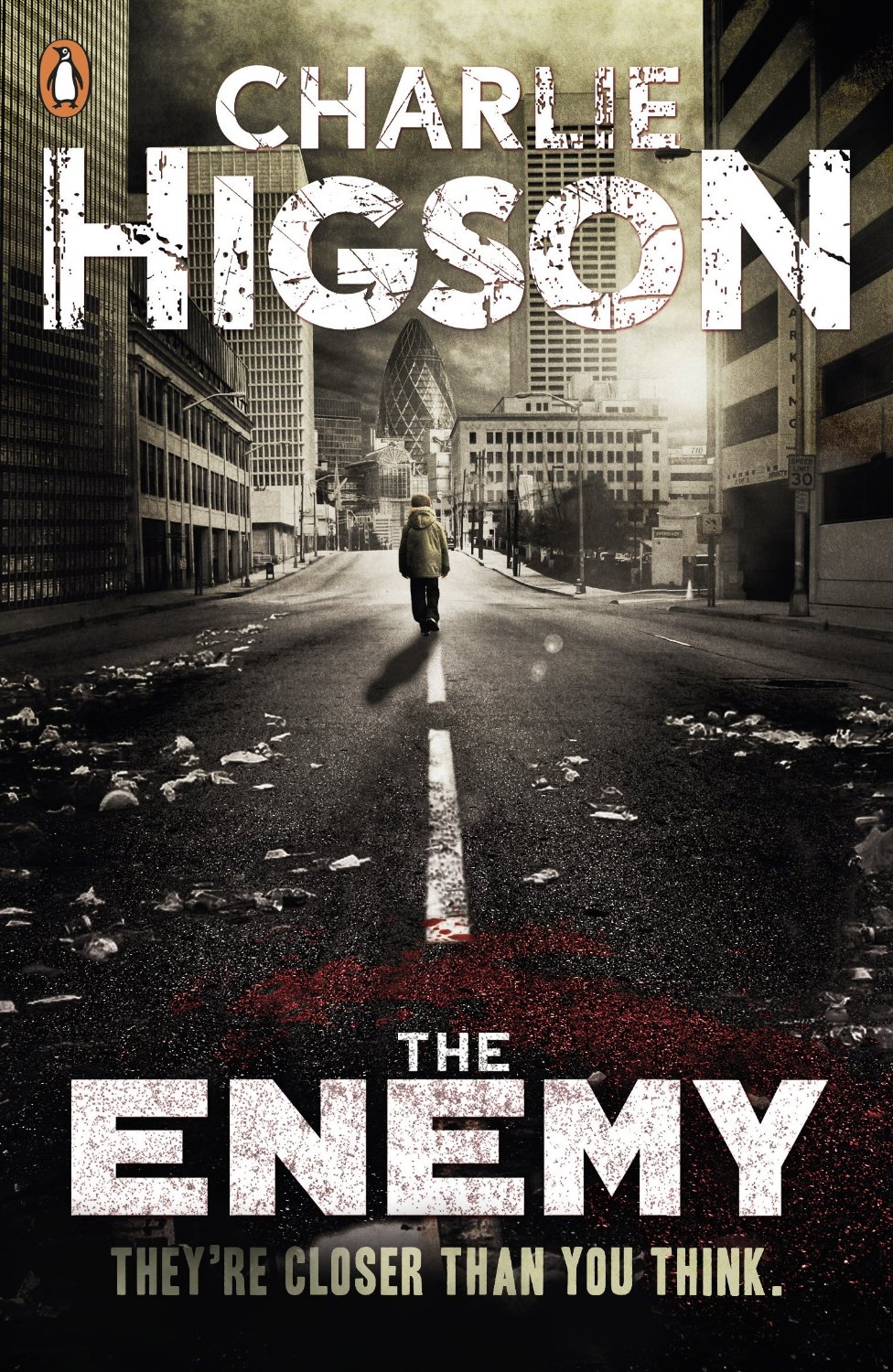
The Enemy, by Charlie Higson

I got so engrossed in this novel this summer that I actually sustained some of the worst sunburn I've ever had in my life- bubble blisters and the lot- because I couldn't put this book down. Now there's a testament if ever I heard one.

The Enemy is set in a post-apocalyptic London after a global epidemic of a horrifying sickness has reduced all people over the age of 14 into flesh-eating monsters. The remaining children have formed small bands of survivors all over England in an attempt to fend off the attacking adults and to increase their chances of survival. The story follows a group of survivors based in a Waitrose store, led by 13 year old Aaran and his right hand woman Maxie. They are becoming increasingly worried about the apparent increase in the intelligence of the attacking adults, they are getting smarter and they're picking off the little kids more easily. Waitrose is not going to sustain and protect them for much longer.

It's a brilliant combination of The Walking Dead and Lord of the Flies. But British, and with YouTube. How do kids cope in a world without adults? What if there are adults but they're fatally hostile? It's an action packed struggle for survival against the odds and against the people that are supposed to look after you, with additional themes of belonging, security, leadership and responsibility and the battles for power and dominance which have no age restrictions. 

Charlie Higson is such a brilliant, brilliant story teller, switching between the main Waitrose group (later allied and merged with the Morrison’s group) as they make their way across the grown up infested streets of London to the rumoured safe zone of Buckingham Palace, and the solo journey of Small Sam, snatched by the adults and taken to the Arsenal stadium as he makes his way to find them at the palace. The groups learn fairly quickly that safety always comes at a price, and in this case that price is manipulation and dictatorship. 

Higson looks at both the best and the worst personality traits that emerge in times of trial- it really is the only real way to ever discover what type of person you truly are. The leadership skills that only really reveal themselves under immense pressure, loyalty, cowardice, villainy and greed. Higson really does a brilliant job of distinguishing between those who want nothing more than to survive in modest security, and those hell bent on domination.

Each section ends with a breathless cliff-hanger and features all manner of escapes, rescues, battles and alliances. What I appreciated most of all was that none of his characters are bullet proof, which so often happens in survival fiction. There are characters that the reader is certain will survive that are killed off- nobody is safe. I love that Higson doesn't shy away from really going to town on some of the deaths, the gratuitous gore and some of the impossible decisions that these 12 and 13 year olds have to make. He's so good at creating these sympathetic, put upon teens that are just trying to keep their flocks together. He also has a brilliant knack for striking exactly the right balance between funny, horrific and the familiar things that modern teens will relate to. It all contributes to that horrible authenticity of the scenario.

It's a breathless, tense start to the series that really examines the nature of responsibility and leadership and the temptation of seizing control when the opportunity presents itself. Thoroughly engrossing, believable and full of genuine horror, I enjoyed it hugely and will definitely be reading the rest of the series. I am an absolute sucker for survival apocalypse stories, and this is such a brilliant take on the zombie genre.

Charlie Higson being a dude. https://www.youtube.com/watch?v=1jUXsJOlmoY

Wednesday, 9 July 2014

Ghost Hawk, by Susan Cooper

Ghost Hawk, Susan Cooper, CarnegieGhost Hawk begins with the father of the story's narrator journeying to a secluded marsh island in pre-colonial New England to wedge the loose blade of a tomahawk into the cleft of a Bitternut Hickory sapling. He knows that when he returns 11 years later, the tree will have grown into a strong handle for the tomahawk; a gift for his new son. 11 winters later, that son, Little Hawk, takes that tomahawk into the forest for his three-month winter ordeal of meditation, solitude and survival that to his community represents the transition from boyhood. Some individuals do not return from the forest. Those that do return as men.

However, Little Hawk's time on Earth coincides with the arrival to the New World of white settlers from Europe, bringing with them their disease, their greed and their charters and laws. Little Hawk's ancient way of life, and the way of life of all the other tribal American Indian villages is under threat from these settlers who mistrust and persecute the natives and alter the country's landscape beyond recognition.

Little Hawk tries to help out a white settler during a terrible logging accident  and as a result, his fate is tied forever to that of young John Wakely, a boy he'd met some summers ago. Together, Little Hawk and John learn about each other's cultures, fears and behaviours in an attempt to build bridges between their communities, but as the years roll on, intolerance, prejudice and fear play bigger and more important roles in the narrative of the New World.

I really enjoyed the setting of this book- I love the idea of natural, wild America, untouched by European tools and boots. Cooper writes beautifully of the wilderness, the mood of the natural world and the seasons, and the Native characters' love for and respect of their world comes across brilliantly. I just wanted to savour that environment, knowing now that it no longer exists. I really warmed towards Little Hawk during his coming of age trip, his resilience and intelligence shone through and the reader gets a good insight into the conscience and upbringing of the character, even though one book will never be enough to understand Native American culture or life. I liked John too; we follow him through his seven year apprenticeship to a Master Cooper, his own community's idea of the journey to manhood. John grows to be a morally resolute  man, outspoken in the face of prejudice and inherently peaceful. He sees the hypocrisy and the extremism of the religious leaders around him and chooses to distance himself, to find somewhere where he can live the life he wants.

The book feels well researched, at least there are a lot of names, dates and events that match up with historical accounts. The author did a good job of creating the feeling of the bustling and expanding "civilisations" of Providence and Boston as they grow rapidly from small settlements to towns and the behaviour of the people in them felt believable and realistic. I think it was a nice touch that the first white American generation, those who've never seen Europe, were so different to their parents' and grandparents' generations that sailed the Atlantic for a new life. And also that the Native tribal leaders that have been born after the white settlers' arrival vary greatly from their predecessors. More suspicious, more affronted and faster to retaliate in both cases. I think the behaviour of colonials will baffle me forever.

Towards the latter part of the book I felt it lost its way a little as the narrative shoots forward in time and the lives that have been so skillfully entwined throughout the book begin to diverge slightly. I really liked Little Hawk as a narrator, though he fades away towards the end as the world becomes so divorced from the one he knows. I was a bit disappointed that John Wakeley, now a grown man, couldn't merely be a benevolent supporter of native Americans, he had to be the saviour of them too. That post-rescue gratitude had no need to exist really- it felt a little bit of a betrayal of the naturally trusting nature of John's character.

In summary though, this is a well written story of friendship and bravery that's eye opening and skillfully crafted. Though there are flaws with some of the themes and events, it's still a wonderfully written book that questions the nature of certainty and righteousness- it makes the reader wonder if life might be simpler if the human race was a little more flexible and a little less certain.

Friday, 9 May 2014

The Undertaking, by Audrey Magee

Peter Faber, a Nazi solder on the Russian front marries a photograph in a ceremony conducted by an army chaplain. Hundreds of miles away in Berlin, Katherina Spinell marries a photograph of the soldier. They meet for the first time when the lice-riddled Peter is given honeymoon leave in Berlin. Leave for him, a widow's pension for her in the event of his death. Also the possibility of a new German baby to continue the empire, which obviously every German has the God-given right to produce. Expecting a marriage of convenience, both Peter and Katherina are surprised by the strength of their attraction to each other and the passionate intensity of their relationship. After his leave, Peter returns to the Eastern front with Katherina's promise that she will wait for him.

This book handles the idea of trial by separation (and subsequent proving of the marriage bond) in an unusual way. Peter's promise to his new wife protects him, gives him a reason to drag himself outside in the morning and the courage to shoot Russian old ladies and drag screaming children from their homes because he's doing it to create a better world for his wife (and eventual child). But the reader is constantly aware of the fact that his marriage is a lie really, part of the Nazi agenda.

I've read narratives featuring Nazis before, but almost always these stories feature the politicians or soldiers. Magee writes of the ordinary people in Berlin, sitting out the war and hoping for the best. Not Katherina and her parents though. All fully buy into the Nazi ideals, swallowing propaganda as gospel and believing themselves entitled to whatever they like simply because they are German. They're vain, greedy and shameless social climbers. Her father, Gunther is an associate of the notorious Doctor Weinart whose mysterious nocturnal business involves raiding the homes of Jews and deporting them, taking the spoils for himself and his circle of friends. Katherina's family grab greedily at all the privileges and tidbits that the Doctor offers them, basking in their raised positions.

The style is sparse, detached. Functional. The narrative places the victims at arm's length so the shootings, pistol whippings and the cruel evictions are experienced through the eyes of the German soldiers, simply tasks to be done, obstacles to remove. They complain among themselves of the frustration and discomfort of being stuck in Russia, but it's mixed in with their intense feelings of pride and elation at the thought of being national heroes, expanding the reach of the great German Empire one meter at a time.

This novel made me wonder at the motivations of German soldiers (or pretty much anybody that decides to fight a war for a cause). Does an individual lace his boots and pick up his gun because he truly believes in the cause he is fighting for? Or does he eventually condition himself to believe in the cause to justify his war atrocities? To explain his behaviour and absolve his guilt? And with the Nazis in particular, did they ever doubt themselves? Did the party news of victory after victory, of triumph and entitlement ever seem even for a moment to be too good to be true? Peter and Katherina both suffer horrifically, and it's almost possible to feel sympathy for them at times. But their suffering does not change them as people, merely makes them bitter. They seem to really believe that they were right.

I really enjoyed reading this book. The eastern front from an Axis perspective is a voice that I've never experienced before and the dialogue heavy structure gave the narrative a detached immediacy. It was horrific at first, but the reader quickly becomes hard to shock. It's just the way of war. Peter and Katherina could be anybody. The narrative does not go into their inner worlds too much, but sticks to descriptions of their movements and widely-held opinions. It is not a very personal story at all and that is what makes it so thought provoking.


Tuesday, 22 April 2014

Watchmen, by Alan Moore and Dave Gibbons

My Graphic Novel education continues with Watchmen. I'm not a massive superheroes fan, and haven't seen most of the DC/Marvel films, so wasn't really sure what to expect from this. As it happens I enjoyed it immensely and it leaves the reader with a hell of a lot to think about.

Watchmen is set in a sort of alternate future (possibly 1980s?) New York. From the drab, graffiti filled streets and the uneasy aura of depression and fear that infects the location and its inhabitants, it's not hard to surmise that it's not a happy place. In this reality, superheroes emerged in the 1940s and 1960s to national fame and adulation, helpfully assisting the United States in its Vietnam victory. Nowadays tensions are rising once more and the USA are on the verge of nuclear war with the Soviet Union. Hence the unease. Freelance, costumed vigilantes have been discredited and outlawed and many of the former superheroes so decorated and applauded in the past are either in hiding, retirement or working for the Government. Think the concept of Pixar's The Incredibles, but set in the oppressive world of Batman's Gotham City.

The plot starts with the murder of a government-employed superhero. His death pulls the remaining superheroes out of retirement in order to investigate and to prevent themselves or their colleagues from being the next victim. Each of the former heroes has to come to terms with their altered place in the world and many of them struggle with their responsibilities to themselves, each other and to the public. Some hanker for the thrill of the chase, some believe they were never truly themselves out of costume. The novel spends a great deal of time developing the unique traits of the characters, giving them motivations, heroes, backstories and inner conflicts. This is done in a variety of ways; through interactions with each other, flashbacks and most effectively through miscellaneous documents that are injected into the narrative. These include ephemera (favourite word alert) such as extracts from characters' autobiographies, newspaper articles, interview transcripts and so on. Watchmen definitely suggests that the life of a superhero is more guilt driven duty than heroism. Personally I found the fictional documents structure really added a great deal to the plot- it gave it more depth and really allowed the reader to understand the complexity of the characters and their seemingly impossible daily conflicts.

The way that the book mirrored real life, but took a few well selected alternate paths was excellent. I've no doubt that's why the tension and the unease was so strong and the fear so prevalent. Most noticably, rather than developing nuclear weapons during WW2, in this reality the US accidentally created Dr. Manhatten, a radioactive superhuman that can pare the world back to its elements and sees all of time at once. He's the main cause of the US/Soviet tension and the only true suerhero in the novel. It was genuinely interesting to see a character with all the Universe's secrets be so disillusioned and sulky.

I loved the structure of this book, its murky purple/brown/red palate and how clever and thought provoking its messages were. The recurring images (the blood soaked smiley face, the five-to-midnight clock, the intertwining of the narrative with the horrific fictional comic Tales of the Black Freighter) really effectively contributed to the sense of time ticking down. It always felt like there was some huge, disastrous even that everything was building up to, a nihilistic speeding towards the inevitable from the very beginning. It's rarely as simple as good versus evil, and I think that that awareness is perhaps what elevates Watchmen over much of its comic series contemporaries. It's having a bit of a dig at the superhero concept, as well as commenting on the ethics of scientific progression, weapons development and the cost and effect of fame. Questions are asked about the validity of war, and the price of peace and for that conflict alone it's worth investigating. Brilliant stuff.

Thursday, 27 February 2014

Life After Life, by Kate Atkinson

Life After Life begins in November 1930 with Ursula Todd pointing a gun at Hitler in a crowded pub. She pulls the trigger. Darkness descends. How has this happened? Who is this woman? How will history look without the evil shadow of Hitler looming over it? From the first page this novel asks questions, and it doesn't always answer them.

Ursula is born on the 11th of February 1910 as the snow falls outside, barring the doctor's way to the house. Within minutes of birth she is dead, strangled by her umbilical cord before she could take her first breath. 11th of February 1910 again. Ursula is born, but a pair of scissors are standing by to cut the cord. Each time Ursula dies during this novel, this is where it starts again. Fox Corner, blanketed in snow. A fresh start for another life and another story to be written. Some elements are the same on each occasion and marginal differences shape the way that life is to be this time.

I love Atkinson's style of prose- it's gently atmospheric, sweeping the reader through woodlands and regency revival dining-rooms, the comforts and fashions of a large Edwardian family of the upper middle class. Her family will prove to be one of the most crucial constant forces in Ursula's many versions of life. Maurice, her brother is always cruel and cold, sister Pamela always opinionated and strong. Her little brother Teddy is everybody's favourite, sweet and loved by everyone. The reader really gets a sense of 'home' from Fox Corner; the love of the family, the abundance of nature. It's a happy place and the warmth shines through, anchoring Ursula to the World in every life she lives.

Death comes in a variety of ways for Ursula throughout the course of the novel, as "Darkness Falls" at the end of each section. She is reborn to die and die again, always starting on the same snowy night in February. She drowns on a beach, slips from a frosty roof, and dies of Spanish flu in the post War celebrations. On her 16th birthday, a naive Ursula is raped on the landing by one of Maurice's friends. Pregnant, she is shunned by her mother and flees to London for an illegal abortion. This Ursula, subjected to unwanted sexual attention from a colleague, wonders if there is something unseen to her but obvious to others that attracts this kind of behaviour from men. This section was beautifully and heartbreakingly written, highlighting the downward spiral of a woman crippled by low self-esteem as a result of abuse. It makes it clear that it can happen to anyone. Lonely and ashamed she turns to drink for comfort until the illusion of love comes along. Another betrayal, Ursula is married to a misogynist and a liar.

In another life, Ursula avoids the rape. Empowered, feisty Ursula lives abroad, has affairs, a daughter in one case, adventures. In others she is embroiled in Nazi politics. Repeatedly bombed in the Blitz. I loved the Blitz section; the assembly of characters that Ursula lived and worked alongside in the 1940s provides so much colour and life to the destroyed London. The attitude and the stoicism of the Wartime Londoners comes across beautifully and each event that befalls Ursula is written with sensitivity, a degree of charm and in some cases a fatalistic resignation. This section feels exhausting, infinitely dangerous and its presence overshadows the rest of the books somewhat. Interestingly, the Blitz leads down some very different paths to similar deaths. The skill of the storytelling in this section is incredible, all the loose ends tied up in the repeated fates of sometimes strangers and sometimes acquaintances in London.

I absolutely adored this book. I could not cram the words into my eyes fast enough. Beautifully written, full of engaging characters and a truly heroic protagonist. It's part family saga, part historical whilwind and it's dizzyingly impressive. I love the idea that even chance encounters and happenstance can have enormous, often fatal effects on the course of a life. The idea too that sometimes our lives are determined by our choices, sometimes it's the choices that others make that affect us and sometimes it's the lack of choice that leads down a certain road. Everbybody has those "What if?" moments in their lives. Sometimes it's not until time has elapsed that you realised how much of an impact certain past decisions have made to turn a life in any given direction...

Ursula is semi aware of her position (in some lives) occasionally feeling intense dread at pivotal moments when her paths diverge. She has disturbing dreams and Déjà vu, remembers things that never happened. This is woven beautifully into the philosophy and the behaviour of Ursula who seems dimly aware of the power of this prior knowledge. I love the partial awareness she has of her opportunity to live life again and the action she takes to steer her course, however better or worse it may turn out. The reader is really in quite a powerful position, able to see from their vantage point the web of choices available to Ursula and the ultimate end point of each of these paths. Thought provoking, immersive and incredibly well written with immense skill, warmth and craft.

Loved it. Everybody should read it.

Any Human Heart, by William Boyd

Where do you start with a book this good? I could not drink this in fast enough, a whirlwind of history, art, literature, love, life, chances and embarrassment. An incredible biography of a fictional man. Absolutely stunning. The novel takes the form of diary entries, sometimes philosophical or nihilistic, sometimes blunt and upfront. Logan is a man of many moods and opinions and this comes across in his journals. Sometimes dated, sometimes not, depending on where he is in his life. An omniscient and anonymous narrator links the parts together as best he can, where Logan has been inattentive in his continuity.

The intimate Diaries of Logan Mountstuart start with Logan as a child in Uruguay, the son of a Beef Products manufacturer. His family move to Birmingham and we witness his East Anglian school days with his friends Peter Scabius and Benjamin Leeping, their bets and wagers designed to spice up their dull academic lives. They will appear regularly through the rest of it. Then to his unremarkable time studying History at Oxford, where Logan falls in love with the mysterious Land Fothergill and decides that his future lies in writing.

He writes. A biography of Shelley and a sexy novel, some translations of obscure French poets. He drifts from literature to journalism, to the art world, to literary criticism, enjoying a modest amount of success at each. The art scenes of London, Paris, New York. Battles of wits with Virginia Woolf, meetings with Joyce and Picasso in Paris, then a spell as a civil War reporter in Spain and acquaintance with Hemmingway (getting three Miro canvasses out of it too). Barbados, Ian Fleming murder and the Duke of Windsor. The War lived out in a Swiss prison. Logan spends so long waiting for his life to begin, waiting for it to get more exciting, more important. It's not until he gets to the latter stages of it that he realises it was important. He knew real love once, and losing it does not take away that memory.

The Jazz era, the War years, the post war, then the psychedelic 60s all come alive, bringing with them their important cultural who's-who that wend their way into Logan's life. All depicted with such conviction, historical accuracy and believability, that at times it's incredibly easy to forget that Logan Mountstuart wasn't a real person too. "Surely not" you think as you read this, "He must have existed and merely been forgotten by history". Logan as a character is a dream. At times arrogant, at others crippled with self-doubt and embarrassment. His respectable exterior and modest professional success disguising his slides into alcoholism and adultery and his grim bouts of depression. Every year ends in a roundup of friends lost, resolutions to drink less and finish that novel he's planning.

Boyd skilfully (sooooo skilfully it's almost painful) weaves the eras of Logan's life together, creating a person that is flawed, but always always interesting. He drifts apart from his family, rarely sees his children, or any of his ex-wives. His solitary life gets a bit grim, at one point he goes from a respected professor living with a staff of four and a villa in Nigeria to existing in a basement flat living on dog food and flogging political newspapers to students. But his fortunes prove that poverty, good luck and greatness can happen to anyone. Even the formerly grand Mrs. Mountstuart descends from wealthy widow to dishevelled landlady on the few occasions that her son visits her. We see that poverty has claimed her too.

I can't possibly even begin to describe the scope of this novel. It's an absolute gift. Absorbing, intimate, funny, tragic, life affirming- the whole human condition lived out in one remarkable life. The prose was absolutely joyous and the tableaux of domestic family life, scandal, political upheaval and personal disaster that it painted were beyond immersive.

Monday, 27 January 2014

Stories of World War I, edited by Tony Bradman

A collection of short stories from some of the best children's and young people's writers in the business. Between them, the stories look at World War I from just about every perspective imaginable; the underage enlistees that sign on the dotted line looking for adventure and a ticket out of their home town; the wives, mothers, sisters and children left behind; the men in the trenches; the women on the home front; the broken men that return to their families; the Germans, who had a pretty terrible time too; the soldiers from the Imperial countries who have been shipped in to England to serve the Empire. The book really captures what a global conflict the Great War really was and seems to appreciate the deeply personal and devastatingly unique effect it had on every individual that fought, and every individual that didn't. 

Some of the stories use WWI as a backdrop to address issues as diverse as race, exile, patriotism, class, political unrest and everything in between. None of the authors glamourise, defend or justify the War, they just seek to communicate the horrors of the trenches and the front line, the pain of those left behind and the difficulties faced by all involved, the numbness of those that returned and the holes left behind by those that didn't.

The characters and perspectives are varied, forming a true cross-section of those involved in the conflict.  All stories are easy to read, tailored to the YA audience- many of the narrators are 17 or under, telling their own War experiences.  It's easy to understand the early motivations of the naive, the uninformed and those with no options, and it's easy to empathise with them, knowing that they think they are doing the right thing.  There are a lot of female characters, narrators and voices, so the anthology doesn't feel at all like it is targeting a specific gender.

Though the tone of the anthology is informative and emotional, the stories don't feel exploitative or filled with any sort of political or ideological agenda.  It's respectful and somber and in places it's darkly funny and full of the type of human spirit that always seems to shine through in times of enormous trial or hardship.  A really well put together collection of narratives that do an excellent job of conveying the tragedy and the impact of the Great War.

Tuesday, 21 January 2014

When the Guns Fall Silent, by James Riordan

Published in the centenary year of the Great War, this novel handles the commemoration of a historical event like this in a sensitive and respectable way.  It is thought provoking and shocking to see the events of 1914 through young eyes.  The tone is not celebratory or bombastic, but respectably applauds the hope and the spirit that can be shown by individuals even under the most atrocious circumstances.  There's a sort of gently shocked disbelief that something as tragic and as mindless as this could ever have happened.

Set in 1954, 50 years after the end of the Great War, When the Guns Fall Silent sees Perry and his grandfather visiting the War graves in Flanders. After finding an old photo resting on grave of a long dead friend,  Perry is taken aback when his Grandfather speaks for the first time of his experiences in the war and he begins to tell his story of the conflict and the famous Christmas ceasefire that resulted in one of the most famous football matches of the 20th century.

Jack tells the story of his and his best friend Harry's pre-War football prospects, their underage sign up, the horror of the trenches and the miserable months spent in waist deep mud, all the senseless killing.  But he also remembers the incredible, impossible moment that the guns fall silent and the Germans and the British forces joined together to celebrate Christmas, to swap stories, songs and trinkets and to turn the body-strewn, frozen cesspit of No Man's Land into a football pitch for one day.  Jack recalls to Perry how it was on that day that he realised that the regular German people, shipped unwillingly to France and Belgium to rot and to die had no more quarrel with the British soldiers than he had with any of them.  They were all fighting somebody else's war.

The bookending of war narrative with present day (well, 1954) action contextualises the events, makes the lasting effects of war evident.  The style of the novel is simple, emotional and evocative- 17 year old Jack does a good job of documenting the experience of a "soldier" with zero previous experience.  He's confused and fails to understand the reason behind the blind, meaningless hatred they are required to show towards people they don't even really care about.  Jack has more humanity than that and sees the German forces for what they are- scared boys a long way from home, just like him.  His narrative is clear, full of pain and suffering and horror.  He watches his childhood friends die one by one, recounts his sometimes hopeful, sometimes bitter letters home to his sister and describes in thorough detail the day to day conditions in the freezing trenches.

I also really liked the decision to include some original War poetry at the beginning of some of the chapters- snippets from famous poets such as Rupert Brooke, Rudyard Kipling and Ezra Pound that set the tone for what's to come as the narrative unfolds- they tell such similar stories of death and despair. The book strikes a good balance between the speculative, fictional elements and the first hand experience of the poets.  The author also includes poetry from those left behind and translations of Russian and German poetry, reminding the modern reader that poetry of the first World War was not something unique to the British and providing stories and experiences from different perspectives.

The dual appearance of football in this novel, I think, is going to make it a bit of a hit with non-reader boys.  I get a lot of requests for football stories, and I think this is a really satisfying, thought provoking one.  The book presents football, in times of peace, as the pinnacle of normal- it's the weekly event that brings towns together to hope and celebrate and applaud.  The parallels between football and War are drawn, but it's not something that's pursued to any great extent.  It's also evident that even in times of war, football is a common ground, a great equaliser, still capable of inspiring hope and celebration.

Wednesday, 30 October 2013

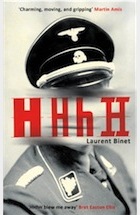
HHhH, by Laurent Binet

Another Broadway Book Club choice, HHhH I can only describe as uniquely annoying. I can't even decide what my overall feelings about it were, they swung from admiration to hatred so frequently.

HHhH (eventually) tells the story of Operation Anthropoid, a daring assassination attempt on the life of super-Nazi extraordinaire Reinhard Heydrich in Prague during World War II. The part that has a narrative follows the history of Operation Anthropoid, picking up a few historical strand from elsewhere as it rolls along, and looks at the lives, histories and circumstances of heroic parachutists and would be assassins Jozef Gabčík and Jan Kubis.  Binet is also careful to pay proper tribute to all the Czech and Slovak civilians that risked their own necks and the necks of their families in the name of resistance and paid the price.

I felt like I learned a lot from this book- did I ever mention how bad my history was? I didn't know Russia was even *in* WW2 until I played Call of Duty: World at War. Not my strong suit. The diplomatic and social history of the now non-existent Czechoslovakia is really interesting, as is the history and the career of one of the only men who can claim to be more evil than Hitler. Apparently it was Heydrich that masterminded and executed "The Final Solution" towards the end of the War. His several nicknames (The Blond Beast, The Hangman, The Butcher of Prague) don't really do justice to the absolute walking ball of evil that was Heydrich.

But what of the annoyance? Well. Throughout the entire novel, Binet bemoans the fact that all historical novels are riddled with painful inaccuracies, speculation and embellishment. And so they may be. But it's not of particular importance to the people that read them. Binet seems torn throughout- he is obviously an indisputable expert, borderline obsessive about the story of this particular mission. Should he have just written a factual book about Operation Anthropoid? I think he should have...I think he would have been happier with that, maybe he would have felt that he was doing a greater service to his heroes.

HHhH is insanely thoroughly researched, you have to give him that. But to constantly berate the concept of fiction, to make your hatred of literature (both with and without a capital L) known repeatedly throughout- I think, just antagonises the reader. I like fiction. That's why I'm reading whatever this book is. A non-fiction novel? I dunno. Just don't make out that your story, or your information, or whatever it is is too noble, too worthy or just far too important to stoop to the murky depths of fiction.

Half of the book is the story of the assassination mission. This is very good- expertly told, informative, full of heroism and suspense. 25% is Binet moaning about fiction, the inaccuracy, the embellishment, the speculation, the unworthy authors that have smeared his precious fact. 25% is a biography of the book. It's like Binet is a character in a book who's currently writing a book about Heydrich's assassination. He talks about his trips to Prague, to museums, to cafes. He talks about his girlfriend, his friends, his father.

It's unique, it's unusual.  Binet's obviously a gifted storyteller, which is what makes his attacks on the concept of fiction so annoying.  Is he being ironic?  Is he saying that nobody can ever know for sure what happened in the annals of history, but he knows more than most, and though he hates embellishment he's going to embellish anyway and then moan about it and we'll never know where the history ends and the fiction begins?   I honestly can't tell if I liked it or not, but it was certainly interesting.