Showing posts with label Nonfiction. Show all posts

Friday, 27 March 2015

H is For Hawk, by Helen Macdonald

Part memoir, part self help book, part literary criticism and part nature book, H is for Hawk is a beautifully written story of grief and dedication, of obsession and nature. When lecturer Helen's beloved father dies unexpectedly, she does not know how to react. There is no right way to react, no best way to cope. How Helen copes is by deciding, suddenly and irrefutably that what she needs is a Goshawk, a fearsome killing machine and notoriously strong willed and difficult breed of hawk. She drives all day to meet a guy by a Scottish dock with £800 in an envelope and leaves with a box full of feathers, sharp points, muscle and fear.

What follows is her story of struggle and hope, of dedication and discipline. It looks like it's going to be a battle of wills, a war between woman and nature. But it doesn't feel like it. Yes there's an element of battle- but it's more of a teaching process than a conquest, the hawk learns to hunt, to return when called. She learns how to be around strangers and dogs and not to be terrified of everything. It feels like a series of lessons that teach a lost and hurting person how to be a human again. But first she needs to learn how to be a hawk.

Mable, as the hawk becomes, is one of my favourite animal characters of all time. I loved how Helen's falconry attitude allowed her to have a character. She's never a pet, never a true companion, but there's a wild, mutual respect and dependency that develops that I've never really read about before. There's a lovely bit where Helen plays catch with Mabel and is astounded that Goshawks play. The book is definitely full of surprises.

Helen becomes a recluse, weeks, months go by that see her purposely avoiding people. She draws the curtains, fills her freezer with dead chicks and shuts the world out. It's hard to tell if this is a part of the falconry process or the grieving process. Perhaps there's no need to separate them. Mabel is the solution to her isolation as much as the cause of it.

I loved the style of Macdonald's prose- she writes about nature beautifully and with such attention. This book made me want to go for a long walk in a forest and deep-breathe some good nature air. She punctuates her own story with parts of the life of TH White, author of The Goshawk and Sword in the Stone. His inexperienced and disastrous attempt at raising and flying his own Goshawk, Gos, contrast with Helen's researched and practiced methods, but he never seems evil, just misguided and a bit useless. But she makes mistakes too- overthinking things, getting neurotic, getting desperate when things don't work. It's a narrative about perseverance and hope as much as anything else. I admired her strength enormously. I think this context grounded the memoir, it made us understand more about Helen and her drive, as well as more about the ancient art of falconry.

I could go on...but I don't want to spoil it too much. H is For Hawk is, in short, a beautiful, complicated and in parts baffling story about coming to terms with loss and refusing to be defeated, and loyalty and nature. It's about so many things, and it's an absolute joy to read. Lyrical and mystical and honest- there's no wonder people keep throwing prizes at it.

Broadway Book Club Discussion of H is For Hawk, by Helen Macdonald

Though there were only four of us for this discussion, it was a pretty lengthy one and there was a lot to talk about! We loved the style of Helen Macdonald's writing- she had such an acute eye for detail and description and the feel of the environment.

Comments about this book were overwhelmingly positive- we thought it was an accurate and very personal story of grief and depression. One member pointed out how surprised she was at how little Helen's father featured in the book, how little she talked about her memories of him, like the author wasn't permitting herself to think about him. We talked for a while about the surprises that loss brings and the things that bereaved people still find themselves doing- like making cups of tea for people that aren't there anymore, or reaching for the phone to call a person before realising that they won't answer. The book was a mixture of things that made it really unique- part nature writing, part literary criticism, part self help book and part memoir. We acknowledged that grief affects everybody differently and that some people might be more unaware of when things have crossed that invisible threshold into 'out of control'. We understood the need of Helen to invest so much of herself into her hawk- the need for distraction and discipline. It must have been hard for her friends to watch.

We all loved Mabel and how Helen's handling of her allowed her to have her own personality- playing catch with a hawk. Madness. We were collectively enraged when Helen's talent and compassion was belittled by the husband of a friend as being because the hawk and the handler were both female so 'of course they get along'. Helen offered a lot of insight into the patriarchy of her hobby- how most falconers' aim is to conquer their 'hormonal, irrational' birds, Helen was able to keep that balance between freedom and captivity well and she showed how important patience, hope and resilience are.

We had mixed feelings about TH White sections- some people felt that these parts were less enjoyable and disrupted the flow of Helen's story, but we were thought too that it was also kind of essential to understanding Helen's story. He wasn't an evil man, just inexperienced and misguided- we all felt really bad for Gos and all the misery and confusion she was put through before she escaped.

It was mentioned how surprisingly little this book gave away about Helen's life outside of falconry. We wondered if this was intentional, a result of her focus and obsession. We definitely felt like we got to know Mabel and Gos better than any of their humans!


The next book on our reading list is A Complicated Kindness, by Miriam Toews. The next meeting will be at 7pm on April 30th at Broadway Cinema Nottingham. Hope to see you there!

Tuesday, 28 January 2014

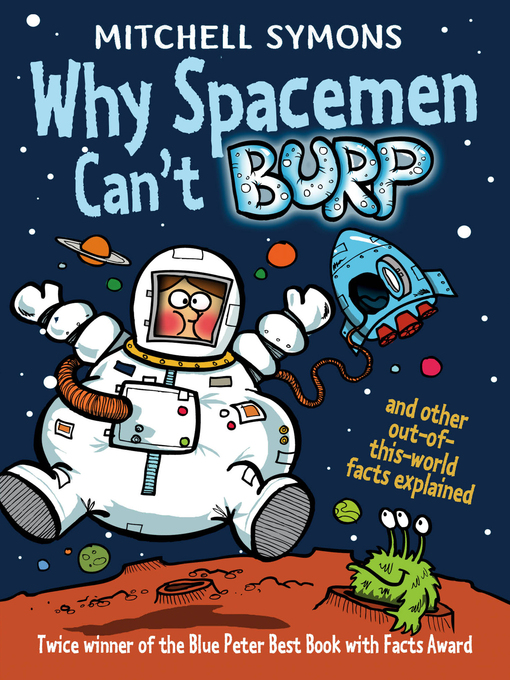
Why Spacemen Can't Burp, by Mitchell Symons


The latest in Symons' series of weird 'did-you-know?' fact books takes a pretty similar format to his other books, even right down to having some sort of bodily function in the title.  We've had burps, bums, bogies, ear wax, poo, farts and pukes.  What will the next one be called?  I dread to think...

Why Spacemen Can't Burp is laid out in a Question and Answer format and seasoned with various appropriate doodles.  Symons answers various (loosely science based) questions, many of which have been sent in to him by inquiring young minds.  He explains some unusual idioms, debunks various myths, urban legends and misnomers and generally fuels the reader with enough interesting facts and amusing tidbits to see you comfortably through your next form quiz or episode of QI.

Covering topics such as human bodies, animals, forces, sayings, food, geography and just about everything else, it's a pretty broad spectrum of facts and oddities, corrections and confirmations.

It's funny, informative and interesting and will obviously be wildly popular, as have all of Symons' other titles. It's full of the gross facts and bits and bobs that young readers love to dip in and out of and out-do eachother reading aloud.  Personally, I find these sorts of books really difficult to read, as my attention tends to wander with each page and there's nothing to develop really, in a book of facts but I know there's a pretty huge readership  for this type of book.

Monday, 27 January 2014

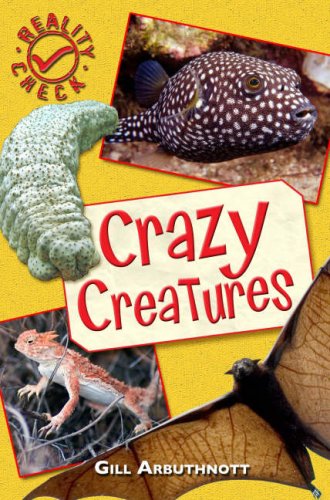
Crazy Creatures, by Gill Arbuthnott

A short wander through some of the world's more unusual and bizarre creatures including vampire bats, naked mole rats and a bird that has the World's smelliest attack sick.  I found the information in this book interesting, but struggled to understand the format a little bit.  The text is kept to a minimum and there are no images, but it's not a fact-file and it doesn't really have any sort of structure...it reads more like a series of quite interesting animal anecdotes that are just grouped into four vague groups...

I have seen similar books to this that include eye catching colour layouts, photos, habitat information and interesting or gross facts. These types of books are accessible, engaging and popular with low ability readers who don't seem to have too much trouble understanding them.  I just found it odd that a book about weird, mind boggling creatures didn't provide any pictures or any other information at all about the animals, apart from the fact that they did something odd or looked a bit strange.  It is quite difficult to appreciate how strange some of the animals are, unless you know already what they look like.  I'm not sure there is much demand for accessible books that just provide random chunks of information and odd animal attributes without any sort of context- I liked the information, but thought that by itself, the contents of the book was lacking in substance.

I think these factual snippets might have been better used as flashcards, perhaps with an image of the creature on the back that could still be used to develop literacy skills, but in a way that fits the format a bit better.

Saturday, 18 January 2014

Tony Robinson's Weird Wonders: The British, by Tony Robinson

Tony Robinson, of Time Team and Blackadder fame guides the reader through the triumphs and tragedies of the British Empire.  It's inventions, explorers, key personnel, overseas territories and general aura of 'Conquer or Die'.  He talks about the various displaced peoples, the lifestyles, habits and tastes of the overseas British ex-pats and some of the key dates that each of the territories were released back to the people that live in them. Robinson also visits some more modern history, such as The Great War and World War II and discusses the effect that these conflicts had on the Empire.

The tone of the book is gently humorous, full of factual titbits of information and trivia.  It's presented by five young illustrated characters who pop in and out at various points and deliver information or ask questions.  A bit Horrible Histories in style, but with less focus on the obscure and the gross.  It's well researched and gives an engaging whistle stop historical narrative that is informative and interesting.

What it lacks in detail it makes up for in accessibility, though it could be said that the single-strand historical narrative is a little simplistic in its approach.  Though Robinson's style is accessible to all and the book is not overtly pitched at either gender, history does seem to be a little bit dude-heavy.  Though, obviously, that is not something that Tony has any control over, it wouldn't have killed him to sprinkle the historical page with a few more women.  Women that aren't Queen Victoria, anyway.

All in all, a speedy, informative read and I actually learned what caused the First World War, which is something I've never been totally sure about.

My history is terrible.

Friday, 9 August 2013

Zombies and Forces in Motion, by Mark Weakland

Another brilliant series from the Graphic Library Collection- I can't recommend these enough.

This series uses various monsters and phenomena to explain scientific theories, the full list is pretty impressive;
  • Aliens and Energy
  • Bigfoot and Adaptation
  • Frankenstein's Monster and Scientific Methods
  • Ghosts and Atoms
  • Mummies and Sound
  • Vampires and Cells
  • Vampires and Light
  • Werewolves and States of Matter
  • Zombies and Electricity
  • Zombies and Forces and Motion
Note they have correctly gone for "Frankenstein's Monster" instead of Frankenstein.  19th Century lit pet peeve right there.

There is no excuse for not revising when it's explained like this!  Hopefully I'll be able to buy the rest of the series this year, because these really are brilliant.  This particular edition uses a zombie attack to demonstrate the effect of various forces and how they might be utilised on the undead.  Having a thorough knowledge of the function and application of the forces of gravity, the first law of motion and resistance are going to be nothing but helpful in the event of a zombie invasion. 

Dangle them off planes, shoot them out of cannons, slide them around in the back of a pick-up truck. As long as you're remembering why and how these poor Zombies are being flung around in such hilarious ways, then it's all good.

It's like if Bill Nye the Science Guy got put in charge of directing an episode of the Walking Dead. Awesome, right?

Monday, 3 June 2013

Harriet Tubman, the Life of an African American Abolitionist, by Rob Shone and Anita Ganeri


Before reading this book, I had never heard of Hariet Tubman.  We're not huge studiers of the Civil Rights movement in the UK (or at least I did very little at school), and whenever Civil Rights comes up, it's often Martin Luther Kind Jr. or Rosa Parks.  Not that they're not worth learning about of course, but there are bound to be many unsung heroes of history, and I think old Harriet here might be one of them.

Firstly, I thing graphic novel Biographies are a brilliant idea.  Particularly for people from either really important historical events, or really boring ones.  The American Civil war, Slavery and Abolition and everything that comes with them are immensely complex topics covering politics, human rights, trade, ethics and any other angle you care to come from.  However, these graphic novel biographies streamline history, and tell it from the perspective or a single character.  A reader will also learn about the historical period and contemporary issues, but it is the life story of the individual that is central.  If you're going to break history into bite size chunks, seems a pretty good place to start.

As a child Harriet was hit on the head with a metal weight by her owner which gave her seizures, headaches, hallucinations, visions and dreams throughout her life which Harriet put down to being messages from God.  Anyway, old Harriet had an eventful life.  An escaped slave herself, she personally led a total of 300 slaves to freedom on 19 separate missions over the border into Canada (ON FOOT in WINTER), freed 700 more as part of the Combahee River Raid, dabbled in espionage and armed scouting for the Unionists during the Civil War, nursing and cooking for the wounded, founding care homes for the elderly and being a suffragette.  Looking at photos of her she didn't smile a whole lot, but I guess some things are more important than fun.

The artwork is not overly stylised- realistic but unfussy, think functional cinema storyboard but in bright colours, and the text is kept to a minimum.  To the untrained eye it looks much the same as any other graphic novel.  Focused, clear storytelling that is engaging as well as informative, the authors stick to the biography and avoid getting too sentimental or preachy.  Harriet's adventures and the risks that she takes to help others help to maintain interest, and her
Such a good, accessible resource for learning about history, slavery or Civil Rights, would definitely recommend the series.  Glad it came my way and I'm doubly glad I read it because I learned a lot about an amazing woman.