Showing posts with label Rescue. Show all posts

Thursday, 7 April 2016

Quicksand, by Steve Toltz


Quicksand is a sort of tragically comic (or comedically tragic) saga about the sort of friendship that is for better or worse. Through a long and thorough examination of failure, the creative soul and the sheer endurance of the human spirit we  witness Aldo Benjamin and Liam Wilder as they deadpan their way through a lifelong phase of unproductive blockage, unfulfilled potential and misadventure.

The basic frame of the book is Liam, a failed novelist and accidental police officer has resolved to chronicle the life and times of his old school friend Aldo Benjamin. The first person to be tried and convicted under a new trafficking/rape law, Aldo is recently out of prison and now in a wheelchair thanks to his last suicide attempt. Aldo is the world's most persistently bad entrepreneur with a long list of Dragon's-Den reject business ventures to his name. He's a walking catalogue of bad decisions, mistakes, defaulted promises and an individual so monumentally unlucky, he diagnoses himself as immortal just to deprive himself of the option successful suicide.

Lurching from one misdemeanour to another disaster, Liam has often resolved to cut ties with Aldo, only to find himself repeatedly reunited with his friend. Using his influence as a police officer to get Aldo out of countless scrapes, Liam decides to turn the millstone around his neck into a muse- Much of the plot (or series of incidents?) is formed through Liam's attempts to novelise his friend's life. There's a fairly large section (that does go on for quite a while) where it transpires that Aldo is on trial for the murder of his lover and eventual carer, Mimi. During his immense monologue to the ladies and gentlemen of the jury, he also delivers a somewhat epic poem, detailed descriptions of various ill-fated escapades and trials, and a verbal transcript of a conversation with God. Context is very important to Aldo, as he goes on to link the loss of a baby, several confusing sexual encounters, life at an artist's residence and a wrongful accusation of virginal rape into his detailed history.

The novel really highlights the absurdity of modern life though. If Aldo is something of a far-fetched character, the elements that comprise him are quite recognisable. The get-rich-quick for no effort mentality is very recognisable, as is the idea that if it wasn't for bad luck, some people would have no luck at all. There's an irony to his character and behaviour that all at once seems impossible, but absurdly like it's just bizarre enough to be true. That a person could attempt to commit suicide, survive and accidentally kill someone else in the process. An obviously invented religion. That a someone can be convicted of something that wasn't even a crime three weeks ago. The manner in which Liam drifts into his job (Police academy training for novel research left him with the qualifications to be a Police Officer and he needed the money) is also familiar, the portrayal of artists as pathologically pretentious drama queens, the self centred detachment of the two characters is interesting and at times hilarious. Society's obsession with self help books and achieving individuality by religiously following the rules.

I was reminded throughout of Martin Amis' writing style, and the charismatic oaf of a character that it's hard to tell whether admiration, pity or repulsion has the upper hand in the reader's reactions. It's a book that requires stamina from the reader, and for the most part, you just need to go with all the figurative language and the everlasting wackyness of the characters. It's not the world's most coherent or fluid novel, but it's funny, entertaining and it's certainly got its own style. Its blackly comic style and grim episodes won't be to everybody's taste, but I found it to be a surprising, engrossing novel, unusually structured, yes, and overburdened with language in places, but playful and dexterous in others- I laughed the whole way through and cringed through the rest. I'd definitely seek to read Steve Toltz's other earlier novel after reading Quicksand.

Friday, 11 March 2016

There Will Be Lies, by Nick Lake


There Will Be Lies, is Lake's third appearance on the Carnegie list since I've been following it, but I have to confess that TWBL is the first one I've read. The book starts of ordinary enough- modern day Arizona. A dry, dusty, infinitely flat place that has been Shelby Cooper's world since she moved from Alaska as a baby. Homeschooled by her mother and obsessively shielded from the outside world, Shelby is intelligent, naïve but with an appealingly defiant, snarky attitude. The book's other location, "The Dreaming" shows up later on- a mythical space that exists beyond time and before our World and is inhabited by figures from Native American folklore, some of which can pass into the real world.

When the over protected, apparently super-vulnerable Shelby is knocked down by a car when standing outside the library, a coyote appears with the message that "There will be two lies. And then there will be the truth". This cryptic, bizarrely delivered message starts off a chain of events that ultimately highlights how fragile our sense of identity is. Shelby discovers that everything her world is built upon is nothing more than a flimsy web of lies and deception and that her whole reality is threatened by the newly revealed truth. Though I don't want to give too much away, I do want to mention that the final section of the book, post truth, I found to be the most thought provoking and certainly the most emotional. How do you deal with a discovery like that? It's a really unexplored perspective of an unusual crime. 

The theme of identity runs thickly throughout the book. Do we change as we get older? Are we always the same person? What makes us the person that we are? What does a person take into account when building their identity? *Do we* build our own identity or is it built for us? What's left when somebody takes those things away? Do we ever really know ourselves or the people around us?

I really liked Shelby as a character, she was sarcastic, clever and kind of lippy which makes her a really believable, authentic feeling teen girl. I liked her little asides to the reader (the one about her mom's Pyjama jeans especially made me laugh). When Shelby discovers she can enter The Dreaming, she is given a mission by Coyote (Capitalised, as in the archetypal trickster or lore, and AKA Mark, hot library guy). Shelby must rescue the Child and kill the Crone, or the world will end. It seems fairly high stakes and there isn't much contextual information available. It transpires to be a quest with more personal consequences to Shelby than it initially appears.

In the possibly real, possibly metaphorical world of The Dreaming, the Crone has kidnapped and imprisoned the Child to give her more power. Archetypally evil character that she is, this is preventing the rain from falling, parching the land of The Dreaming and starving its majestic wildlife. It's a fairly by-the-numbers quest, complete with animal helpers, flimsy frayed rope bridge and slavering wolves, but it takes on a new significance as Shelby starts to unravel the lies in her own world. I liked that it's never really made clear how concrete the Dreaming is, but the mirroring of the Draming's problems and Shelby's real-life crisis is skilfully managed and it adds a new dimension to the plot. Whilst I found the real-world Thelma and Louise scenario to be much more gripping to read, I can see what this fantastical fantasy world added to Shelby's story, and it provided her with the perspective and the tools to do what she needed to do in the real world. 

It's hard to talk about this book without giving too much away. It's a twisty, intelligent and original thriller that throws some surprising twists at the reader- there are a lot of OMG moments that the reader needs to feel for themselves in order to even attempt to grasp the extent to which Shelby must be reeling. The story is at first glance quite far-fetched, but it's constructed in a way that makes the whole thing quite believable and ultimately tragic. 

I really enjoyed this novel, though oddly I'm not in any hurry to backtrack and read his other titles. There was something about the frantic, mysterious concept of this novel that appealed to me in a way that the others didn't. It really is a very clever book that asks questions about identity, family and love. Shelby's mother, a character I've not really talked about because she's the one that all of the titular lies are orchestrated by, is a really interesting character- she's a good example of how duplicitous and contradictory a person can be, You can never really know. If you enjoyed this, I'd recommend Magonia by Maria Dahvana Headley, another book that features a dual reality, a protagonist with a quest and a disability (that only applies in one of the Worlds too, snap) and a really likeable, believable teen girl at its centre,

I do think it will make the Shortlist but I'm not sure about taking home the title- we'll have to see who else makes the final 9.

Tuesday, 12 January 2016

Lorali, by Laura Dockrill

I was somewhat dubious about a Young Adult book featuring mermaids...our underwater sisters seem so much more at home in Middle Grade fiction, picture books and fairy tales, so I was unsure whether or not they could make the jump into YA. Turns out they can and just haven't had the chance yet. Enter Lorali.

The book starts with Rory moodily nursing a bag of chips and brooding on the beach over his dad's abandonment of him and his mum. It's his 16th birthday and in the past his dad would've be there too, sharing some chips and a can of larger. Not any more. Rory's 16th is different in another respect too- he discovers a naked girl under the pier, huddled up but still alive; mute and fragile. That's a new one.

Gobsmacked, suddenly responsible and without any other immediate plan, Rory gives the girl his clothes and smuggles her back to his mum's house, convinced she's some sort of traumatised runaway. Gradually she thaws, begins talking, demonstrates boundless enthusiasm for cake and raw butter. When Rory finds her swimming in his neighbour's pond, he begins to wonder who this girl really is and where she came from. Drawing a blank, he takes her to his friend Finn and his loopy granddad in their lighthouse home, desperate to hide her and keep her safe, Rory is just looking to share his burden. What he gets in a lot of answers and an impossible conclusion. Lorali is a surfaced mermaid and Finn's granddad, Iris, is very much a land-based expert in the Mer folk. Who knew?

What starts off as a literal fish out of water story becomes a tale of desperate first love and the events that conspire to keep Lorali and Rory apart; greed, revenge, pirates. The pirates. I loved the Ablegares so much- for supporting characters they were so vividly drawn and so insanely out of place in 21st century Hastings. I loved how proud and hearty the 5 brothers were and the sections of the book in which they appear take on a weird Captain Hook via All Saints vibe that is totally unique. It's a joy to get to know Lorali as she experiences everything for the first time (sleep, wearing clothes, seeing herself with dry hair) and as she starts to establish her place in the World. It's just the right amount of inspired by Ariel, but entirely and unmistakably its own thing. In many ways Lorali experiences the same things as any non-Mermaid teenager; first love, confusion, not knowing where she belongs in the grand scheme of things. Under water she's always been told she is special, a miracle. Now she is the same as everybody else and she feels at home at last.

There are some new elements to Mer lore that I've not encountered before that I thought Dockrill wove into the narrative beautifully; the idea that Mer are not born but 'salvaged' as drowning victims deemed worthy of a second chance, that their tails are actually tapestries that tell their stories, their personalities and interests and that when they become Mer they lose their memories of life on land. The reader finds out more about the Mer people, and about Lorali and her past as the book progresses, and we eventually learn what drove the daughter of the Mer Queen out of the Sea and into Rory's life.

Lorali is an unusual book, not only because of its as-yet-unbroken magical creature territory, but in its style and approach too. Dockrill's prose is so adaptable and multi-functional, capable of any challenge or task. She demonstrates her range brilliantly- there's tenderness and brutality, violence and beauty. I loved how sensory some passages were, particularly when Lorali experiences flavours and sensations for the first time, it's so immediate and visceral. I loved the contrast between Rory's resigned and self-deprecating style, a teen with no plan and no prospects that's just winging it and Lorali, who's brand new. Full of secrets and pain and confusion, she is lost in this new world but overjoyed to have found Rory to guide her through. Her chapters are narrated with such fire and bravery and sheer nerve that it's impossible to not love her immediately.
I loved that the Sea narrated some chapters too, the pages splodged with moisture. Her ancient, lyrical voice added amazing depth and age to the story, filling in the parts that characters did not witness, providing both a location, an opinion and a beautifully enthralling narrative voice. It seems that on and in the Sea, time doesn't really exist, there are no ages. Pirates and sea monsters still roam the waves, the Mer stay at the age they were when salvaged...after all, we have explored more of the Moon than the Deep Sea, so who knows?

I think it's fairly safe to say that I adored this book for a lot of reasons. For its prose, for its characters, for its daring to open up a whole new underwater world to the YA readership. Its little digs ar patriachy and the materialistic celeb lifestyle. I like that LD was ballsy enough to deny a traditional happy ending (will say no more). It's been vampires and dystopias for so long it was genuinely a refreshing surprise to read something that's out there on its own, the first of a new kind of YA. Excellent.

If you liked this, I would also recommend Magonia, by Maria Dahvana Headley which uses similar fantastical themes; another unknown, hidden race, a narrator leaving one world for another and hleaving her old life behind, the love interest that can never be and the wry, relateable narrative style. Go read it because it's also very good

Wednesday, 11 February 2015

Rocket Girl, by Brandon Montclare and Amy Reeder

I think the story of this comic is that a teen NYPD cop from 2014, Dayoung Johansson needs to go back in time to the 1986 to sabotage/prevent a scientific breakthrough at Quintum Mechanics. If she's successful, her technologically advanced future world will cease to exist because the tech that the world is based upon will never have been invented. It should never have been invented. 2014 shouldn't look like it does. She doesn't seem massively fazed by her task of destroying everything she's ever known in life, but maybe that will come later.

A bit of a fish out of water, Dayoung needs to do some serious damage to Quintum Mechanics' R&D and avoid getting arrested by the 1986 police. There might even be time for a spot of damsel-in-distress rescuing and some superheroics. I loved the end couple of pages where Dayoung gets her 1980s outfit on and really digs in to life in the virtual stone age.

The style of the book is incredibly kinetic and the artists have created the movements of Rocket Girl's jetpack beautifully, the lights of New York (both overground, underground, present and future) whizzing by in a blur- but I found the pace and the movement kind of made the story hard to follow. In places the panels kind of jump around all over the place, all different shapes, sizes and orders and I had to go back in several places and re-read parts.

I found myself too noticing more and more the amount of open mouths in the artwork- and the more I noticed, the more I looked for, and the more I found, the more it irritated me. Totally irrationally, of course. Other than that, the artwork is gorgeous- moody blues and purples and I loved the contrast between 1986 and 2014 New York. Though 27 years have dramatically changed the appearance of the city, all its technology doesn't seem to have gone far to solving its social problems.

If I'm honest I don't think the story or the concept really grabbed me- I get that it's a vol 1, so things are only just getting started, but I'm not sure if I'd go looking for vol 2. I didn't really understand Dayoung as a character, so I struggled to warm to her really. A beautiful looking book, but I can't sat it's one of my favourites.

Tuesday, 27 January 2015

Ms. Marvel: No Normal, by G. Willow Wilson and Adrian Alphona

This is probably one of the first traditional superhero narratives I've read. I read graphic novels fairly regularly, but superhero comics are definitely a new one for me, so my knowledge of the Marvel universe and its inhabitants is pretty limited. Therefore I can't pretend how to know where this fits in, what's happening elsewhere, where in the timeline this comes or anything like that, or how it compares to incarnation that have come before it. So anyway...

Ms Marvel stars 16 year old Kamala Khan, born to a Pakistani family in Jersey City. She's obsessed with the Avengers, writes fanfic and leads a pretty normal, though tragically early-curfewed life. The story begins with a tiny glimpse at the practicalities of growing up Muslim in America. The temptation of bacon, the decision to wear a veil or not. The way people might decide what it says about you, whatever decision one comes to. The differences in parental expectations of American parents and Turkish or Pakistani parents is highlighted too (Or is it different? Don't all parents want their kids to be successful and stable?). It's really interesting to see the mundane, everydayness of other lives, rather than seeing an 'issue' made out of them- a difference is suggested, but it doesn't seem a big deal. Anyway. There's a party at the waterfront and Kamala can't go because there's alcohol. But her recently veiled friend Nikia won't go because there's alcohol. Both girls know their own mind and they both have things to work out for themselves.

When a debilitating fog rolls in as Kamala walks home from her disastrous party, she passes out and has what could be described as a religious experience. The Avengers are speaking to her- imparting wisdom and speaking Urdu and arranged in a beautiful, if slightly unorthodox religious tableau complete with hulk-hand Sloths and seagulls wearing trapper hats. She wakes up from her brush with divinity with inexplicable and initially uncontrollable powers. I love this full-page panel- the swirls, the sash, the hair...it's just incredible and now I feel somewhat indoctrinated into comics.

Basically Kamala has a bit of an identity crisis early on- her polymorph powers let her become the buxom blonde superhero that she thinks people expect, the All-American figurehead that she has always seen in school. A reader could choose to perceive this as a cultural thing, but most likely it's a teen thing. Her indecision doesn't last long- Kamala is ready to show the world that brown hair, brown skin and burkini can be sufficiently super with the right attitude and the requisite amount of kick-assery. I think it is mostly about attitude. Kamala thinks a lot, even at this early stage, about what it means to do the right thing and why people might choose to intervene or not and what that says about them and their place in the world. She's brilliant and I love her.

As well as Kamala being a goofy, funny and occasionally melodramatic girl, she's also got a brilliant family. I absolutely loved the Khans- the deadpan, super sarcastic dad and her holier-than-thou brother who prays all day everyday (possibly to avoid getting a job) and the mum who simply doesn't understand what's going on in the heads of her kids. Her family, though glimpsed pretty briefly, seem dynamic and real, they seem pretty normal. They worry about the grades and the safety of their daughter, they want her to do well in life. It seems you don't need to be a massively traumatised orphan, radioactive or a millionaire to be a superhero anymore...

I loved how identifiable the story is so far, and just how modern it is. Most kids that have ever gone to school have wanted to be somebody else. They've wanted a smaller nose, less/more freckles, bigger/smaller boobs or to be taller/shorter or less clever/cleverer. Most readers too will relate to the pressure that Kamala feels she is under- the type of expectations that come with increased power or influence, the worries that she might not be up to it, might not be worthy of wielding such abilities. What teenager has never doubted their ability to successfully pull off what's expected of them?

It's pretty much a story about taking on a massive challenge despite having no idea whether you can manage it or not. It's about facing up to responsibilities and putting the time into getting something right. It's about learning to be happy with yourself and confident about the things that you can do. The artwork is immense and the characters come alive in the panels- I love how atmospheric they are. Dust, knock-out fog, school study-hall detritus, there's always something going on in the background and in the corners. I loved the neon blue lights too- sometimes it looks like the paper is actually luminous . It's not overly fussy or mega stylised, and I love the purple, orange and pinkish hues that tell the story of Kamala's night time missions. Can't wait for the next issue.

Wednesday, 22 October 2014

The Sacrifice, by Charlie Higson

The Sacrifice, Charlie Higson, The EnemyThe Sacrifice is the fourth book in The Enemy series and we have a pretty established cast of characters by now. This breaks the pattern of the preceding books in the series in that it doesn’t introduce a new cast, instead the book begins to further develop those we have already met. This is where Higson has woven his web, now he’s beginning to pull the strands together. London, the World for what matters, is becoming smaller as contact is established between the groups. Community is reborn in a fashion. This book sees a watershed in the narrative where the focal point of the series ceases to be coming to terms and coping with the new world, instead shifting to making sense of it and the pursuit of answers.
So,

This book focuses primarily on two related stories and on one apparently separate one. The Sacrifice continues the chronology, following immediately after the events of The Fear. It begins to look at the development and evolution of the adults and the disease that has changed them beyond recognition and turned the world upside down.

After being taken in at the Tower of London, the Kid and Small Sam are keen to get back on the road to the Natural History Museum in search of Ella, Sam’s sister from whom he has become separated. Nice guy Ed, star of the second book isn't keen to let them go as it would mean going through the No Go Zone and that’s just suicide. However, they slip away after encouragement and persuasion from Tish, a green-clad girl that Ed rescued from grownups. The three of them head off towards Kensington. Their journey and their eventual (unexpected) destination is one half of the main story, and we find out what some divergent characters from The Dead  have been getting up to for the last year.

Realising that they have put themselves in danger by leaving the tower and reluctant to lose any more kids after the disappearance of DogNut, Ed sets off with a small rescue party of loyal fighters to find Small Sam and The Kid. Stopping off at the Houses of Parliament, he discovers the existence of a sort of information exchange between settlements of kids and the hunters that destroy adults on a mercenary basis. It’s here he meets Nicola at Westminster and learns not only that DogNut passed through recently, but that Small Sam and his friend are not on their way to the museum at all, but have seen sighted near St. Paul’s Cathedral. He also learns of David’s settlement at the Palace and the expatriates that have fled his regime. Ed’s group’s pursuit of Sam and The Kid and their dramatic rescue make up the other side of the group-based story.

Separately, Shadowman has continued to track The Fear singlehandedly through London, observing them, learning their behaviour and gathering intelligence on them. The adults are beginning to display some signs of organisation- setting traps, using weapons, displaying a herd mentality- survival of the fittest. Naturally this disturbs Shadowman greatly. I really liked the accidental lapses in Shadowman, when he catches himself off guard almost feeling proud of The Fear, impressed by their strength and organisation. I'm increasingly intrigued about Shadowman’s character in general. Inherently mysterious, he’s obviously an incredible survivor, intelligent and resourceful and he’s demonstrated both a detached and hardened exterior and a surprisingly heroic side. He's a contradiction and an enigma. What intrigues me most is his peripheral nature. The main story wouldn't be hugely different without him, but the amount of time invested in his narrative makes him seem incredibly important. I look forward to seeing where Shadowman is going.

Another aspect of this book that really caught my imagination was the religious themes. Being a huge extremist, Mad Matt, Pope of the religion of The Lamb really has change to flex his crazy muscles in this book. His pomposity, his arrogance and his fundamentalism lead him to make some really dodgy decisions- decisions that are not seen only in Theocracy but in Military rule too. But I liked that the scared 14 year old showed through sometimes. It’s something not communicated very often- that religious extremists might have a scared and confused person inside that just wants someone to tell them to stop. Is it important that the two primary themes are evolution and religion in this book? Is that intentionally polarised? Is Wormwood, the monster living underneath St. Paul’s some kind of bridge between the two? I honestly can't wait to find out.

Not as character driven as the previous instalments of the series, The Sacrifice definitely gives the reader the sense that things are heating up. The adults are evolving, the settlements are all up to their necks in their own problems and conflicts. David is trying to take over the physical World, Matt the Spiritual one. The politics of power have remained dangerous and contaminating throughout. The kids are starting to ask questions about the disease, they’re starting to get a grip on the new world, establish an order, get things organised. But unfortunately so are their advisories. The adults in this fourth book are truly terrifying. They've stopped simply being gross and dangerous and have become eerie and uncanny, automatons in some cases. It’s just getting weirder. I'm continually baffled by the breadth of the narrative in this story and the skill with which the separate strands are all developed, reigned in then combined. To have so many plates spinning and to still leave the reader gagging for more is a pretty incredible feat. I'm sad already to have passed into the concluding half of the series. Two more books to go!

Tuesday, 8 July 2014

Eleanor & Park, by Rainbow Rowell


Excuse me for a moment while I squee a little bit; I love love loved this book. Okay.

I've been wanting to read this for a while, and the upcoming YALC this weekend gave me the perfect motivation. It's also become something of a Twitter juggernaut recently...I'm fully expecting a The Fault in Our Stars style explosion of love for this novel...

This book could so easily have been a soppy, twee story of teen-aged star crossed lovers making dramatic gestures and cooing at one another. Thankfully it is so much more than that; it's intense, sincere and tender and it is completely submerged in the heartbreak, pain and beauty of first love. To begin with it simply made me laugh, then it just killed me.

Briefly and without spoiling anything, the wild haired and unconventionally attired Eleanor has just moved into a too-small house in Omaha with her downtrodden mother and numerous younger siblings. Her alcoholic brute of a stepfather threw her out a year ago and has only just allowed her to come back. On the first day of her new high school, Park begrudgingly lets her sit next to him on the bus to avoid the agony of watching the new girl accidentally taking someone else's seat. Terrible bus protocol. Despite it taking several weeks to exchange a word, they gradually fall in love- the rest is a whirlwind of comic books, mix tapes, high school politics and the agonised exhilaration of first experiences. They fall in love in a way unique to teenagers- with intensity and self-consciously. A person only has one shot at first love and Eleanor and Park do not waste their chance on each other.

I absolutely and completely loved the characters; Eleanor and Park are simply brilliant creations. I loved the way that each of them only really came to know themselves when they'd begun to know each other. Park, the only (obviously) half Korean kid in Omaha doesn't struggle with his own identity exactly, but he struggles to place himself in the wider world. Eleanor is hugely self conscious about her body and her home life, but Park manages to make her forget that and truly escape into his company for a few hours a day. Each of them are incomplete without the other, and it is simply a beautiful story of love and discovery, rather than romance, and about the slow building of trust and the self-sabotaging impulses that run through even the strongest of people.

I loved Park's family, and all the crazy that came with it. His relatives were all believable and their relationships were realistic, easy to relate to and really endearing. His "best shape of my life" action hero Tom Selleck dad had me in stitches and it was such a lovely (though inevitably complicated) father-son relationship.  My heart broke for Eleanor and the awful, terrifying situation that she was placed in daily, and I was so angry at her mom for letting it happen, for not taking herself and her family out of the clutches of her husband. I admired Eleanor's strength and her courage, and I loved Park for being able to see through all the secrets and the shame.

This book is incredibly well written, with brilliantly funny prose that can have you laughing on one page and wincing with internal pain on the next. It was compelling and nostalgic, and the intensity of that first love screamed out from every line. I really liked the frustratingly enigmatic ending, some things are just unknowable, even to readers who get to know characters as intimately as we get to know Eleanor and Park. It is simply a lovely book about love and finding the place that you belong.

Wednesday, 2 July 2014

Dorothy Must Die, by Danielle Paige

Amy Gumm, high school student and Kansas trailer park resident endures her unremarkable life with a sort of grim defeat. Her pink hair and slightly sullen attitude has not won her any admirers, her mother is permanently in a semi-comatose state of pill and alcohol dependency and she resignedly lets the school's dim heart throb copy her homework, knowing already that he's blown his chance of a sports scholarship. And she's just been suspended from school for picking a fight with a pregnant girl despite not actually hitting her. Things are looking bad and they only get worse- that night a tornado sweeps through the park whirling Amy, Amy's mum's pet rat Star and their trailer home away- away to Oz.

Kansas girl swept away to a strange and magical land called Oz. Pretty familiar, right? Amy thinks so too, only this isn't the Oz that she remembers reading about. Its magical inhabitants live in constant, intense fear, petrified of the insane wrath of their leader, the maniacal Dorothy. The magic is gone, mined by hoards of slaves on the princess' orders and forbidden to everyone else. Dorothy rules her kingdom with an iron fist and the help of her devoted followers- the mad scientist Scarecrow, the walking implement of torture and High Inquisitor, the Tin Man, and the ravenous, deadly lion. The rest of the population either cowers in terror or is brainwashed into acceptance, even pleasure, at their good fortune to have such a beautiful, wise and generous ruler. The wicked have turned good and the good are causing a lot of problems.

Being from "The Other Place" too, hopefully therefore able to understand their feared dictator, Amy is Oz's best chance to end Dorothy's reign of terror. Forging an unilluminating allegiance with a mismatched band of Wicked Witches and learning their magic, defence skills and their powers and secrets of concealment, Amy sets out to infiltrate the Emerald City and bring about an end to Dorothy's reign. She must get close to her, learn her ways and her habits but remain undetected- because if the Magic is ever going to be allowed to return to Oz, Dorothy Must Die.

A twisting fantastical story of power and corruption, Dorothy Must Die pits a whole host of new characters against some old and familiar (but not as you remember them) faces. It's definitely an intriguing concept and is bound to appeal to fans of Wicked and Grimm. It's full of nasty surprises, gruesome detail and debunks the idea of the magical Ozian Utopia completely.

I grappled with this book . I was impressed with the story's beginning that saw Amy battling prejudice and bullying at her high school; she came across as a really admirable character, empathetic yet defensive and brave and she was really easy to relate to. However, once she got to Oz, I felt that the plot became a series of perilous events that brought her closer and closer to the Emerald Palace and into the household of Dorothy, without really developing her character much. I couldn't really understand Amy's motivation for most of her behaviour. I found that Amy became very invested in the population and the fate of Oz incredibly quickly, despite her earliest encounters with its populace being quite hostile, but nothing really provided an answer as to why. It wasn't vengeance, nor greed, she had no score to settle. She put up very little fight at the idea of becoming an assassin for a cause she previously had zero knowledge of. As the book went on, Oz Amy was barely recognisable from the endearing high school loser. Maybe it was supposed to be a transformational journey, but I liked her much better in the beginning.

I'm afraid it wasn't just Amy that I struggled to comprehend. Despite never being a huge Dorothy fan myself, I was a little confused by this new version of Dorothy Gale. I just didn't feel that the author utilised much of the original Dorothy's character in creating the power-crazed version. A version based on an exaggerated aspect of herself might have worked, but Dorothy seemed to have had an entire personality/interest/memory transplant. Why did she suddenly become so power hungry? How did she manage to seize control of Oz so effortlessly? Some of the best supervillains have always had the source of their hunger for power rooted in loss, seeking to redress unbalance, righting imagined wrongs or in some other quality that would usually be an asset but in excess is dangerous...I just didn't think evil Dorothy worked as a character, and without that buy in, the whole book kind of  falls down.

I really liked the idea of the decrepit, mouldering Oz, starved of the Magic that keeps it alive, but once Amy enters the Emerald Palace, then the Oz setting becomes forgotten. The surreal landscape is brilliantly described to begin with, but then even that fizzles out towards the middle of the book, replaced with the luxury of the palace. The concept sounds so brilliant and I was really looking forward to reading this,  but I was ultimately disappointed with this novel's plotting and characters. As this is the beginning of a series, there's still hope! I'd love to see Amy reconcile her real and Oz selves a little more- to use her upbringing and the injustices and neglect that she's suffered to fuel her mission in Oz. I'd like her to gather her own parallel band of followers, rather than seeing her raving about how few people she can trust and about how uninformed she is. I'd like to see her out and about in Oz a little more, bringing uncharted Ozlands to the reader and gathering her own indigenous army. I want the Wizard to turn out to be either insanely important or woefully unimportant and I want Oz to fight back. There's hope and resilience in its population that is just waiting to be tapped into further down the narrative line. As a concept, it's got huge potential, and I'd certainly be interested in reading further installments to see if any of the aspects that frustrated me during the first book were worked out.


Thursday, 19 June 2014

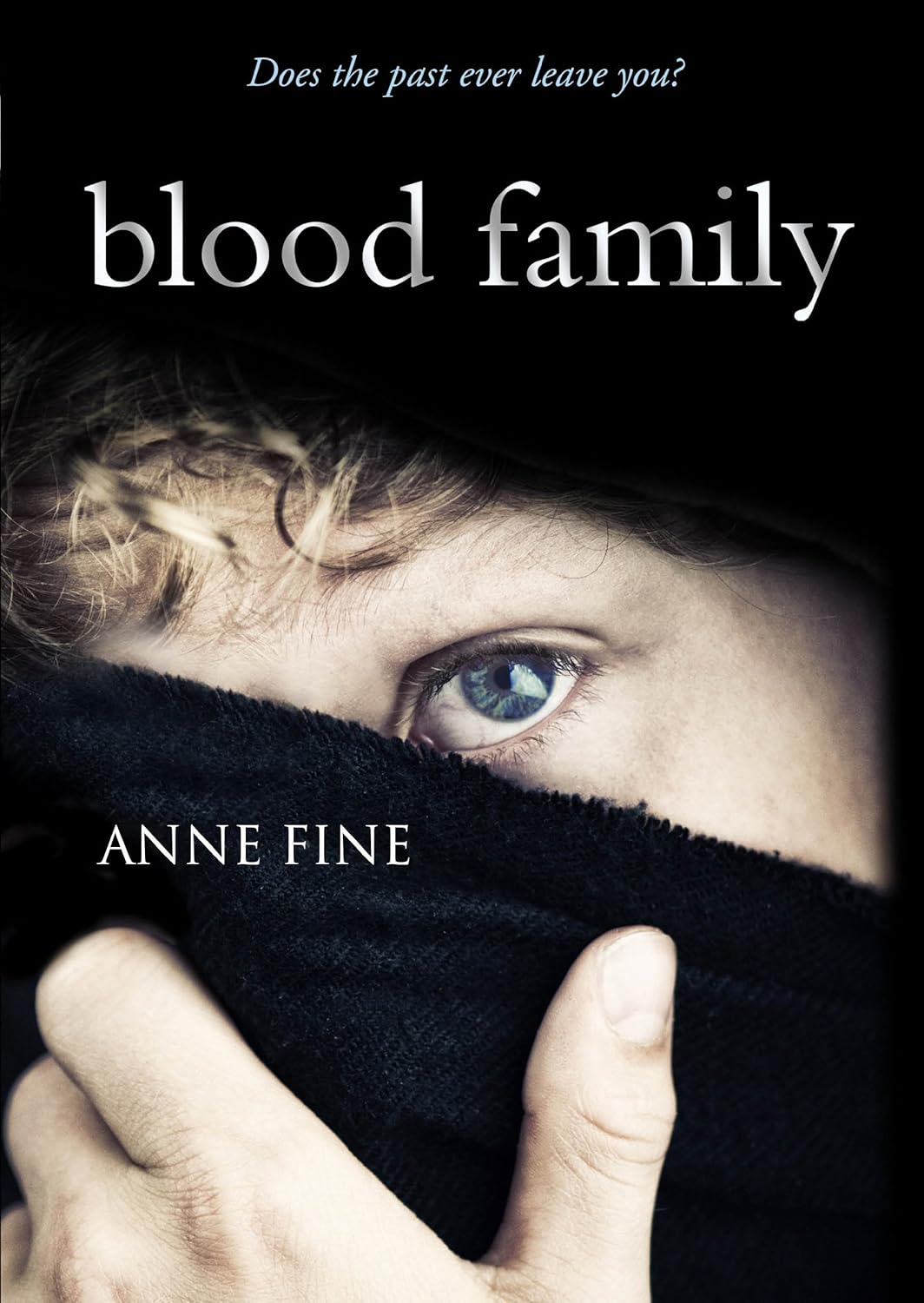
Blood Family, by Anne Fine

The book starts with the Police and Social Services breaking down the door and forcing entry into a dark, squalid flat. Seven year old Eddie has not been outside for years. He's shared a filthy blanket with the dog in the corner of the room, lived on cheap bread and cheese and is bruised and silent, shrinking into the wall in terror at every sound or sudden movement. His mother has been beaten into a state of vacant dependence by her abusive partner. She is frozen in armchair, keening and unable to move or speak.

To start with, Eddie seems like he has escaped his traumatic upbringing unscathed- as a seven year old he's bright, responsive and eager to please. He responds well to the care and attention of his foster family, then his adopted family. He seems remarkably normal, considering regular things like swimming or going to the supermarket are totally new experiences to him. The problems really start in his early teens when Eddie makes a horrible discovery about his biological father that sets him on a destructive path to drugs and alcoholism.

Blood Family is beautifully written, it's a tragic and thought provoking story about the struggles of living with the after effects of violence, emotional trauma and neglect. Eddie struggles through adolescence battling feelings of worthlessness and fear and slides into destructive, damaging behaviour, despite the efforts of everyone around him that cares for him. I think many readers will be able to relate to Eddie's self sabotaging behaviour, even if their personal circumstances are difficult. His struggle with self esteem and confidence, and his fear for his future feel universally understandable, as is his desire to escape.

I thought the structure of this book worked brilliantly. The various narrators from different agencies voice their experiences and opinions in a way that builds up a complete picture of the pitfalls and practices of the adoption system, the thoughts that haunt those from troubled backgrounds and the tireless efforts of individuals in the care system to patch up the damage they can manage with the children they care for. They're honest, conversational accounts from different perspectives and even the most fleeting accounts seem important, adding their voice to the choir. Each of the characters has their own flaws and issues, seem full and unique and each contributes to the story brilliantly. Many of the characters' recollections of Eddie were incredibly touching and written with an understandable mixture of anger and tenderness.

Blood Family raises questions about the bond of blood and its importance; is your future determined by your genes? Is a person doomed to follow the same path as those blood relatives that have gone before them? Is background important in the making of a person? The novel handles numerous complex and difficult subjects tactfully and with care- the nature of addiction, adoption, the aftermath of abuse. Eddie blames his mother for allowing Bryce to destroy her, for having no backbone and for retreating mentally, but the book does not blame her and neither do many of the novel's other narrators. It highlights the ways that domestic violence can be committed methodically, psychologically and consistently under the noses of family and friends and has the capacity to change the victim beyond recognition.

It can't be described as an enjoyable book, but it's brilliantly crafted, engaging and incredibly emotional. I can't even imagine what surviving neglect, violence and abuse must be like, and Eddie and his mother are both very inspirational characters just for managing to survive. It made me realise too that whilst the care and justice systems might not be perfect, there are so many good people within them that just want to help to rebuild people's lives. Fictional though their account might have been, it was quite humbling to know that people like the characters in this book exist in the real world, and horrific to realise that there are Eddies and Lucys out there too. A brave, inspirational book about living with impossible fear and excessive emotional damage.

Tuesday, 22 April 2014

Watchmen, by Alan Moore and Dave Gibbons

My Graphic Novel education continues with Watchmen. I'm not a massive superheroes fan, and haven't seen most of the DC/Marvel films, so wasn't really sure what to expect from this. As it happens I enjoyed it immensely and it leaves the reader with a hell of a lot to think about.

Watchmen is set in a sort of alternate future (possibly 1980s?) New York. From the drab, graffiti filled streets and the uneasy aura of depression and fear that infects the location and its inhabitants, it's not hard to surmise that it's not a happy place. In this reality, superheroes emerged in the 1940s and 1960s to national fame and adulation, helpfully assisting the United States in its Vietnam victory. Nowadays tensions are rising once more and the USA are on the verge of nuclear war with the Soviet Union. Hence the unease. Freelance, costumed vigilantes have been discredited and outlawed and many of the former superheroes so decorated and applauded in the past are either in hiding, retirement or working for the Government. Think the concept of Pixar's The Incredibles, but set in the oppressive world of Batman's Gotham City.

The plot starts with the murder of a government-employed superhero. His death pulls the remaining superheroes out of retirement in order to investigate and to prevent themselves or their colleagues from being the next victim. Each of the former heroes has to come to terms with their altered place in the world and many of them struggle with their responsibilities to themselves, each other and to the public. Some hanker for the thrill of the chase, some believe they were never truly themselves out of costume. The novel spends a great deal of time developing the unique traits of the characters, giving them motivations, heroes, backstories and inner conflicts. This is done in a variety of ways; through interactions with each other, flashbacks and most effectively through miscellaneous documents that are injected into the narrative. These include ephemera (favourite word alert) such as extracts from characters' autobiographies, newspaper articles, interview transcripts and so on. Watchmen definitely suggests that the life of a superhero is more guilt driven duty than heroism. Personally I found the fictional documents structure really added a great deal to the plot- it gave it more depth and really allowed the reader to understand the complexity of the characters and their seemingly impossible daily conflicts.

The way that the book mirrored real life, but took a few well selected alternate paths was excellent. I've no doubt that's why the tension and the unease was so strong and the fear so prevalent. Most noticably, rather than developing nuclear weapons during WW2, in this reality the US accidentally created Dr. Manhatten, a radioactive superhuman that can pare the world back to its elements and sees all of time at once. He's the main cause of the US/Soviet tension and the only true suerhero in the novel. It was genuinely interesting to see a character with all the Universe's secrets be so disillusioned and sulky.

I loved the structure of this book, its murky purple/brown/red palate and how clever and thought provoking its messages were. The recurring images (the blood soaked smiley face, the five-to-midnight clock, the intertwining of the narrative with the horrific fictional comic Tales of the Black Freighter) really effectively contributed to the sense of time ticking down. It always felt like there was some huge, disastrous even that everything was building up to, a nihilistic speeding towards the inevitable from the very beginning. It's rarely as simple as good versus evil, and I think that that awareness is perhaps what elevates Watchmen over much of its comic series contemporaries. It's having a bit of a dig at the superhero concept, as well as commenting on the ethics of scientific progression, weapons development and the cost and effect of fame. Questions are asked about the validity of war, and the price of peace and for that conflict alone it's worth investigating. Brilliant stuff.

Monday, 24 March 2014

The Troop, by Nick Cutter

Imagine if Stephen King rewrote Lord of the Flies for the Internet generation, and then John Carpenter made the film of it...that's pretty much The Troop.

Scoutmaster Tim, the only doctor in town, takes five boy scouts of troop 52 to the uninhabited Falstaff Island (just off the Canadian coast) for a long scouting weekend of campfires, survival lessons and wilderness trails. There's supposed to be a big storm brewing so Tim's had to bring the radio, the only way of communicating with the mainland, just in case.

Just as he's settling in on the first night, an emancipated stranger staggers up to their cabin, thinner than a corpse, reeking of sweet decay and desperate for food. Any food. Things take an unexpectedly horrific turn when Tim realises that this stranger is sick, sick in a way that Tim hasn't ever even heard of before.

Firstly, I'm not a horror reader as a rule, but this book had me glued to the pages. Though it's gross in places, cringy disgusting in others and fairly stomach turning throughout, I couldn't help but make my bets early on about who would live and who would die, and I needed to know if I was right.

The book does an excellent job of exploring pack dynamics of adolescent boys, and how those dynamics change with the absence or acquisition of authority. It's interesting to see which characters become dominant, which respond to action and which to violence and how the hierarchy is established and where it gets them. Their early camaraderie is well written and believable, and their conversations (girls, the 'Would you rather?' game and their home lives) are familiar and realistic. The character types are recognisable from any school in the world; there's the intelligent but overweight lad, the boy that's angry doesn't know his own strength, the psychopath, the popular sporty boy and the nondescript passenger. The reader is guessing up until the final chapters which ones will have the mental strength to make it through and which will succumb to the deadly contagion. The reader's perceptions (and the perceptions of the boys themselves) change and evolve as the story progresses as each of the five show their true colours in the face of pressure, immense danger and responsibility. I found the character of Shelley to be the most disturbing. He starts off conspicuously vague, his sociopathic tendencies hidden behind his slack expression, but an absence of adult supervision means that he can let his disturbed fantasies run free. He makes the character from the Wasp Factory look intriguingly pleasant.

One of my favourite aspects of the book was the 14 year olds’ absolute conviction that adults have the answer to everything. That adults exist to advise, protect and shelter the younger generation. Teens and children are free to shrug off responsibility and consequences, because they are not yet at an age where they are duty bound to accept them. The dawning realisation that began to surface in several of the characters was really well done, and formed a pretty pivotal part of the plot. In some ways that was scarier than the contagion- the idea that nobody is coming for you. Adults cannot sort this. You are on your own.

The action on the Island is interspersed every so often with documents from other sources. Newspaper clippings, adverts, transcripts from tribunals, transcripts of counselling sessions that some of the characters attend to address their issues. All of this helps to build up a fuller picture of the events on the island from some unspecified time in the future. It provides some context and some explanations, as well as delivering a bit of welcome respite from the gore of the narrative. These sections were really effective, and it demonstrated what a dangerous, morally bankrupt enterprise the contagion was. It also made it seem horrifically real.

The Troop is confidently written with a wry, relatable narrative voice. It certainly doesn't hold anything back from the reader. It's not an easy read, but it is quite a lot of fun. Cutter's inventive use of language is impressive and it lends a really relatable and (occasionally) horribly recognisable edge to the events that happen in the story. There are some really effective but apparently everyday similes that take on horrendous new meanings in this book. It's darkly funny in places, and stomach churning throughout. The fear, the panic and the desperation of all seven characters swamps the reader, as well as the horrific smells, sights and sounds that the author ensures the his audience do not miss out on.

Cutter builds the tension well, though the reader is pretty aware of what the final solution is eventually going to be. Definitely not a book for the faint hearted or for anybody even remotely squeamish. It's a fast paced, old fashioned body horror, with all the splattering gore and grisly demises that tend to come with it.

Tuesday, 18 March 2014

Tiger Wars, by Steve Backshall

Saker, a highly trained and dangerous teen warrior is on the run from the only life he has ever known. When an attack of conscience during a 'job' causes him to question the motives of the mysterious "Clan" to which he has always belonged, Saker must flee for his life. Riddled with amnesia and pursued by mercenaries and assassins, hunting dogs and other Clan members, they will not stop until he is caught- and his former friends are every bit as trained and as deadly as he is.

After accidentally kidnapping Sinter, the feisty daughter of a tea plantation owner, Saker's memory begins to return in lumps and patches. As he shares his history and his reasons with Sinter, her hostility and haughtiness begins to melt away. Aligning herself to his cause, their shared mission takes them both from humid India to the magnificent Himalayas and the highest settlements of Tibet. Using all the survival skills, knowledge and bravery they possess between them, Saker and Sinter must risk everything to save Asia's most fearsome and majestic (not to mention unfortunately valuable) of predators- the Tiger.

Tiger Wars is the sort of book that combines pretty complex emotional themes seamlessly with moral themes, all wrapped up in action, suspense and interesting characters. The plot is full of peril, danger, terrible decisions and breathtaking escapes but also makes a huge effort to celebrate the power of friendship, the strength of overcoming adversity and bravery. It also has a really vital conservation message that focuses on the protection of the last of the world's wild tiger population from the illegal Asian medicine trade. So all in all it has a lot to say, a really engaging voice with which to say it.

Firstly, I loved the setting of this novel. It's an arm-chair tour of some of the world's most hostile but beautiful territories. Saker and Sinter's flight takes them through dense forests, dusty cities and impassable mountains into some of the most inhospitable and isolated areas of the world. The reader learns a little of the culture of these places and the challenges that their inhabitants face. The unusually exotic locations make a really welcome change to the Victorian London or the English Secondary School setting that feels so prominent in Middle Grade fiction. Reading it, I felt I had been somewhere new.

Another of the book's strengths was the detailed and intricate characterisation of the two main characters. To begin with they are thrown together by circumstance and bad luck, nobody is particularly happy and both want to scarper as soon as possible- but a mutual respect and understanding soon develops. Eventually, Saker and Sinter prove to be a formidable and unbreakable team- each bringing their own skills and unwavering loyalty and determination to the duo. Both are displaced and alone; Sinter is fleeing an arranged marriage and a future of unfulfillment and servitude and Saker has known nothing but life in the Clan, which until recently seemed fun but now is filled with deadly enemies.

One of the most appealing aspects of the book is the sheer enthusiasm of the author. Steve Backshall's love for nature, for the environment and for the wilderness is infectious. What's more he knows his stuff. Backshall skillfully sprinkles the story with facts and information about survival skills, ecology, geography, Asian spirituality, geology and natural history, so I think this book will also appeal to fans of non-fiction- there's plenty of quiz friendly trivia in here. These additions are genuinely interesting, they work within the context of the narrative and add weight and authenticity to the book. It also proves you're never too old to learn new things!

In conclusion, I was immensely impressed with this book and look forward to the rest of the series. It has good characters who share a strong, genuine bond, loads of action and danger and a really pacy story. It's an inspiring tale about doing the right thing even when it seems impossible and about caring for the natural world, as well as the transformative power of friendship. Top stuff.

Thursday, 27 February 2014

Life After Life, by Kate Atkinson

Life After Life begins in November 1930 with Ursula Todd pointing a gun at Hitler in a crowded pub. She pulls the trigger. Darkness descends. How has this happened? Who is this woman? How will history look without the evil shadow of Hitler looming over it? From the first page this novel asks questions, and it doesn't always answer them.

Ursula is born on the 11th of February 1910 as the snow falls outside, barring the doctor's way to the house. Within minutes of birth she is dead, strangled by her umbilical cord before she could take her first breath. 11th of February 1910 again. Ursula is born, but a pair of scissors are standing by to cut the cord. Each time Ursula dies during this novel, this is where it starts again. Fox Corner, blanketed in snow. A fresh start for another life and another story to be written. Some elements are the same on each occasion and marginal differences shape the way that life is to be this time.

I love Atkinson's style of prose- it's gently atmospheric, sweeping the reader through woodlands and regency revival dining-rooms, the comforts and fashions of a large Edwardian family of the upper middle class. Her family will prove to be one of the most crucial constant forces in Ursula's many versions of life. Maurice, her brother is always cruel and cold, sister Pamela always opinionated and strong. Her little brother Teddy is everybody's favourite, sweet and loved by everyone. The reader really gets a sense of 'home' from Fox Corner; the love of the family, the abundance of nature. It's a happy place and the warmth shines through, anchoring Ursula to the World in every life she lives.

Death comes in a variety of ways for Ursula throughout the course of the novel, as "Darkness Falls" at the end of each section. She is reborn to die and die again, always starting on the same snowy night in February. She drowns on a beach, slips from a frosty roof, and dies of Spanish flu in the post War celebrations. On her 16th birthday, a naive Ursula is raped on the landing by one of Maurice's friends. Pregnant, she is shunned by her mother and flees to London for an illegal abortion. This Ursula, subjected to unwanted sexual attention from a colleague, wonders if there is something unseen to her but obvious to others that attracts this kind of behaviour from men. This section was beautifully and heartbreakingly written, highlighting the downward spiral of a woman crippled by low self-esteem as a result of abuse. It makes it clear that it can happen to anyone. Lonely and ashamed she turns to drink for comfort until the illusion of love comes along. Another betrayal, Ursula is married to a misogynist and a liar.

In another life, Ursula avoids the rape. Empowered, feisty Ursula lives abroad, has affairs, a daughter in one case, adventures. In others she is embroiled in Nazi politics. Repeatedly bombed in the Blitz. I loved the Blitz section; the assembly of characters that Ursula lived and worked alongside in the 1940s provides so much colour and life to the destroyed London. The attitude and the stoicism of the Wartime Londoners comes across beautifully and each event that befalls Ursula is written with sensitivity, a degree of charm and in some cases a fatalistic resignation. This section feels exhausting, infinitely dangerous and its presence overshadows the rest of the books somewhat. Interestingly, the Blitz leads down some very different paths to similar deaths. The skill of the storytelling in this section is incredible, all the loose ends tied up in the repeated fates of sometimes strangers and sometimes acquaintances in London.

I absolutely adored this book. I could not cram the words into my eyes fast enough. Beautifully written, full of engaging characters and a truly heroic protagonist. It's part family saga, part historical whilwind and it's dizzyingly impressive. I love the idea that even chance encounters and happenstance can have enormous, often fatal effects on the course of a life. The idea too that sometimes our lives are determined by our choices, sometimes it's the choices that others make that affect us and sometimes it's the lack of choice that leads down a certain road. Everbybody has those "What if?" moments in their lives. Sometimes it's not until time has elapsed that you realised how much of an impact certain past decisions have made to turn a life in any given direction...

Ursula is semi aware of her position (in some lives) occasionally feeling intense dread at pivotal moments when her paths diverge. She has disturbing dreams and Déjà vu, remembers things that never happened. This is woven beautifully into the philosophy and the behaviour of Ursula who seems dimly aware of the power of this prior knowledge. I love the partial awareness she has of her opportunity to live life again and the action she takes to steer her course, however better or worse it may turn out. The reader is really in quite a powerful position, able to see from their vantage point the web of choices available to Ursula and the ultimate end point of each of these paths. Thought provoking, immersive and incredibly well written with immense skill, warmth and craft.

Loved it. Everybody should read it.

Wednesday, 19 February 2014

Ruby Redfort: Look Into My Eyes, by Lauren Child

Eeeeeeasily one of my favourites so far, Ruby Redfort is just so entertaining- this is going to go down a treat. I think it might even have the Katniss factor- a female character that eeeeven boys want to read about- gender becomes irrelevant at last!

Ruby Redfort is far from a normal teenager. A gifted code breaker, she was offered a place at Harvard before she was even finished with Middle School. Not that she wanted to go or anything. She's way too clever for education. Content to observe and record the mundane with her friend Clancy, Ruby spends her days drinking banana milk, writing her observations in her hundreds of notebooks and watching cop shows with the housekeeper...Until one day the housekeeper, and the entire contents of the house are stolen. Everything except the phone. Following the theft of the century, Ruby is coincidentally recruited by a mysterious voice on the phone that gives her a code hidden in what appears to be a normal conversation- who's calling and why? What do they want with her? Maybe a few new sleuth skills wouldn't be the worst thing ever...

Sassy, sarcastic and with the best dress sense ever, Ruby manages to talk like a real teenager, act like a real teenager, and also be aware of how clever she is and not even come close to annoying. Something that a many fictional teens with swagger do not manage to pull off. She oozes bravado, but she's loyal and has a solid moral code, so she really does come off well throughout the book- it's easy to root for her and she is genuinely entertaining. I thought the dynamic between her and her best friend Clancy was skilfully done, their origami communications was such a cool idea and I really got the impression that they were best friends through thick and thin. Clancy’s definitely more of a Doctor Watson though, always a couple of steps behind his Sherlock but brave, loyal and a sixth sense for knowing when and how to save the day.

The plot is excellent and moves swiftly, twisting itself together until every seemingly seperate event is tied together. There are abductions, perilous escapes, low-speed chases, mysterious strangers, valuable treasures and vintage gadgets and some truly funny characters. I loved Ruby's parents- well meaning, but so, so dense. Bless them and their organic tomato diets. I forgot I was reading this as a grown-up and completely got swept up in the action. A really fun read that I think most kids will take something away from.

Monday, 27 January 2014

SOS Lusitania, by Kevin Kiely

13 year old Finbar Kennedy dreams of working on the world's biggest and fastest ocean liner, the RMS Lusitania, just like his dad. After a flying visit during his brief period of shore leave, Staff Captain Kennedy is due to set sail from Ireland to New York. Determined to stow away on board and have some adventures, Finbar slips off in the night to find a hiding place on the ship and leaving his Ma and his siblings. Once on board, Finbar gets cold feet at the last moment and tries to disembark but he's trapped in a cabin and he's just overheard something dangerous...

With the Great War looming over Europe and submarine warfare on the increase, many of the passengers are a bit tense, particularly after certain pieces of propaganda have been printed.  Finbar has his suspicions too about certain individuals on board who are definitely up to something; he's heard whispers of gold, weapons, ammunition and other deadly things.

I really liked Finbar, he had the wide eyed wonder of a child, but the bravery and resilience of a much more mature person.  I loved how much pride he took in performing his messenger role and how pleased he was to be even a small cog in what to him, was the most impressive machine in the world.  Putting his hat straight all the time and racing around like a madman, calling everything 'duty'. His father was also a well crafted character.  It was revealing to see, through Finbar's eyes, the difference between what he was like as a father and what he was like as an officer.  He's obviously a very well respected man, which I think surprised Finbar a bit.  He knew himself what a hero his father was, but I think it seems strange to him to have that confirmed by other, important people.

Based on a true maritime disaster, the blurb makes it clear from the beginning that the Lusitania sinks, with a not-insignificant loss of life.  Comparisons are of course drawn to the Titanic, 2 years previously, but this sinking was no accident.  The book's narrative has a German U-boat torpedoing the Lusitania, but also has characters discuss the idea (in whispers) that it might be a British plot to force the Americans into the War. Successfully, if that was indeed the intention.  The lack of promised Naval support from the British appears to back this up in the plot.  The author never makes it clear which he wants to be the truth, but works each possibility into the narrative.  He also provides details in the appendix about the following real life court cases and the evidence given by the crew and the Navy, leaving the reader to decide for themselves who is responsible for the attack.

An enjoyable read, Finbar makes a good narrator- he's morally upstanding and takes his job seriously. He has a few early dealings with spies, smugglers and illness, but on the whole, the book is a pretty slow burner. They sail, they discover, the dock, they explore, they sail and they sink.  Large parts of the novel are just the daily business of a passenger liner in 1915.  The tension never really builds, I suppose because technically there is no perceived threat, just the chance of threat for much of the book.  Characters can't really react to something that they don't know is there.  It's not until the attack itself that the tension starts to mount and the reader begins to wonder which of the characters will make it to Liverpool. The crux of the story is in the sinking, which from the very start, the reader knows about.  It's a bit of an odd layout for a book, and an unusual narrative structure, but being based on true events it's the way it has to go.  It's an interesting novel, and I think it will prove popular, as disasters at sea seem to appeal to the macabre part of a person's imagination, especially those based on real events.

Island of Thieves, by Josh Lacey

Sent to stay with his Uncle Harvey whilst his parents enjoy a child-free holiday,  Tom Trelawney thinks he's in for an exciting week in London.  What he doesn't expect is a whirlwind trip to Peru, thrown into a dangerous and highly unstable situation with gangsters, thugs and thieves.  Convinced he's on the trail of something valuable, Harvey has just one problem (aside from a gang of ruthless criminals on his trail)- the document that he's convinced is a treasure map doesn't actually describe the location of the gold.  So, his first task is to track down the rest of the journal that describes the voyage of the Pelican, the ship of the famous explorer Francis Drake.  But where is the rest of the journal?  After 400 years will the treasure still even be there?  And can Tom and Uncle Harvey evade Peru's most notorious criminal  long enough to actually find the gold?

I really enjoyed Island of Thieves- it reminded me a bit of one of my favorite guilty pleasure films, National Treasure- an unlikely treasure hidden behind riddles preserved in a historically significant document. It's well written, narrated by the likable Tom who can never quite believe what he has gotten himself messed up in- resigned to his demise one moment, determined to accomplish his mission the next.  Quite cinematic in style, the book doesn't focus excessively on description, choosing instead to focus on the action and on Tom's thoughts and feelings, which means that the reader feels like they get to know him well.  The book feels like a re imagining of some of the old fashioned swashbuckling adventure stories, but with guns and organised crime instead of swords and the British Navy.  The author strikes an excellent balance between exciting peril and unraveling mystery, but without too much suffering and violence which I think would give it a broader appeal.

Tom makes an interesting and likable narrator and a good character overall.  Getting stuck into the biggest adventure of his life and then kind of regretting it when it looks like he will probably die (by accident, then murder) and probably never being found by his parents at all.  As the storyteller, his thoughts are readily available to the reader, his admiration for his uncle, as well as his concern for his apparent lack of common sense or sense of adult responsibility are expressed well and does a lot to flesh out the characters of Tom and Harvey at the same time.  Harvey, the reckless but charismatic adventurer that can talk his way out of anything finds his nephew an unexpected asset on the trip, and the two of them make a good (if unlikely) team. The bad guys are stock pantomime villains and a bit two dimensional, but it's not really about them and they do serve a purpose, even if it is to be menacing and villainous.

Another really enjoyable adventure story- I haven't read a good buried treasure story for ages!  A slightly far fetched but swift and twisty plot that that is delivered a way that doesn't seem too absurd at the time.  I loved how Tom's research and reading of the journal brought history to life right infront of him and how excited he was as he made discoveries and connections that went back to the 1500s.  It was refreshing to read something that was simply an exciting adventure, rather than a book that tackled an issue or taught a lesson.  Don't get me wrong, I like lessons and issues, but a book that is just fun is sometimes very welcome.

Tuesday, 21 January 2014

Monster Odyssey: Eye of Neptune, by Jon Mayhew

Prince Dakkar, an heir to the Indian throne in an alternative 19th Century, is sent to England by his father to learn how to be a fearsome ruler and leader of people. His mentor and host, Count Oginski, a brilliant but unconventional inventor and engineer is determined that the Prince will not escape from him, as he has from every other school he has ever attended, gradually earning the Prince's trust over a period of years.

However, Dakkar is not the only person that is interested in the genius designs of his mysterious memento. When Oginski is kidnapped in the night and their housekeeper murdered, Dakkar vows to rescue to only friend he has ever had.  Commandeering his latest invention, a submersible clockwork sea-craft, Dakkar takes to the sea.  Braving gigantic sea squids, pirates, the formidable British Navy, sharks, giant, genetically modified monsters and the feisty temper of his discovered-along-the-way friend and accomplice Georgia.  Together, Dakkar and Georgia take on everything the ocean and its various inhabitants have to throw at them using the handy arsenal in their prototype submarine in their quest to rescue their brilliant mentors from the most dangerous man on land or sea.

I thought one of the particular strengths of this novel was the characterisation, which is really well developed and easy to relate to- both characters are convinced it's their mission and the other is the sidekick, which works well, both Dakkar and Georgia are not afraid to put themselves in danger and get their hands dirty- together they make quite an effective team.  They both learn a lot from each other and form a genuine bond that (thankfully) is never undermined by any sort of romantic element.    Dakkar, entitled and a bit egotistical learns the value of friendship and humility, as well as learning how to understand people and power, not just seizing it.

A really good, engaging and wonderfully old fashioned swashbuckling adventure story that is quite obviously inspired a good deal by Jules Verne.  Sea monsters, pirates, sword fights, explosions, unsavoury rogues and double (even triple) crossing.  The Eye of Neptune has an understandable, episodic narrative that sees Dakkar and Georgia stumbling pretty much from one deadly peril to another- it's definitely a page turner right up until the final showdown in an underground volcano with an evil megalomaniac intent on ruling the seas and lands of the world.

Whilst the book was enjoyable and fun, featured a really strong female character and had positive messages about doing the right thing, bravery and democracy, I can't help but have doubts about how popular it would prove with its target audience.  Though personally I found it charmingly old fashioned, I'm not sure if that would be a bit of a put-off to today's 11 year olds as the pirates or steampunk (or a combination of the two) isn't any kind of trend at the moment that I've noticed.  I hope I'm wrong though.