Showing posts with label Diary. Show all posts

Wednesday, 4 November 2015

Stonebird, by Mike Revell

A powerful and uplifting début from Mike Revell, Stonebird is a somewhat magical but mostly real-life story narrated by 11 year old Liam. Uprooted from his home and dragged across the country to be near to his ill and fading grandmother, Liam's mum is not coping well with her mother's dementia and the strain drives her to alcohol. Liam finds dealing with his drunk mum tough to handle, and his older sister is of little help. Suddenly rebellious, she's out at all hours with a new boyfriend, breaking rules and ignoring instructions from their mum and seems pretty indifferent to anything going on around her. When Liam starts his new school, he is immediately targeted by bullies. Things aren't going well for him.

Walking his dog one afternoon, Liam comes across an eerie stone gargoyle in an abandoned church. Awed by its size and its ugly but impressive bulk, it reminds him of a gargoyle he read about in his gran's old diary from when she lived in Pre-War Paris- originally adorning Norte Dame cathedral, she christened him Stonebird and believed he offered her protection. Inspired by the connection, he uses this gargoyle as the basis for some stories in class, prompted by his new and lovely teacher. Continuing to find out more about his grandma's younger years, back before she was ill, back before she's even had children, Liam learns about the person stolen from him by dementia, convinced that a devil is inside his gran eating away at everything that ever made her the person she once was.

When Liam starts to see some connection between the Stonebid stories he tells in class and subsequent events, he begins to think that Stonebird might be the answer to all his prayers- getting rid of his tormentors, making his gran better and healing his mum. Liam is about to learn the age old lesson of being careful what he wishes for, and he is going to experience first hand what powerful magic stories can hold.

I liked Liam as a character- he was brave and determined, even if he was a bit naïve (and very understanding of Mark, his main bully). He's an incredibly thoughtful boy who tries so hard to make his mum happy, and he worries so much about her depression and her sad eyes. He accepts quite maturely that not all stories can have a happy ending, but that happiness is always out there somewhere- and that a person can always help to bring other people happiness even when they can't find it for themselves. While the book itself has some quite dark themes, ultimately it's uplifting and is more about the strength of family and positivity. There is no one way of dealing with grief or depression, no magic cure to make everything better, but Stonebird shows that even then, even when things are absolutely awful, people manage and they are stronger than they think.

I had expected more of a magical tale of a boy and his friendship with a sentient, mobile statue, but the narrative is much more real life than that. Liam struggles with seeing his family fall apart, the various mental illnesses and coping strategies, and he sees the devastation and hurt that dementia brings, something that all too many readers will be able to relate to. It's a much darker book than I had anticipated. Liam learns that while the world is very black and white to a child, when he is forced to grow up and mature very quickly, as he is, the line between good and evil and right and wrong is not so clear, and wishes and decisions can have unexpected, sometimes deadly consequences.

Stonebird would be a brilliant and absorbing read for any 10+ child, but it would be especially pertinent to anyone who is experiencing similar issues at home- dementia, as we are forever being told, is becoming more and more common. It would make a great year 7 class reader, enabling dialogue and discussion about dementia, bereavement, and depression. And depression' unfortunate connection with alcohol dependency. An excellent book, a gripping story and much more real life than its magical fantasy elements might originally suggest.

Tuesday, 16 December 2014

Stories of World War II: Kindertransport, by A.J. Stones

2014 has been all about World War I, as the year marks the 100th anniversary of the outbreak of the conflict. However, 2014 has also seen the publication of some brilliant WWII titles, of which this is most definately one.

I recently ordered Stories of World War II: Kindertransport- a collaboration between kids' publishers Wayland and the National archives, having been informed that it told the German side of the story as regards evacuation. Having read it, I realise now that that's only partially true.

I can't speak for everyone educated in 1990s Britain, but my knowledge of WWII is patchy at best. We did medicine in WWII extensively, the Holocaust obviously, and D-Day. Bits and bobs you pick up along the way from films, novels, TV, museums- the Home Front, the Blitz, the plight of the Evacuees, Digging for Victory and so on. But I personally was quite surprised to find a totally new, unheard of topic that sat squarely in the history of WWII and that is the story of the Kindertransport.

I simply had no idea that thousands and thousands of Jewish German children were rounded up by Christians, Quakers and Jews and shipped to the safety of Britain after the ascent of the Nazi party but before the outbreak of the war. Then from Belgium, the Netherlands, Czechoslovakia, Austria and Poland for as long as it was possible before the Nazis closed Germany's borders.

This title is a truly brilliant introduction and source book for anybody learning about or interested in the Second World War. The layout is brilliant- it's engaging and invites the eye easily. Text is broken up into easily digestible paragraphs that are concise but really informative, there are loads of contemporary and recent photographs,illustrations and images that accompany the information, as well as captions and annotations. The pages are always interesting, but never overwhelming.

The book's pages have a beautiful sepia scrapbook quality, so it really does feel like you're examining someone real's personal history- a photo album or a diary. The snapshots and portraits and little personal touches really bring home what a traumatic, life changing experience this was for the young Germans and what a remarkable achievement it was to be able to not just evacuate such large numbers to safer locations, but welcome and nurture them to that extent.

It really is a fascinating insight into what I can only assume is quite a forgotten event of World War II. I very much recommend it to all libraries, historians and students. If only Britain were still as welcoming and hospitable to newcomers.

Friday, 29 August 2014

My Notorious Life by Madame X, by Kate Manning

Ostensibly based on a true story, My Notorious life follows the story of Axie Muldoon, New York street urchin and general ragamuffin as she claws her way up the fashionable ranks of the rich and privileged to her eventual position as a wealthy but notorious women’s physician. It documents the birth of midwifery, the stifling social oppression and dual standards that were rife in the Victorian era and the pretty grim lives of ordinary women 

Foul mouthed and filthy, living with her Irish Immigrant mother, sister Duchess and baby brother (Joe) in on of New York’s numerous slums, Axie’s family’s life is changed forever when a philanthropist sends her and her siblings East to ‘better lives’. Unfortunately the Muldoon matriarch has lost an arm and is sadly incapable of looking after her children so consents to send them to the prairies. Axie’s more amenable siblings are adopted but she returns to New York, foul mouthed and wild as ever, determined to return to her mother and rescue Dutchie and Baby Joe from their captors. When her mother dies in childbirth shortly after Axie’s return, she goes into the service of a midwife and learns the trade over the course of the following years- always spurred on by the thought of saving women from the fate that befell her mother.

With the help of her fellow orphan-train returnee turned husband Charlie (whose business acumen and penmanship help get the business up and running) what starts off as a few remedies sold from a tray soon becomes a mail order success, then a small surgery and on and on. Until Madame de Beausacq, Axie’s professional alias is one of the most notorious figures in New York. Hounded by the judges and the journalists but visited in secret by their very wives and daughters, Axie has brought midwifery out of the hands of doctors and into the hands of women and paid the price. Condemned for her “Murderous” practices, her compassion for her patients' circumstances and situations has brought women’s physicians to the attention of the law, practises that have always been technically illegal but largely ignored are suddenly becoming more and more heinous and public.

I had sort of mixed reactions to this book. It is quite soapy and a tad melodramatic. The book opens with a dead body in the bath and Axie making the decision to use its demise to fake her own death...this is the big mystery that I suppose is supposed to keep the reader's interest engaged, but it was not interesting or mysterious enough to warrant such a dramatic opening...it fell a bit flat because of how easy it was to guess the body's identity. It would've been better told in sequence. Some of the characters were more thoroughly developed than others, Greta the German housemaid turned prostitute turned receptionist really isn't very well developed at all. She appears to exist purely to set up situations for Axie. Secondly, midwifery really isn't an area that I would ever choose to read about. Some find it fascinating. I would normally have avoided this book had it not been a Book Club choice. I also found a lot of the editorial choices (the censorship of scandalous words, for example) to be quite off putting.

However, I liked the character of Axie, I liked how she fought tooth and nail for her position in life and made a success of her meagre lot- a proper little  American Dream success story. The fact that she was never a proper ‘lady’ was also a nice touch, proof that all the money in the world can’t buy class and you will always swear like a fishwife if that's who you are underneath. I found her relationship with her husband Charlie to be a bit confusing. I understand that orphans can never really trust as they have always been abandoned- but it just seemed to hinder the development of the characters really, her doubting his fidelity and his intentions just distracted from the story. The novel did a good job of demonstrating the lopsided obligation of men and women when it comes to reproduction. Axie is driven partially by the need to save the lives of mothers and babies, but also by the social injustice that places so much blame, infamy and judgement on women, for what is at best a joint mistake, at worst entirely the fault of the man’s desire and force. She becomes a champion of preventatives, advice and “obstruction” medicine, allowing women to plan their families for the first time.

Tuesday, 26 August 2014

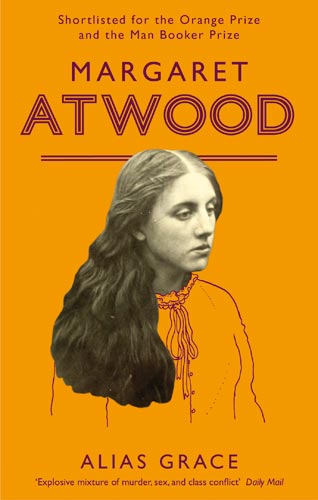
Alias Grace, by Margaret Atwood

Alias Grace is one of those novels that feels like taking deep breaths of fresh air. It just fills you with something that feels substantial and essential. All in, it's a rich and vibrant historical novel that asks questions about women's lots throughout history, the nature of justice and its connection with the press, the history of mental illness and the cult of the paranormal.

The book follows the life of Grace Marks “celebrated” murderess, one time mental institution inhabitant and one of the most infamous Women of Canada’s 19th Century.  Convicted at the age of 16 (along with the surly stable hand) of murdering her wealthy employer and his housemaid mistress, she is spared the gallows at the last moment and sentenced to life in prison. She claims to have no memory of the day that her employer died, but gave several differing accounts of her whereabouts and actions during her court appearances, which certainly didn't  do much for her defence case.

Doctor Jordan, a well-bred but financially unstable specialist in mental health (or as expert as it is possible to be, considering the time) takes an interest in Grace’s case. He aims to coax the details of the murder from her, convinced that she has buried them deep within her memory and sets about arranging weekly meetings with her in the home of the prison warden.

The two strike up an unlikely friendship based initially on vegetables. The doctor writes many letters to his colleagues, friends and mother detailing the contemporary medical theories on women, hysteria and afflictions of the mind. His narrative attention frequently finds itself returning to thoughts of Grace, considering her story and remembering her posture, complexion or some element of the press’ reportage of her case.

Grace’s narrative is complicated, occasionally contradictory and thoroughly tragic. The reader is never really sure whether she is disclosing the truth to Dr. Jordan or only telling him what he wishes to hear, maybe simply telling an elaborate story to amuse herself. She could be a skilled manipulator and liar; the whole thing could be an impressive performance. We're never even sure, as the reader, which parts Grace is saying. The line between thought and speech seems purposefully vague and the relationship between action and idea recurs regularly- Grace herself points out at one point that "If we were all on trial for our thoughts, we would all be hanged".

I'm thoroughly convinced that Margaret Atwood will turn out to be like, the Dickens of the post-Dickens era. Her ability to get inside the heads of her characters is uncanny. Even the most fleeting characters instantly jump off the page. The book is based on a true story; Grace Marks was a real person that spent X many years in prison for the murder of Nancy Montgomery and Thomas Kinnear. Contemporary newspaper articles and likenesses add context and authority to the story- I loved Atwood's decision to keep referring the reader to the contemporary press articles relating to the Marks case. We assume that media influence and one-sided news reporting is a new phenomena, but Atwood points out that as early as 1840s, papers were printing (potentially) slanderous and thoroughly contradictory stories, pointing fingers and passing judgement. , and it’s practically impossible to tell where the fact ends and the fiction begins. Each seems so dependent on the other, but neither dominates. It’s hard to describe fictionalised fact when it’s done so well and so seamlessly. 

Wednesday, 25 June 2014

The Bunker Diary, by Kevin Brooks

The Bunker Diary, Carnegie, 2014, CILIP Carnegie, WinnerThe day that begins with Linus Weems assisting a blind man with a suitcase ends with him captive in a deserted, underground bunker. Completely sealed and empty of any other inhabitants but equipped for six, Linus knows he won't be alone for long. He searches the bunker for clues, escape routes and sharp objects and finds only surveillance cameras and microphones. He waits. Sure enough, the buttonless lift (the only way in or out) eventually delivers another victim the following day, a 9 year old girl called Jenny. The new arrivals roll in, each with a different story about how the unknown man overcame them; a muscly casual labourer, a sleek property saleswoman, a fat commuter and an ageing physicist. No connection, no pattern. The pieces are now all in play and the captor's games begin.

The captor, Him, as he is referred to in the novel, subjects his collection of prisoners to slow, deliberate torture and torment- remotely controlling the temperature, the lighting, the supply of food and even the pace of time. Like the Sims, but with real people. Linus writes a diary of his existence in the bunker, the routines, the boredom, the failed escape attempts and the cruel punishments for their attempts. He talks about the friction of six strangers living in captivity together, the nature of time and identity, the motivations and psychology of their captor and tormentor. Is he holding them for entertainment? Is it a game? A project? A power thing? The author has risked alienating their readers (and it's paid off) to demonstrate how isolated the characters are, and how frustrating it is to know so little.

The diary provides an intimate insight into the thoughts and feelings of Linus the narrator, his protective love for Jenny obvious throughout. He's incredibly real, and is so engaging as a character. He's a bit messed up, confused and angry, but all in all he's not too different from the average teen. The idea that he could quite easily have been any other given individual is unsettling and all things considered, he comes off incredibly well in the circumstances. I can't see how any reader would not be rooting for Linus- he's proven himself in the bunker which makes him a brilliant protagonist.

This book was remarkable in its ability to create unendurable tension and suspense. The reader sees only the bunker's side of events, the movements, motivations and environment of Him, the captor, remain unknown. Our guess is as good as anyone else's and it's incredibly frustrating to be denied access to such a crucial character. The way some of the prisoners cope with impossible circumstances and under such strain is admirable- The Bunker Diary shows that good people come in all guises and from all backgrounds, as do bad, weak or greedy people. It shows too that the human race is capable of great and horrific things. Torture, cruelty and abuse, yes. But also love and hope and comfort, even when it seems pretty desperate. It shows that in difficult circumstances and in impossible predicaments a person's true nature shows through. Being captive in the bunker forced Linus to become the person he'd always avoided and forced him to come to terms with his broken home life.

I was absolutely enthralled by this book. The prose is masterful and the plot impossible to even guess at- it would make an incredible film. It's fraught and harrowing, but there's a sense of camaraderie and community about it. There's defiance and solidarity and a resilience that's incredibly uplifting, despite the relentlessly grim plot and the unhappy ending. Linus never allows himself to be demeaned. He endures and he resists, the only actions that keep him going. The ending too is uniquely grim, but any other outcome would have felt like cheating. A worthy winner, congratulations Kevin Brooks.

Thursday, 27 February 2014

Any Human Heart, by William Boyd

Where do you start with a book this good? I could not drink this in fast enough, a whirlwind of history, art, literature, love, life, chances and embarrassment. An incredible biography of a fictional man. Absolutely stunning. The novel takes the form of diary entries, sometimes philosophical or nihilistic, sometimes blunt and upfront. Logan is a man of many moods and opinions and this comes across in his journals. Sometimes dated, sometimes not, depending on where he is in his life. An omniscient and anonymous narrator links the parts together as best he can, where Logan has been inattentive in his continuity.

The intimate Diaries of Logan Mountstuart start with Logan as a child in Uruguay, the son of a Beef Products manufacturer. His family move to Birmingham and we witness his East Anglian school days with his friends Peter Scabius and Benjamin Leeping, their bets and wagers designed to spice up their dull academic lives. They will appear regularly through the rest of it. Then to his unremarkable time studying History at Oxford, where Logan falls in love with the mysterious Land Fothergill and decides that his future lies in writing.

He writes. A biography of Shelley and a sexy novel, some translations of obscure French poets. He drifts from literature to journalism, to the art world, to literary criticism, enjoying a modest amount of success at each. The art scenes of London, Paris, New York. Battles of wits with Virginia Woolf, meetings with Joyce and Picasso in Paris, then a spell as a civil War reporter in Spain and acquaintance with Hemmingway (getting three Miro canvasses out of it too). Barbados, Ian Fleming murder and the Duke of Windsor. The War lived out in a Swiss prison. Logan spends so long waiting for his life to begin, waiting for it to get more exciting, more important. It's not until he gets to the latter stages of it that he realises it was important. He knew real love once, and losing it does not take away that memory.

The Jazz era, the War years, the post war, then the psychedelic 60s all come alive, bringing with them their important cultural who's-who that wend their way into Logan's life. All depicted with such conviction, historical accuracy and believability, that at times it's incredibly easy to forget that Logan Mountstuart wasn't a real person too. "Surely not" you think as you read this, "He must have existed and merely been forgotten by history". Logan as a character is a dream. At times arrogant, at others crippled with self-doubt and embarrassment. His respectable exterior and modest professional success disguising his slides into alcoholism and adultery and his grim bouts of depression. Every year ends in a roundup of friends lost, resolutions to drink less and finish that novel he's planning.

Boyd skilfully (sooooo skilfully it's almost painful) weaves the eras of Logan's life together, creating a person that is flawed, but always always interesting. He drifts apart from his family, rarely sees his children, or any of his ex-wives. His solitary life gets a bit grim, at one point he goes from a respected professor living with a staff of four and a villa in Nigeria to existing in a basement flat living on dog food and flogging political newspapers to students. But his fortunes prove that poverty, good luck and greatness can happen to anyone. Even the formerly grand Mrs. Mountstuart descends from wealthy widow to dishevelled landlady on the few occasions that her son visits her. We see that poverty has claimed her too.

I can't possibly even begin to describe the scope of this novel. It's an absolute gift. Absorbing, intimate, funny, tragic, life affirming- the whole human condition lived out in one remarkable life. The prose was absolutely joyous and the tableaux of domestic family life, scandal, political upheaval and personal disaster that it painted were beyond immersive.

Monday, 22 April 2013

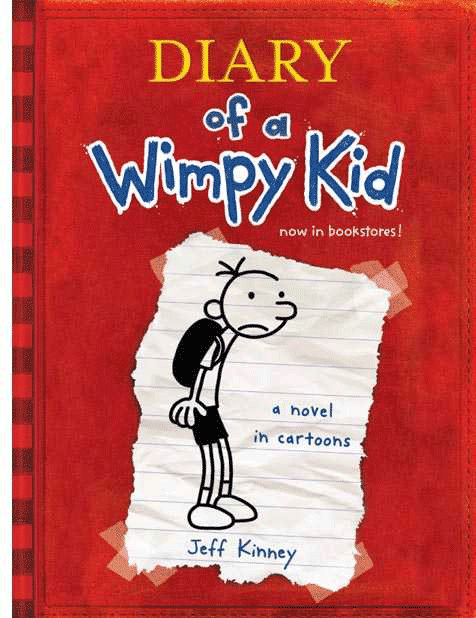
Diary of a Wimpy Kid, by Jeff Kinney

Chances are, if you have any contact with kids who read, they have read Diary of a Wimpy Kid.  Any school librarian in the English speaking world will handle this bad-boy a lot, but shelve it very rarely.  It doesn't even touch the shelf at my school.  I actually got the chance to sneakily read it during the Easter holidays to see what all the fuss is about.

Firstly, I can see why it's appealing to the 11-15 age group.  Greg, wimpy diarist extrordinnaire, is incredibly funny and perfectly captures what it's like to be a put-upon kid in the modern age.  Despite being set in America, his plight is pretty universal.  Middle child, middle grades, middling friends.  His older brother bullies him, his little brother is the apple of his parents' eyes.  Greg just wants to get through school in one piece so that he can go on to adult life and become famous.  So far we don't know what for, but Greg assures us that that's the reason that he's writing this diary, for historical posterity.

It's the averageness of Greg that makes him so universally appealing- he aimlessly drifts through school being a nobody.  He doesn't ask to be top of the class, athletically remarkable or to be popular (well, not super popular anyway, he's still top 100).  What he is is funny.  I'm willing to bet I'm at least twice the target age of this book, but it still made me laugh like a lunatic.  I went to school too.  The 'cheese touch' lurgy was something that was particularly well written and had the hallmarks of a proper school experience.  There's a lurgy, of some form or another, in every school in the world.  I'm pretty sure of that.  His reference to weekend his lay-ins also made me snort- Greg doesn't want to get up on a Saturday, it's merely the foul taste of his own breath that makes him get out of bed.

The cartoons that feature on every page are funny, accurate and tell much of the story.  They also flesh out characters in a way that is not reliant on text.  It's not a comic, it's not a graphic novel, but it's a heavily illustrated book, which partially explains why even the struggling readers can get on fine with DOAWK.  Girls and boys both love this series, so Greg's universal appeal goes beyond gender too.  It really is written for anyone who is/was/knows a kid. 

Very much recommended to the old and the young, provided you can ever get you hands on a copy.

Sunday, 31 March 2013

The Perks of Being A Wallflower, by Stephen Chbovsky


Really, really enjoyed this. An intelligent and witty coming of age story that's full of charm and emotion- not a desperate teen-aged emotion, like you might expect, but an intelligent emotion that sort of acknowledges the immortality of youth, but also the briefness of it.

The narrator, Charlie, is a little obsessed with the concept of memory and time, worrying whether these are his glory days and he isn't noticing it, and if he'll tell his kids stories about his past. He worries that his kids will see pictures of his youth and think he looked happier at their age than they feel now. Charlie seems too to understand the complexities of life, feelings and relationships, whilst also being quite bad at conducting them. He sees things that others don't, he's painfully honest, socially awkward and inexperienced, but incredibly intelligent and aware of everything. He's also the best gift giver since Santa Claus, stunning his friends to silence with his incredibly personal and thoughtful presents.

The narrative is told through a collection of letters addressed to somebody that Charlie knows that we don't. He claims that he's chosen this person to write to because "she said you listen and understand and didn't try to sleep with that person at that party even though you could have." The letters are his way of understanding what's happening in his life and dealing with his unusual moods and his over-sensitivity. He talks about the tragic deaths of his friend Michael and his much loved aunt, events which affected him a great deal and continue to govern his occasionally erratic behaviour. Though we later find out something about one of these people that has probably caused more of Charlie's problems than he initially reveals. We follow his struggles to cope with adolescence; sex, drugs, the Rocky Horror Picture Show, homosexuality, domestic abuse, teenage pregnancy, abortion and rape.  It sounds a lot of "issues" for such a short book, but it handles them in a characteristically straightforward, if slightly bemused way.  Whilst it's pretty safe to assume the average teenager won't have experienced the entire plethora of issues detailed in the book, most will have probably have had some experience with some of them, either directly or through friends.  It's pretty easy to relate to the experience of Charlie' even if your adolescence was less eventful. Though it may sound disproportionately grim, Chbovsky captures some beautiful moments in the story. The sense of possibility and promise that comes with being 16, the feeling of being infinite- finding the books and the songs and the films that will be the soundtrack to your life and wanting to live in and remember every moment.

I think that was one of the most successful things in the book, and something that I'm sure the majority of readers can relate to- the way the author acknowledges that families are messy. A lot of the time they have nothing in common besides a handful of genetic material. But families are strong, and despite the agonies and the arguments, tears and overwhelming urge to strangle stuff, families do care for each other and will pull together when they need to.

More in the vein of SE Hinton's The Outsiders than Catcher in the Rye, though parallels obviously exist. It's more about learning to be yourself, to realise what it is that makes you unique and to deal with being unusual then it is about being unhappy or disillusioned, or being a moaning little rich boy like Holden.